
Reviewed · ATHENS MYTHOLOGY TOURS
Greek Mythology Storytelling Walk
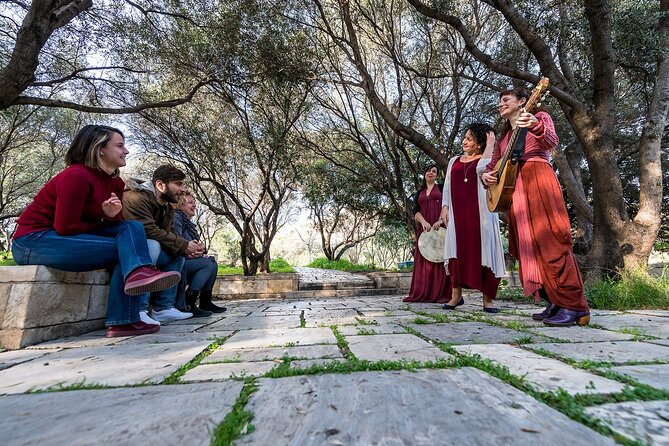
Mythology sounds better on the street. This Greek Mythology Storytelling Walk is a smart way to connect the big names, Zeus, Athena, and Dionysus, to real corners of Athens, not just facts. I love how the professional storytellers make the myths feel like live drama, and I also like the steady walking route that keeps you seeing meaningful ancient spots. One note to plan around: it is not suitable for people with mobility impairments, since it is a full-foot walking experience.
You also get a rare mix of entertainment and orientation. Plaka helps you understand the city’s layout, while the Acropolis area gives you that sense of how these stories belonged to the landscape. If you want a tour that feels more like theater than sightseeing, this is the one.
Key points worth knowing
- Zeus, starting in Plaka with origin and rise-to-power storytelling in Athens’ oldest neighborhood
- Dionysus at the theater zone near the pedestrian street by the ancient performance sites
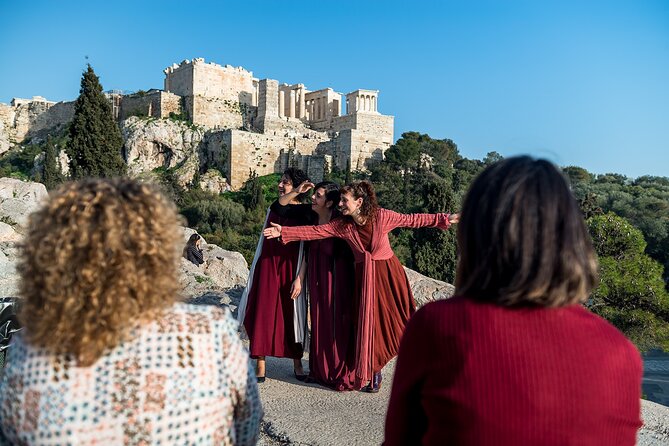
- Pnyx as the Athena closer with a close-up feel toward the Propylae, the Acropolis gateway area
- Professional storytellers, not lectures so you stay engaged even if you are not a mythology nerd
- Small-group potential (it can run private when sign-ups are low) which makes the performance feel personal
- No food included, so build in your own snack or plan to eat after
Why this Athens myth walk feels different (and useful)
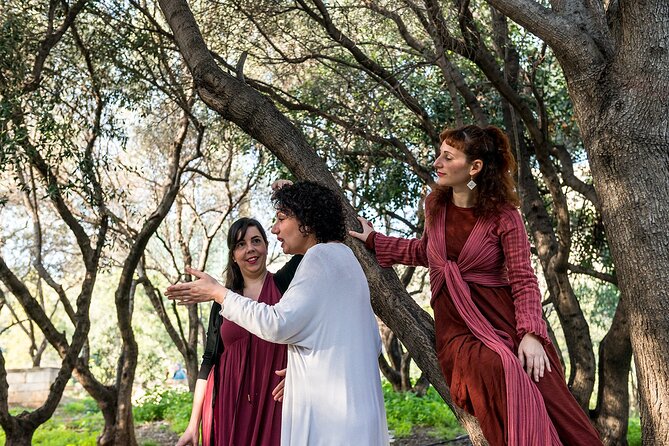
Athens can be overwhelming. You look up at the Acropolis and try to turn ruins into a story, but that is hard to do on your own. This tour does the storytelling first, then hands you the street-level context, so the myths land where they belong.
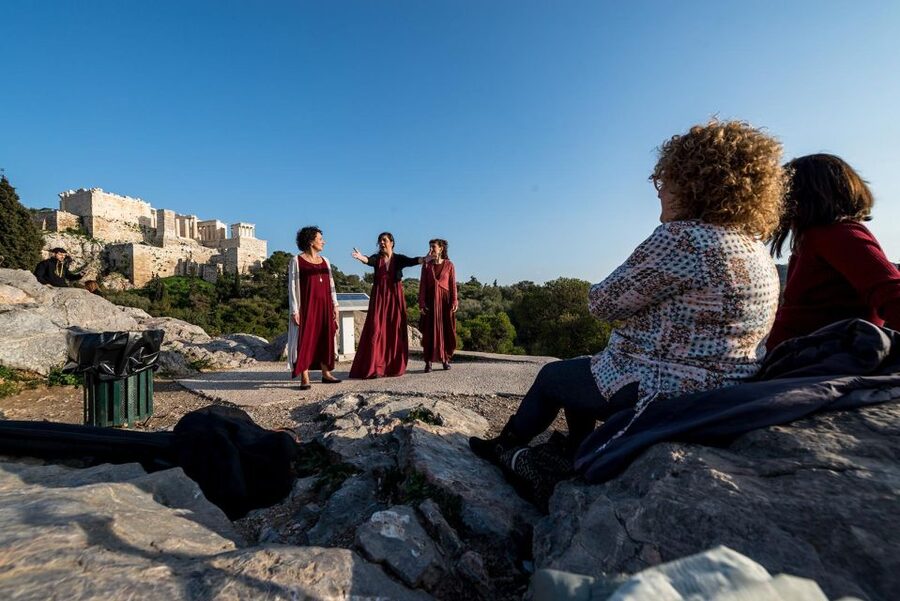
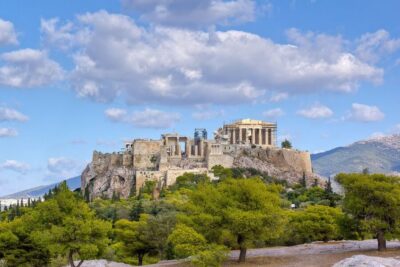
I especially like that you cover multiple gods in a logical loop. Instead of treating mythology like a random list, you move through the city in a way that gives each god a sense of place: Zeus in old Plaka, Dionysus near the theater district, and Athena at Pnyx where the Acropolis becomes unavoidable in your line of sight.
There’s also an honesty to the format. You are not stuck in a classroom. You are walking a real route on foot for two hours, listening to a live performance, and learning how these myths shaped the way Greeks talked about power, art, courage, and city identity.
You can also read our reviews of more walking tours in Athens


Starting at Nikis & Kidathineon in Plaka, with Zeus already in motion
Your walk begins in Plaka, at the corner of Nikis and Kidathineon streets. Your guide meets you holding an Alternative Athens sign, so it is easy to spot the start point without guesswork.
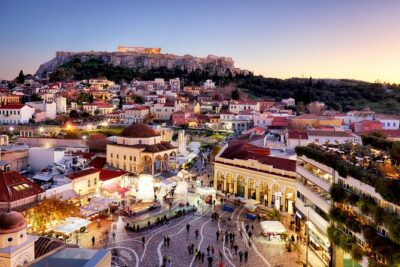
Plaka is tourist-central today, with plenty of souvenir shops and casual streets full of foot traffic. That can be a drawback if you hate crowds, but I see the upside. Starting here lets you understand how Athens layers eras on top of each other. You get the feeling of a living neighborhood, not a frozen open-air exhibit.
From this area, the tour frames Zeus as the first big character. You’ll hear the story of Zeus’ birth, his rise over his father, and his love affair with Europa, the woman whose name gave Europe its name. That last detail is exactly the kind of myth connection that makes the rest of the day click. Suddenly, you are not just hearing a tale from the past. You are seeing how mythology echoes through language and culture.
What to watch for at the start
- If you want great photos, arrive with a comfortable rhythm, since you start in the middle of Plaka’s busy streets.
- Keep your expectations flexible. This is performance storytelling, so you might pause at corners more than you would on a typical walking tour.
Plaka to the theater zone: you walk with Dionysus in mind
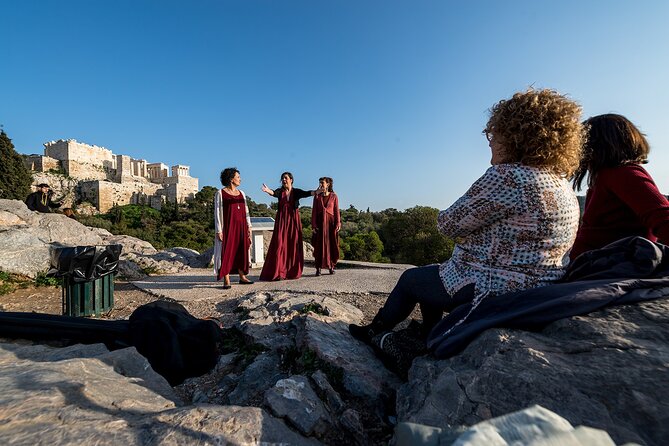
After Zeus, the route moves you toward the Acropolis pedestrian zone area around Dionysiou Areopagitou. This is where the city’s arts connection shows up quickly. You are near ancient theater space and close to the feeling of performance in the ancient world.
Dionysus is next, and the stories focus on what made him important in Greece. He’s tied to wine and the theatrical arts, which explains why his myths were never just private religious tales. They were connected to public celebration and the creative culture that grew up around it.
The tour also gives you the political and cultural twist of myth history: Dionysus later fell out of favor with Romans, who frowned on what they saw as excess tied to Dionysian rites. That’s a useful reminder. Myths do not live in a museum. They get accepted, rejected, reshaped, and reinterpreted as societies change.
And walking through this area helps you feel why theater mattered so much. You are moving through a corridor that still acts like a stage for visitors, and that makes Dionysus easier to picture as a god of celebration and performance rather than a distant legend.
Odeon of Herodes Atticus: when the walking route matches the theme
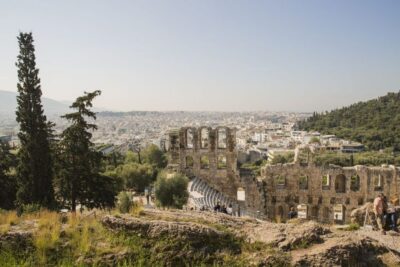
One of the stops builds in a very practical payoff: the Odeon of Herodes Atticus area. It is linked to performance culture, and it acts like a bridge between what you hear and what you see.
Even if you do not sit inside any theater during the walk, the setting matters. You are listening to a god connected to the arts while standing in the general zone where those arts would have been taken seriously. That kind of pairing is what makes this experience work as a learning tool, not just entertainment.
If you are the type who likes to make memories through visuals, this stop is your friend. You’ll come away with a better mental map of how the Acropolis area functions, not only where it sits, but how it relates to theater and community gathering.
- All Day Cruise -3 Islands to Agistri,Moni, Aegina with lunch and drinks included
★ 5.0 · 4,958 reviews




Pnyx: the best place to feel Athena’s story in your line of sight
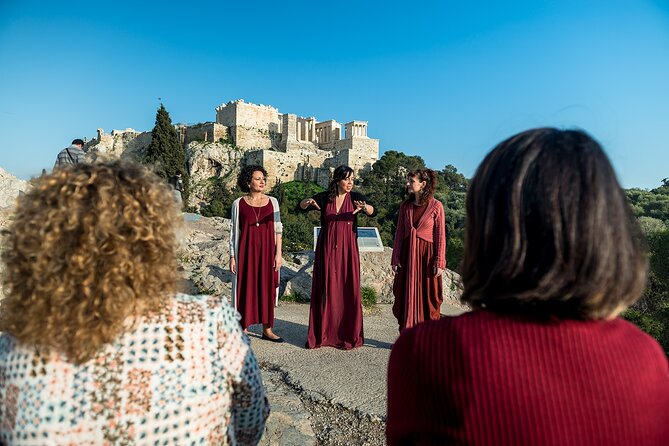
The final stop is Pnyx, and it is a smart ending. Pnyx is known for offering outstanding views and a close-up perspective toward the Propylae, the gateway to the Sacred Rock. That means your last chapter is not just a story in the air. It is paired with a real view that gives the myth a strong sense of scale.
Here, the tour introduces Athena. You’ll start with her birth and then move into the contest between Athena and Poseidon for patronage of the city. This rivalry is the kind of myth that teaches civic identity. Athens becomes Athena’s city because her outcome wins out, and suddenly the name makes sense in a story-shaped way.
I like ending with Athena because she gives you a different flavor than Zeus and Dionysus. Zeus brings power and conflict. Dionysus brings art and celebration. Athena brings wisdom and city-building energy. Ending with her story makes the whole walk feel balanced, like you covered multiple sides of how people explained the world: authority, creativity, and strategy.
A practical photo tip
Plan to look around as much as you look up. The close-up feel toward the Propylae makes Pnyx a great spot for photos, but the best shots often come from stepping back and adjusting your angle, especially if you end up pausing for the performance.
Pace and timing: what a 2-hour walk actually feels like
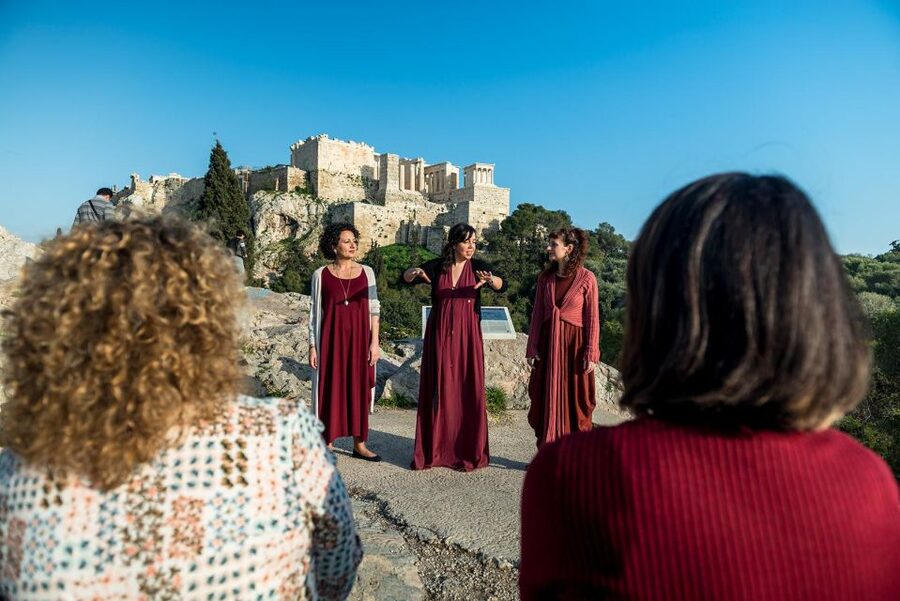
The duration is two hours, and the itinerary is set up as a steady walking loop with visits at each major point. That structure matters because it keeps the tour from turning into a long slog with constant rushing.
You get time to listen at each stop, then time to move between stops at a conversational pace. One review shared that the walk felt easy, and that matches what you should aim for. Bring your attention back when you hear the next scene, then let the streets do the rest.
Group size can vary based on sign-ups. At least one departure has run as a private tour when only a few people booked a slot. Even when it is not private, the performance format typically keeps the guide and storyteller engaged with your group, not just reading facts from a script.
Who the pace suits best
- Perfect if you like walking but do not want a long multi-hour grind
- Great if you prefer guided attention to self-guided wandering
- Comfortable for many families, since it is described as all-ages
Price and value: is $53 per person worth it?
At $53 per person, you are paying for live storytelling, a professional tour leader, and a structured walk through central Athens. That is not the cheapest way to see the Acropolis area, but it is also not trying to be. The value is in what you cannot get from ruins alone.
If you have ever stood in front of ancient stones and thought, I get that this mattered, but why did it matter, this tour answers that question through story. It turns sites into narrative anchors. Zeus stops feeling like a name from a worksheet and becomes a scene connected to Plaka. Dionysus becomes a performer, not a trivia entry. Athena becomes a civic symbol tied to a place with views.
Also, because the experience is English and uses professional storytellers, you get the benefit of pacing and delivery. It is not just information. It is timing, emotion, and clarity, which is why this kind of tour works even if you do not consider yourself a mythology person.
Practical planning: what you should bring and how to avoid hassles
This tour is outdoors and you will be on your feet. Wear comfortable shoes and plan for comfortable clothes, since the walk is long enough that foot comfort matters.
There is no food or drinks included. That matters because it changes how you should schedule the rest of your day. I suggest you eat before you go, or plan a meal after, so you are not thinking about snacks during the performance.
Weather can change how enjoyable it feels, especially in central Athens. If it is hot, you’ll want water before you start (again, since drinks are not included). If rain threatens, consider adjusting clothing so you can still focus on listening.
Who should book this Greek mythology storytelling walk
This experience is a strong fit if you want:
- Live myth storytelling tied to real Athens locations
- A route that connects Plaka to the Acropolis zone without needing a guide for every stop
- A fun learning style that works for kids as well as adults
It also suits you if you are traveling with others who might not be equally excited about archaeology. Storytelling can bring everyone onto the same page fast.
Who should skip or choose another option
It is not suitable for:
- Children under 3 years
- People with mobility impairments
- Hearing-impaired people
If any of those apply, it is worth choosing a different Athens tour format where accessibility is better matched to your needs.
Making the most of it on the ground
A tour like this works best when you treat it like theater with walking breaks. When the guide pauses, listen closely, because those moments often explain the theme you’ll see reflected in the next area.
Here are a few simple ways to boost your enjoyment:
- Keep your phone for later. Let the storyteller finish the scene first.
- When you reach Pnyx, take a minute to orient yourself to the Propylae view before the Athena chapter finishes.
- If you came for Zeus, stay for Athena anyway. The ending story is often the one that makes the whole loop feel complete.
And if you get a smaller group, lean into it. The tour has a performance vibe, so the more responsive your group is, the more fun it usually becomes.
Should you book Alternative Athens for Greek mythology storytelling?
I think you should book if you want a guided Athens experience that blends myth, walking, and live professional storytelling in English. For $53 per person and two hours, it is a practical way to see the key areas around Plaka and the Acropolis zone while learning the stories behind major gods and heroes.
Skip it if you need step-free access or if hearing needs make it tough to follow spoken storytelling. And if you hate walking in tourist-heavy areas, Plaka may feel like a mixed start.
Overall, this is one of those Athens tours that respects your time and your attention. You leave with a better sense of where the myths belong, and you probably leave quoting Zeus, Athena, or Dionysus in conversation later, which is the best kind of souvenir.
FAQ
How long is the Greek Mythology Storytelling Walk?
The tour lasts 2 hours.
How much does it cost?
The price is $53 per person.
Where do we meet for the tour?
You meet at the corner of Nikis and Kidathineon street in Plaka. The guide meets you holding an Alternative Athens sign.
What is included in the price?
It includes the storytelling performance, professional storytellers, and a professional tour leader.
Is food or drinks included?
No, food or drinks are not included.
What language is the tour in?
The tour is offered in English.
Is it suitable for children?
It is described as a tour for all-ages, but it is not suitable for children under 3 years.
Is the tour accessible for mobility impairments?
No, it is not suitable for people with mobility impairments.
Is the tour suitable for hearing-impaired people?
No, it is not suitable for hearing-impaired people.
What should I bring?
Bring comfortable shoes and comfortable clothes.
Can I cancel for a refund?
Yes, you can cancel up to 24 hours in advance for a full refund.
Are there multiple start times?
You can check availability to see starting times.
More Walking Tours in Athens


More Tour Reviews in Athens
- All Day Cruise -3 Islands to Agistri,Moni, Aegina with lunch and drinks included
★ 5.0 · 4,958 reviews
Not for you? Here's more nearby things to do in Athens we have reviewed







Athens Mythology Tours, compared.
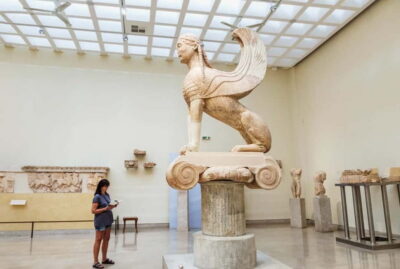 ★ 4.6Mythology of Delphi, Museum and Arachova Guided TourFrom $314,008 reviews
 ★ 5.0Athens & Acropolis Highlights: Greek Mythology Small-Group TourFrom $542,370 reviews
 ★ 4.8Acropolis and Mythology Highlights Small Group TourFrom $532,275 reviews
 ★ 4.8Mythology Tour for FamiliesFrom $79173 reviews
 ★ 5.0The History of Athens: Greek Mythology Private TourFrom $199138 reviews
 ★ 4.9Guided Mythological Walking TourFrom $47125 reviews
 ★ 5.0Greek Mythology Treasure Hunt for Kids – Athens Private TourFrom $17477 reviews
 ★ 5.0Mythology, Philosophy and Democracy TourFrom $5064 reviews
Browse the lists this tour appears in