
Reviewed · ATHENS ACROPOLIS & PARTHENON TOURS
Athens & Acropolis Highlights: Greek Mythology Small-Group Tour
Myths make the Acropolis make sense. This small-group tour stitches Greek stories to the stones of Athens, starting near the Temple of Olympian Zeus and ending in the Ancient Agora. I love how expert guides (including Irene/Irini and Michael) translate myth characters into what you actually see on site, so it clicks fast. One thing to plan for: entrance tickets for the Acropolis and Ancient Agora are not included.
You also get an intimate small-group feel (up to 15 travelers) that makes it easier to stay together on busy streets. I really like that the route naturally strings together sacred hilltop sites and the everyday city core, with time at major stops like the Theatre of Dionysus and the Temple of Hephaestus.
Key highlights to know before you go
- Up to 15 travelers keeps the pacing humane, especially on steep, uneven ground
- Myth stories tied to specific monuments makes the Parthenon and nearby temples much easier to understand
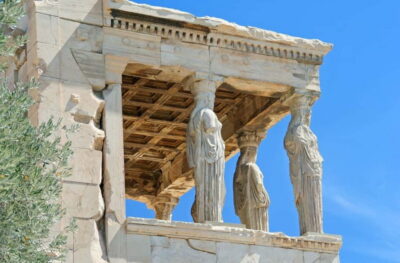
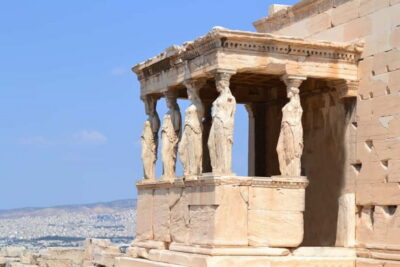
- Multiple Acropolis viewpoints, not just one photo spot including Temple of Athena Nike and the Erechtheion
- Ancient Agora focus on politics, commerce, justice, and religion, then a strong finish at Hephaestus
- Pre-purchase help for entry tickets is available if you want it handled in advance
Where you meet and how the 4-hour walk really plays out
This tour runs about 4 hours, but the real rhythm is driven by your feet and the climb. You meet at the Arch of Hadrian area, at Leof. Vasilisis Amalias 50, and you finish inside the Ancient Agora zone, near Athens 105 55. Mobile ticketing is part of the plan, so you are not juggling paper vouchers on top of the sightseeing.
Expect a mix of paved paths and rougher, uneven surfaces once you are on the Acropolis approach. Reviews repeatedly flag the steep climb and stairs, so wear shoes you trust. Also, while the tour is designed to keep things moving, it is not a sprint, and good guides often break the ascent into smaller talking segments with rest moments.
You can also read our reviews of more tours and experiences in Athens.


Price and tickets: what $54.42 covers, and what to budget next
The advertised price is $54.42 per person, and what you are really paying for is an expert certified guide, a small group size, and guided context across several major sites. You also get a fun ancient Athens map and a mobile ticket for the experience.
Here is the practical catch: entrance fees are not included for the main archaeological areas. For the 2-hour and 4-hour options, you need an Acropolis ticket (listed as €30.00 per person). For the full 4-hour route, you also need an Ancient Agora ticket (listed as €20.00 per person). If you want the least mental load, you can ask them to pre-purchase the entry tickets.
So how is the value? If you are seeing Acropolis plus Agora anyway, the guide turns those tickets into more than a checklist. The story structure matters: Zeus sets the stage, Athena owns the hill, Dionysus brings drama, and the Agora shows where people lived, argued, traded, and judged.
Temple of Olympian Zeus: the quiet setup before the big hilltop
Your first stop is the Temple of Olympian Zeus, also called the Olympieion. From the outside, you will see why it was one of the greatest temples in the ancient world, built for Zeus and famous for its marble ambition. Even without going inside, this spot is a smart opener because it frames Athens as a city that built monumental worship for major gods.
Time here is about 15 minutes, which is just enough to get the stories without burning the rest of your energy before the climb. The guide focuses on what the temple was meant to communicate, so when you later see how the Athenians honored Athena on the Acropolis, the whole “why gods, why here” idea feels connected instead of random.
Acropolis hill: Parthenon views plus Athena Nike and Erechtheion stories
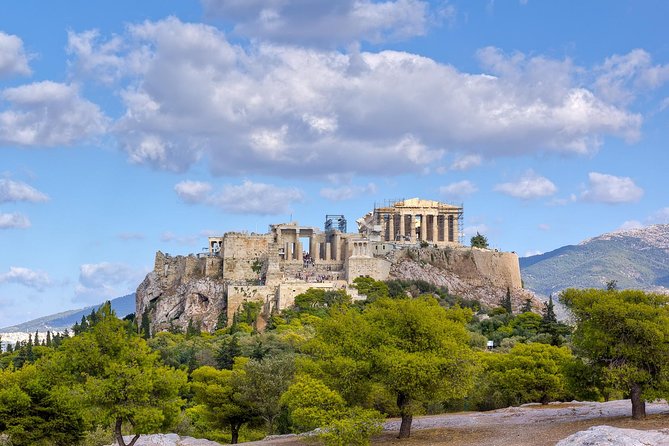
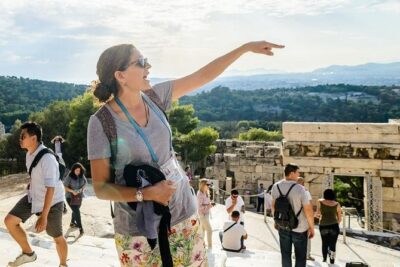
The Acropolis stop is about 1 hour 30 minutes, and yes, it includes a real climb. This is where you will notice the most walking and stair work, so plan for slow and steady. If you go on a hot day, the shade breaks become part of the experience, not an inconvenience.
The guide’s job here is to make the monuments legible. You will see major highlights tied to their myth and purpose, including the Parthenon, Temple of Athena Nike, Erechtheion, and the Propylaea area, plus mention of the Theatre of Dionysus from the broader zone.
Parthenon: Athena Parthenos and the Doric logic
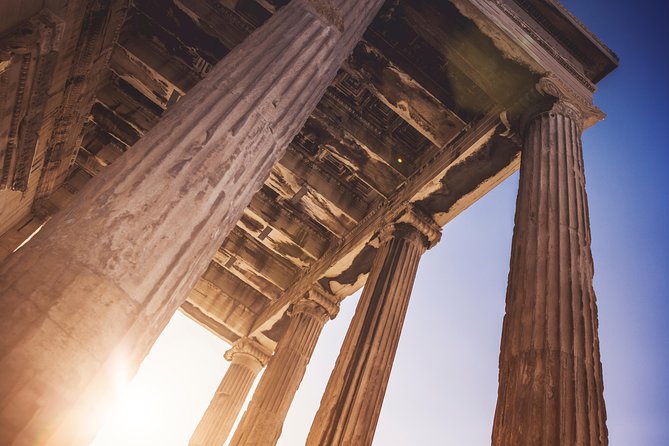
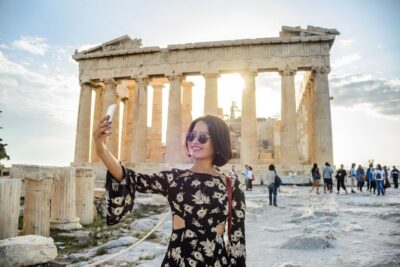
The Parthenon is the visual anchor of the hill, built in the mid-5th century BCE and dedicated to Athena Parthenos, Athena the Virgin. It is also described as a culmination of the Doric order, the simplest of the three Classical Greek architectural styles. The guide’s value is in pointing out how design choices support function and symbolism, so you can look at columns and reliefs with intention instead of just awe.
- All Day Cruise -3 Islands to Agistri,Moni, Aegina with lunch and drinks included
★ 5.0 · 4,958 reviews


Temple of Athena Nike: victory that stays in Athens
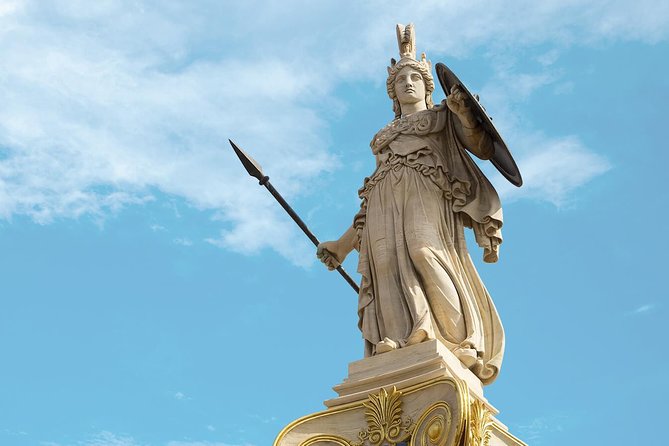
You also spend time at the Temple of Athena Nike for about 10 minutes. The story here is memorable: Nike is the goddess of victory, and Athena is worshipped in this form. One popular telling connects the temple’s cult statue to the idea that victory would not leave Athens, which gives the site a sharper meaning than a quick glance.
Erechtheion: a temple shaped by a cult statue
The Erechtheion takes about 10 minutes. It was constructed to house an ancient wooden cult statue of Athena, and it is tied to Athens at its height of power and influence. This stop matters because it reminds you the Acropolis was not one temple, but a collection of sacred functions tied to specific worship needs.
Theatre of Dionysus Eleuthereus: where drama met the gods
You also have a 15-minute stop at the Theatre of Dionysus Eleuthereus. Dionysus is tied to wine and grape harvest, and this theatre is described as the oldest founded in Athens. The best part of the myth-to-history link is that it was where plays by Aeschylus, Sophocles, Euripides, and Aristophanes were performed for the first time.
If you like how stories turn into culture, this stop is often a favorite. You start seeing Athens as a place where religion, theatre, politics, and identity blended in public life.
Ancient Agora: how the city worked, plus the finish at Hephaestus
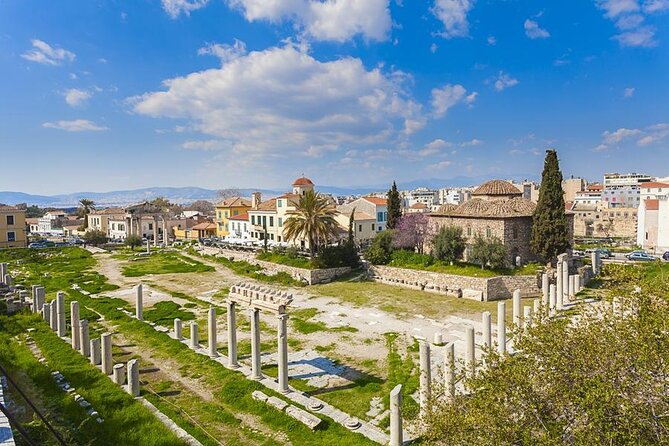
The Ancient Agora is the heart of ancient Athens, and you get about 1 hour here. This is not only about ruins. It is about how the city functioned: political and administrative activity, commercial life, social gatherings, religious and cultural energy, and even the seat of justice.
By the time you reach the Agora area, the myth theme shifts into everyday stakes. You can connect the “who rules, who judges, who trades” reality to the gods and rituals you just saw on the hill. That contrast is the educational win, because it shows the same belief system operating in different ways across daily life.
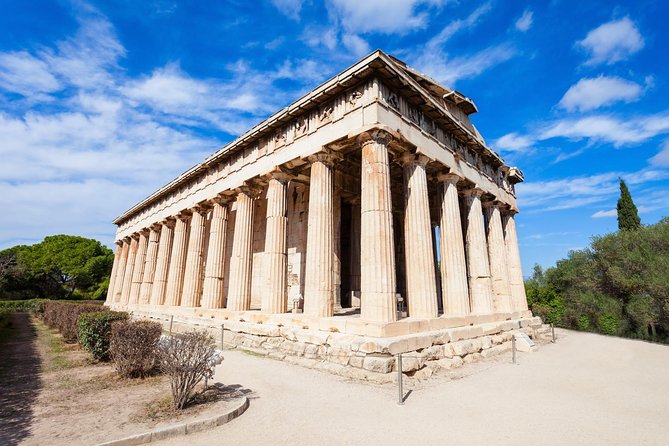
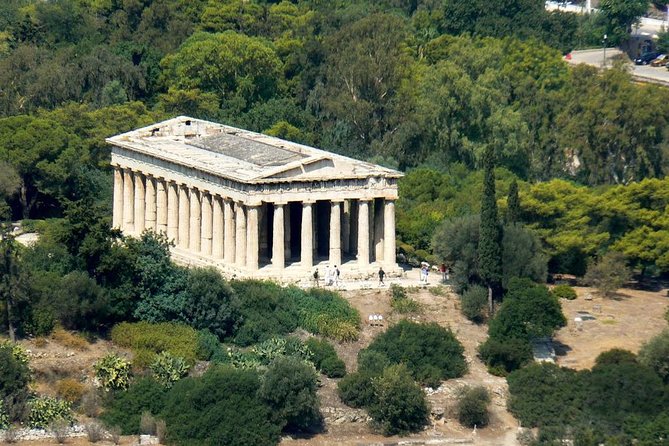
Your final stop is the Temple of Hephaestus, for about 20 minutes. It is one of the best-preserved ancient temples in the world, and it served merchants and shop owners in the surrounding commercial zone. The guide ties it to worship of Hephaestus, protector of metallurgists, and Athena Ergani, protector of potters and cottage industries. In other words, the ending connects the spiritual and the practical, which makes the tour feel like a full picture.
What the mythology teaching style does for your understanding
This tour works best when the guide makes myth feel concrete. The highest-rated experiences point to guides using clear explanations, frequent check-ins, and even visual aids. Some guides, including Irene/Irini, have been praised for using printed photos and visual supports, which helps when you are trying to imagine what you cannot see anymore.
The mythology parts are not random. They are attached to the sites in front of you. Nike’s wing story, Athena’s cult statue at the Erechtheion, and Dionysus linking wine to theatre all give you hooks that stick. And when a guide asks questions or builds in short pauses, you are not just listening, you are mentally sorting the information into categories.
One practical note: one review flagged that there may be times with no microphone, so your best move is to position yourself where you can hear. If your group tends to blend into the crowd, I recommend you keep an eye on where your guide stands and adjust early instead of trying to catch up later.
Practical tips: steep stairs, bag rules, and making photos easier
Here is how to make your day feel lighter. First, plan for the steep Acropolis climb and uneven ground. Wear good walking shoes, and bring a hat and water. Shade breaks help, but they are not magic, so hydration keeps you from turning the visit into a struggle.
Second, follow the Acropolis bag rules. Strollers, backpacks, and big bags are not allowed at the Acropolis, so travel light. If you usually carry a daypack, switch to something small enough for the rules. This matters because it is not just comfort, it affects whether you can move smoothly through the security and access areas.
Third, expect some real walking between stops. The route includes Olympian Zeus, multiple Acropolis monuments, then the Theatre of Dionysus, and later the Agora and Hephaestus. It is doable, but it is not a sitting tour.
Who this small-group tour is best for
This is a great choice if you want meaning behind the monuments, not just background noise. If Greek mythology is your thing, you will appreciate how the guide connects gods to the architecture, like Athena Nike on the hill and Hephaestus in the marketplace zone.
It also fits first-time Athens visitors with a tight schedule. In about half a day, you see the Acropolis core, plus the Ancient Agora finish that many people skip or under-explain.
One caution: because the Acropolis climb and stairs are part of the experience and big bags are restricted, it might be less comfortable if you are traveling with limited mobility or if you are relying on a stroller. If that is your situation, you might be better off looking for a different format that reduces uphill walking.
Should you book this Athens mythology and Acropolis highlights tour?
If you are going to pay for Acropolis and Agora entry anyway, I think booking a guide like this is a smart use of your time. The small-group size up to 15 helps you stay with the story as you move, and the mythology tie-ins turn major landmarks into something you can explain to friends later.
Book it if you want a guided, myth-driven route with enough structure to keep the day from feeling chaotic. Skip it only if you prefer to wander without any organized explanation, or if the steep climb and bag restrictions would genuinely derail your comfort.
FAQ
FAQ
Are the Acropolis and Ancient Agora entrance fees included?
No. Entrance fees are not included. You need an Acropolis ticket for the 2-hour and 4-hour options, and for the 4-hour option you also need an Ancient Agora ticket. You can ask to pre-purchase entry tickets.
How long is the tour?
It runs for about 4 hours.
Where do I meet the guide, and where does the tour end?
You meet at the Arch of Hadrian, Leof. Vasilisis Amalias 50, Athina 105 58, Greece. The tour ends at the Ancient Agora of Athens, Athens 105 55, Greece.
Is the tour offered in English?
Yes, it is offered in English.
What group size should I expect?
This tour has a maximum of 15 travelers.
Do I get a mobile ticket?
Yes. A mobile ticket is included as part of the experience.
Can I bring a stroller or a large backpack?
No. Strollers, backpacks, and big bags are not allowed at the Acropolis and should not be taken on the tour.
Does the tour include food or drinks?
No. Food and drinks are not included.
What do I need if I booked under age 25?
An ID card or passport is required for people under 25 for possible discounts.
What happens if the tour is canceled due to weather?
The experience requires good weather. If canceled due to poor weather, you will be offered a different date or a full refund.
More Tours in Athens


More Tour Reviews in Athens
- All Day Cruise -3 Islands to Agistri,Moni, Aegina with lunch and drinks included
★ 5.0 · 4,958 reviews
Not for you? Here's more nearby things to do in Athens we have reviewed







Athens Acropolis & Parthenon Tours, compared.
 ★ 4.4Acropolis & up to 5 Archaeological Sites Combo PassFrom $4812,619 reviews
 ★ 4.2Acropolis Ticket with Optional Audio or Live GuideFrom $4211,055 reviews
 ★ 4.8Acropolis, Parthenon & Acropolis Museum Guided TourFrom $409,316 reviews
 ★ 4.6Acropolis and Parthenon Guided Walking TourFrom $385,882 reviews
★ 4.8Acropolis, Parthenon & Acropolis Museum Guided TourFrom $413,579 reviews
★ 4.6Acropolis and Parthenon Guided Walking TourFrom $385,882 reviews
★ 4.8Acropolis, Parthenon & Acropolis Museum Guided TourFrom $413,579 reviews
 ★ 4.0Acropolis Ticket with Audio GuideFrom $473,575 reviews
 ★ 4.7Acropolis: Acropolis and Parthenon Guided Walking TourFrom $363,442 reviews
 ★ 5.0Acropolis monuments & Parthenon Walking Tour with Optional Acropolis MuseumFrom $422,678 reviews
Browse the lists this tour appears in