
Reviewed · ATHENS ANCIENT AGORA TOURS
Private Walking Tour: Ancient Agora, Plaka and Monastiraki monuments
Athens past shows up in every turn. This private 3-hour walk stitches together classic Roman sites and Ottoman-era streets, with Ancient Agora as the anchor and Monastiraki and Plaka adding color along the way.
I love the private format and how it keeps the pacing human, not rushed. I also like that you do more than stand in front of stones, you get the stories behind the layers, from a cathedral in 19th-century Athens to the Tower of the Winds in the Agora.
One drawback to plan for: you are on foot for a while, so comfortable shoes and some stamina for uneven sidewalks and steps will matter.
Key highlights worth your attention
- Kostas-style guiding: clear, engaging explanations that work even for teens in the same group.
- Syntagma Metro museum start: you begin with real finds underground, then walk into the city’s big historic sweep.
- Ottoman-era Monastiraki stops: see named mosques and neighborhood textures, not just generic market vibes.
- Ancient Agora focus: you connect the space to politics, trade, and the idea of democracy.
- Stoa of Attalos museum visit: reconstructed setting plus artifacts that explain everyday life.
- End at Avyssinias Square and Athinas Street: food and spice aromas bring you right to the local pulse.
Why this Athens mix of Ottoman and Roman sites works in 3 hours
Most Athens tours split cleanly into either ancient ruins or old neighborhoods. This one makes a more realistic story of the city, because Athens kept getting used and rebuilt long after classical Greece.
You start in a modern spot, Syntagma, and then you walk into layers: a 19th-century Orthodox cathedral, Ottoman-era mosques and lanes, then straight to the Agora, where the ancient city’s political and commercial heartbeat took place. That jump in time is the point, and the guide helps you keep it straight.
Because it is private, the route also feels flexible. If you want extra time to photograph columns or ask a follow-up question about what you are seeing, the tour can usually adjust within the 3-hour window.
You can also read our reviews of more walking tours in Athens


Starting at Syntagma Metro, then using the station museum to set context
You meet near Syntagma Metro station, by Pl. Sintagmatos. The tour begins with a small museum in the station area, which is a smart way to start your day because it gives you physical artifacts early, before you get distracted by the street scene.
Inside, you will look at finds excavated in the area, including burial tomb remains, a 2,000-year-old beehive structure, and remnants of Roman mosaics thought to date to around the 5th century. That matters because Athens is often presented as a neat timeline, when it is really a stack of discoveries. Starting here helps you read what you see later in the Agora.
Practical tip: arrive a few minutes early. Even with a meeting point that is easy to reach, you want time to orient yourself before the guide starts.
Mitropoleos Square to Monastiraki, cathedral grandeur and Ottoman street corners
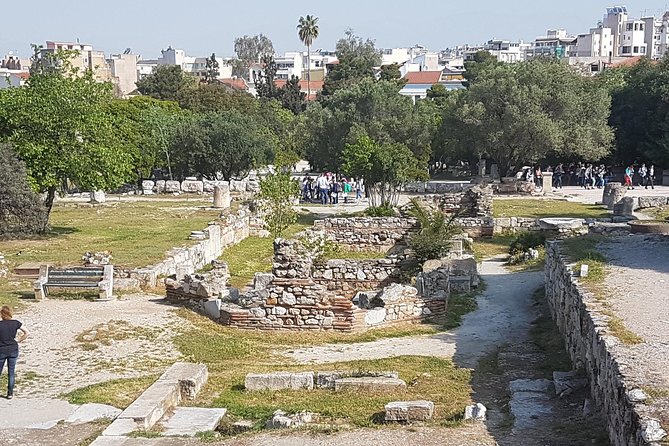
After Syntagma, you stroll toward Mitropoleos Square, home to Athens Cathedral. This ornate Greek Orthodox church was built in 1862 and is the seat of the archbishop of the city’s Greek Orthodox Church. The contrast with the ancient sites is sharp, but that contrast is useful. It reminds you that Athens stayed religious, civic, and central through many eras.
From there you continue into Monastiraki, one of the city’s busiest shopping and street-life areas. The tour moves through the flea market area and focuses on Ottoman-era buildings, including the Tzistarakis Mosque and the Fethiye Mosque.
What I like about this approach is that it turns shopping lanes into something you can read historically. Instead of treating Monastiraki like a backdrop, you learn what to look for in the architecture and how the neighborhood formed.
Downside consideration: Monastiraki can get crowded. A private guide helps you navigate without spending your whole tour weaving through shoulder-to-shoulder foot traffic.
Plaka lanes, Hadrian’s Library columns, and the Doorway of the Medrese
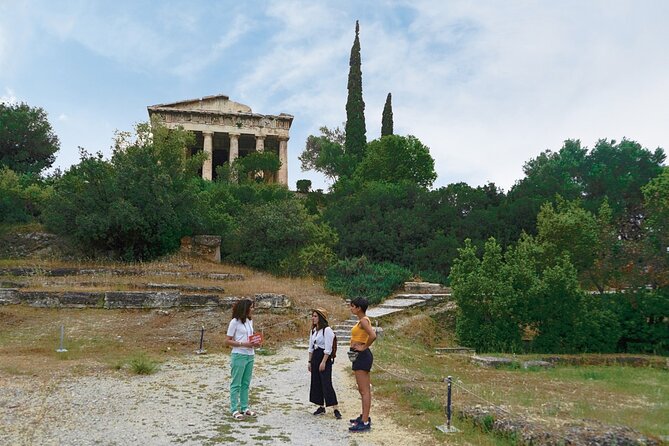
Next comes Plaka, where the lanes turn into a maze of stone paths and small views. The tour highlights two especially photo-friendly historical features.
First is the Doorway of the Medrese, an entrance to a former Turkish theological school. Even if you just walk past it quickly on your own, having a guide gives the doorway meaning in the broader story of education and religion under Ottoman rule.
Second are the remaining columns of Hadrian’s Library, built by Emperor Hadrian around 132 AD. Those columns are a classic Athens photo stop, but the value comes from understanding why Hadrian’s projects mattered in the city and how Roman patronage shaped public life.
If you like street-level wandering, Plaka is your payoff. If you prefer big, uninterrupted ruins views, it might feel more like “walk and notice” than “tour and pose.” Either way, it makes the Ancient Agora feel more grounded in what comes before and after it.
Ancient Agora of Athens, where trade and democracy took shape
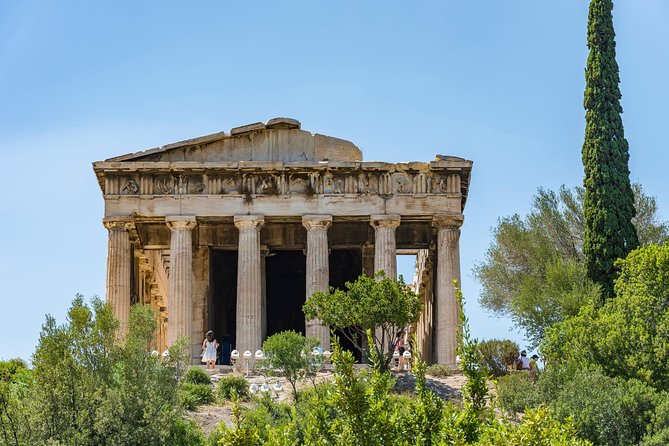
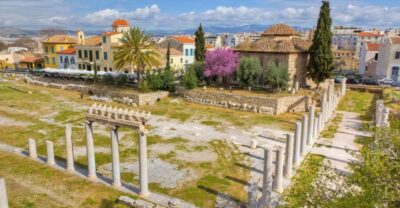
Then the tour reaches the big anchor: the Ancient Agora of Athens. The Agora is described as the site where the commercial, political, and social life of ancient Athens met. According to the tour route, it was developed in the 6th century BC, which is a key detail because it connects the space to the period when Greek political ideas were taking recognizable shape.
You inspect ruins with your guide, hearing how the area was developed and how people used it for both decisions and daily business. The stop includes the market place role, not just the symbolism. You are shown how the Agora wasn’t only a grand forum. It was where people handled practical life and civic debate in the same general space.
Two practical notes:
- You will need to budget for the Ancient Agora entrance ticket, listed as €20 per person (not included).
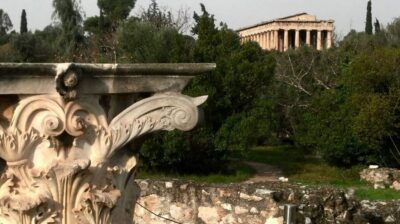
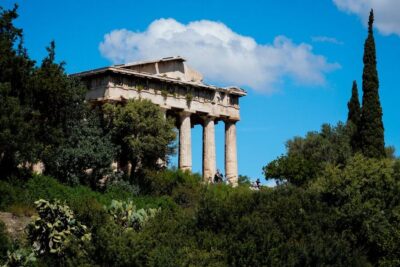
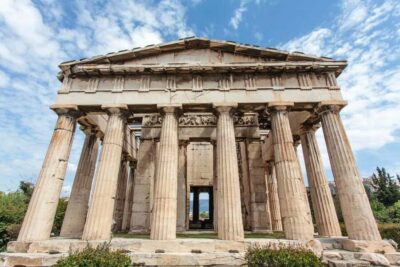
- The Temple of Hephaestus is also part of the itinerary. Even if you only see it as a stop along the walk, it is a major visual anchor in the area.
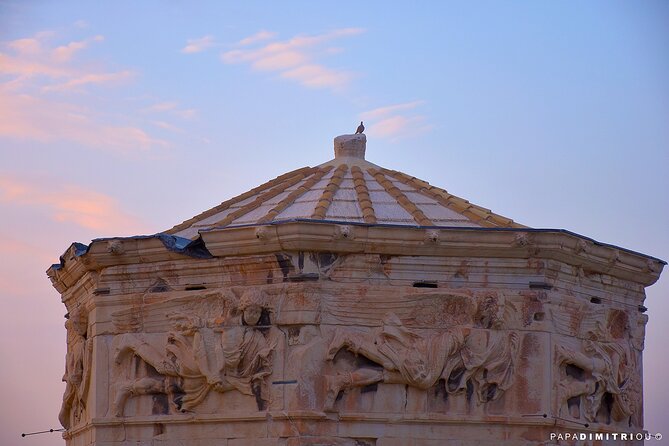
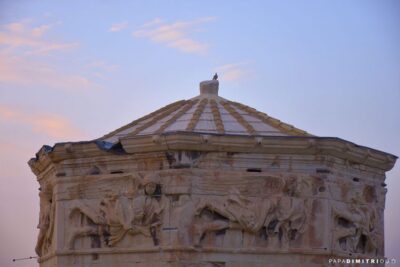
This is also where the tour includes the Tower of the Winds, a timepiece connected to the forum. It is one of those Athens objects that makes you appreciate how “smart” the ancients could be with everyday technology.
You can also read our reviews of more private tours in Athens




Stoa of Attalos museum time, artifacts that explain daily life
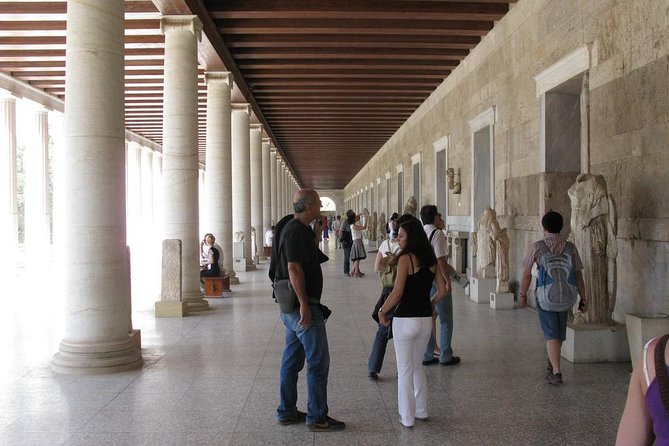
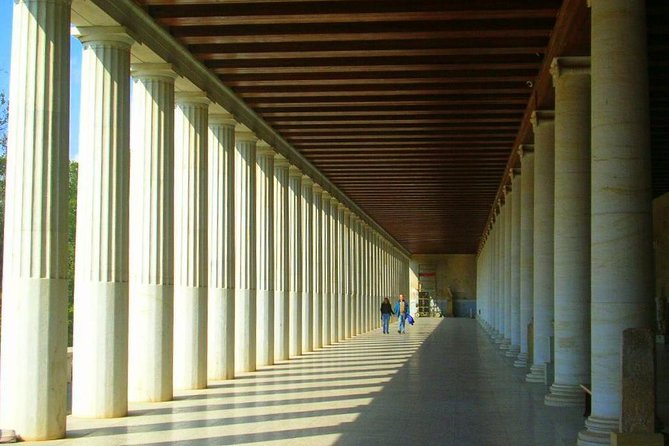
After the Agora ruins, you visit the archaeological museum in the Stoa of Attalos. The Stoa is the reconstructed ancient shopping hall, and that reconstruction is a big part of why this stop works.
Instead of only seeing scattered stones, you get a setting that feels like how the space functioned. The museum visit is planned for about 45 minutes, and the emphasis is on artifacts used in daily life of Athenians. That daily-life angle is a helpful counterweight to the political and architectural focus of the Agora itself.
If you tend to “museum out” halfway through a long site, this timing is decent. It is not a half-day museum program, but it still gives you enough time to absorb how people lived, bought, worked, and traveled through their city.
One more value point: the tour does not just send you from one landmark to another. It tries to connect outdoors ruins to indoors evidence, so your brain makes links instead of collecting disconnected stops.
Avyssinias Square and Athinas Street, ending with local smells and color
When the historical stops wrap up, you walk through Avyssinias Square and then toward Athinas Street. This is where the tour intentionally slows into the sensory side of Athens: food and spice markets.
Even if you do not plan to eat on the spot, the aromas and the colors help you transition from “ancient storytelling” to “present-day Athens.” It is also a practical way to end, because once you are in this area, it is easy to keep exploring on your own.
At the end of the visit connected with the Stoa of Attalos, your guide leaves you so you can continue around the old part of the city. That means you are not forced into a rigid final loop.
Price and value: what $319.39 per person really covers
This tour costs $319.39 per person, and it is offered as a private walking tour for about 3 hours in English. For a private tour, that price makes sense because you are paying for direct guide time plus an efficient route through multiple areas.
What is not included is important for budgeting. The Ancient Agora entrance ticket is listed at €20 per person. Food and drinks are also not included unless specified, and there is no hotel pickup or drop-off.
So, what you get for the money is not a long list of sites, it is:
- A guided sequence that connects Ottoman, Roman, and classical Athens in one storyline
- A museum start at Syntagma that gives context before the big ruins
- A stop in the Stoa of Attalos to tie outdoor space to physical artifacts
- Personalized attention, which matters when you want to ask questions or manage the pace
If you are comparing prices, do not just look at the total. Compare how much time your guide spends interpreting what you see versus simply pointing out landmarks.
Who should book this private Agora, Plaka, and Monastiraki tour
I think this one fits best if you like structure but hate cookie-cutter tours.
Book it if:
- You want Ancient Agora explained in plain terms and connected to civic life and everyday trade
- You enjoy Ottoman-era architecture and want Monastiraki to feel like more than a shopping circuit
- You like a guided mix of cathedral-era Athens, Roman remains, and historic neighborhood lanes
- You want a guide who can pitch explanations so mixed ages can follow, including teens
It might not be your best match if:
- You prefer fully guided museum time with fewer walking breaks
- You struggle with long walks on uneven streets and steps
A note on stamina: “Most travelers can participate” is stated for the tour, but the route still includes walking across multiple neighborhoods.
Practical tips to get the most from the walk
A few small moves can make your 3 hours feel smooth instead of hurried.
- Wear shoes you can stand and walk in comfortably. This route includes paved lanes and site paths.
- Bring water. Food and drinks are not included, and you will be out moving between areas.
- Have some flexibility with timing. The tour ends after the museum time and guide departure, so plan your next stop nearby rather than far away.
- If you care about photos, consider bringing a phone or camera with enough battery. Columns, doorways, and mosque exteriors are all part of the itinerary.
If you are planning to shop for spices or snacks in Avyssinias Square and Athinas Street, decide early whether you will do that at the end or during the walk. The guide will be able to steer you toward a calm moment to browse.
Should you book this private Athens walking tour?
I would recommend it if you want Athens to feel like one connected story instead of three separate checklists. The best part is the way it moves from a station museum finds into Ottoman neighborhood details, then lands in the Ancient Agora with meaning.
It is also a good fit for people who value direct attention. When the guide is named and noted for making the experience easy for teens, that tells you this tour can work well inside a private group with mixed ages.
Skip it only if walking time is a dealbreaker for you or if you are only interested in one era. This tour is built around variety, and that variety is the point.
FAQ
How long is the private walking tour?
The tour duration is about 3 hours.
Where does the tour meet?
You meet near Syntagma Metro station in central Athens, at Pl. Sintagmatos, Athina 105 63, Greece.
Where does the tour end?
The tour ends at the Ancient Agora of Athens, Athens 105 55, Greece. After the visit connected with the Stoa of Attalos, your guide departs so you can explore more on your own.
Is this tour private?
Yes. It is a private tour/activity, and only your group participates.
What is the tour language?
The tour is offered in English.
Are hotel pickup and drop-off included?
No. Hotel pickup and drop-off are not included.
Are entrance fees included?
No. Entrance fee for the Ancient Agora of Athens is listed as €20 per person and is not included.
Is food and drinks included?
Food and drinks are not included unless specified.
Is the tour free to cancel?
Yes, free cancellation is offered. You can cancel up to 24 hours in advance for a full refund.
Is the Ancient Agora included in the itinerary?
Yes. The tour includes the Ancient Agora of Athens, including stops like the Tower of the Winds and the Stoa of Attalos museum area.
More Walking Tours in Athens


More Tours in Athens


More Tour Reviews in Athens
- All Day Cruise -3 Islands to Agistri,Moni, Aegina with lunch and drinks included
★ 5.0 · 4,958 reviews



Not for you? Here's more nearby things to do in Athens we have reviewed







Athens Ancient Agora Tours, compared.
 ★ 4.0Agora and Hephaistos Temple Entrance TicketFrom $30449 reviews
 ★ 3.9Ancient Agora E-Ticket and Audio TourFrom $30413 reviews
 ★ 4.1Roman Agora & Ancient Agora E-ticket & 2 Audio ToursFrom $51107 reviews
 ★ 3.9Ancient Agora: Audiovisual self-guided tour with 3D modelsFrom $731 reviews
 ★ 4.8Acropolis, Plaka & Ancient Agora Guided TourFrom $6610 reviews
 ★ 4.9Acropolis and Ancient Agora Guided Walking TourFrom $1028 reviews
 ★ 4.8Ancient Agora: E-Ticket w/Treasure Hunt Tour on your phoneFrom $286 reviews
 ★ 5.0Ancient Agora and Acropolis Private Tour with Licensed ExpertFrom $1856 reviews
Browse the lists this tour appears in