
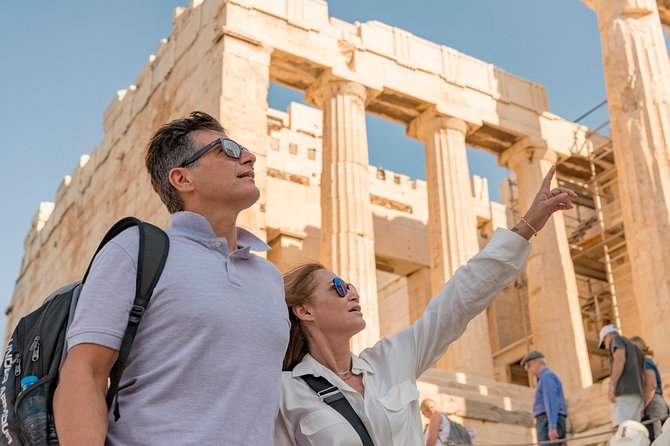
Reviewed · ATHENS ACROPOLIS & PARTHENON TOURS
Ancient Agora and Acropolis Private Tour with Licensed Expert
Two UNESCO sites, one tight plan. This private Athens tour links the Acropolis and Ancient Agora into a single, time-efficient experience guided by a licensed expert. You meet at street level near the Acropolis Museum and you move through the monuments in a way that feels much less like herding cats.
I love the focus on the big moments without wasting time. On the Acropolis side you get a structured walk past the Propylaea gateway, the Temple of Athena Nike, the Parthenon area, the Erechtheion, and major theater stops like the Theater of Dionysus and the Odeon of Herodes Atticus. I also love that the guide turns details into stories, with real guests calling out guide names like Mandio, Manto, Shorty, and Vicky for being funny, interactive, and strong at answering questions.
One consideration: the route includes walking between the Acropolis area and the Agora area, so it is not suitable for reduced mobility. Also, admission tickets are not included, so you’ll want to handle entry timing so the tour does not lose momentum.
Key points you will care about
- Private, licensed expert guidance that keeps the tour conversational, not lecture-style
- A tight 3-hour format that still hits both UNESCO sites and the key monuments at each
- Acropolis highlights in an efficient sequence, including Propylaea, Athena Nike, Parthenon area, Erechtheion, and theaters
- New Acropolis Museum context, so what you see outside has a clearer explanation inside
- Agora time focused on daily life, including a reconstructed commerce scene and a standout temple
Why this Acropolis and Agora combo makes sense

If you only have a half day in Athens, this is one of the smarter ways to spend it. The Acropolis is where you go for the iconic temples and big civic symbolism. The Ancient Agora is where you go for the everyday machinery of the city, the marketplace life, workshops, and civic meeting spaces at the base of the Acropolis.
What I like about pairing them is the cause-and-effect feeling. Up on the hill, the city’s ideals show up in stone. Down at the Agora, you see how people actually lived with those ideals, in commerce, religion, and public culture. Even if you have visited Athens before, seeing the Agora right after the Acropolis helps everything click faster.
This tour also aims to be practical. It is private, scheduled for about three hours, and designed to move you between high-impact stops without long detours. That matters in Athens, where crowds and lines can quietly eat your best light and your energy.
You can also read our reviews of more private tours in Athens


Where you meet and how you get oriented
You start at Makrygianni 7 (Athina 117 42), and your guide meets you at the street-level entrance of the Acropoli Metro Station. The location is right by the Acropolis Museum area, which is a nice setup because it helps you orient quickly and limits wasted time crossing town.
From that meeting spot, you get the kind of orientation that prevents the Acropolis from feeling like a random pile of ruins. You get an intro to why the Acropolis mattered to ancient Greek life and how its setting was shaped long before the classical temples rose there. The guide also uses the wall and nearby viewpoint to set up the bigger story before you start climbing.
For first-time visitors, this kind of groundwork is gold. You do not just “look at” the monuments. You understand what you are looking at, and why the view from each spot matters.
The Acropolis route: temples, gates, and two theater stops
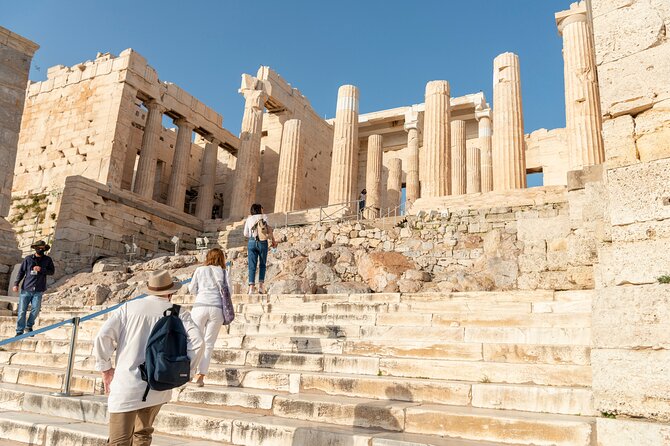
The Acropolis portion is planned for about 80 minutes, and the route is packed but not chaotic. Expect a guided circuit that hits the sights people actually want, with time for photos and explanations as you go.
Here is what you will see and why it matters:
Propylaea and the feeling of arrival
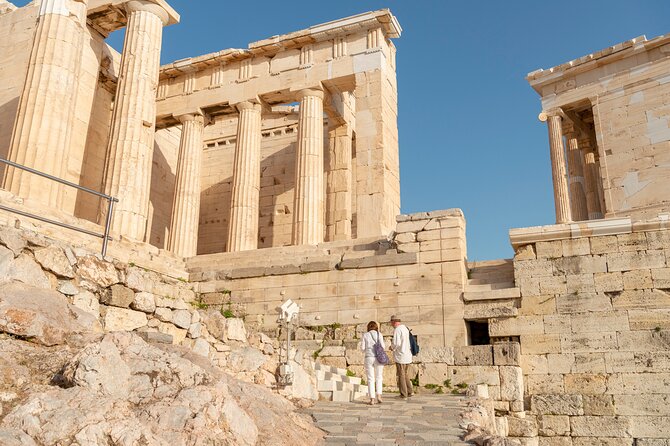
You ascend toward the monumental gateway, the Propylaea. This is the threshold moment. It is a reminder that the Acropolis was not just a viewpoint. It was a controlled sacred approach, built to slow you down and signal significance.
Temple of Athena Nike: a restored, important viewpoint
You then get to the Temple of Athena Nike, a Classical Ionic temple dedicated to the goddess Athena. The plan notes it was built around 420 BC and that it is largely restored. The key takeaway for you is not only the architecture, but the way it sits to overlook the city, linking religion to civic pride.
- All Day Cruise -3 Islands to Agistri,Moni, Aegina with lunch and drinks included
★ 5.0 · 4,958 reviews




Parthenon time: why it was the center of ceremonial Athens
The Parthenon stop is handled with extra attention because it is the pinnacle monument people came for. Your guide takes time for construction, mythology, and historical importance, and that is what turns it from a photo opportunity into a real understanding moment.
Erechtheion: mythology with visible symbolism
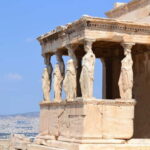
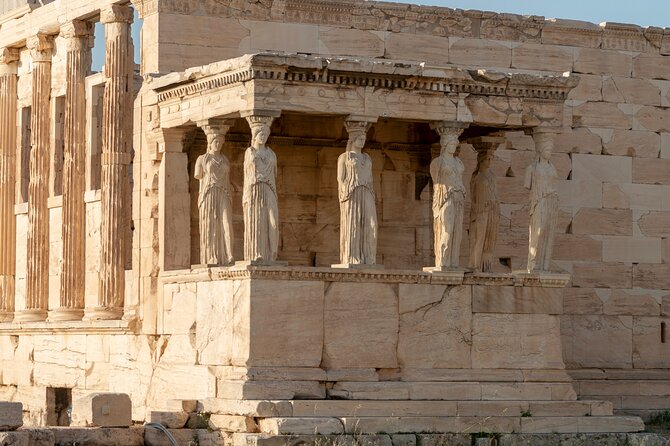
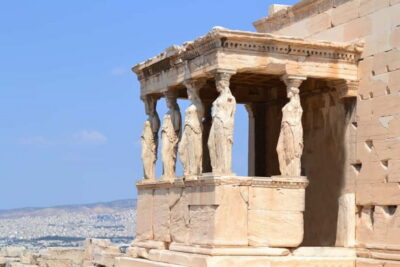
Next is the Erechtheion, dedicated to both Zeus and Athena. The guide focuses on its mythology and main aspects, including statues you can also see later in the museum. This is a great stop if you like symbolic art, because the details are not random. They point to the stories the Athenians told about their identity.
Theater of Dionysus: the world’s oldest theater idea
One of the most memorable stops here is the Theater of Dionysus. The route frames it as the world’s oldest theater, built in the 4th and 5th century BC in a natural amphitheater on the Acropolis slopes, with an estimated capacity of about 25,000. The guide also connects it to Greek drama, including the idea that famous plays would have had premieres here.
If you like theater or enjoy how culture shapes politics, this stop brings a fresh angle. You see the Acropolis as a cultural engine, not just a religious hill.
Odeon of Herodes Atticus: old stage, still alive
You will also pass the Odeon of Herodes Atticus, a marble amphitheater built in AD 161 by Herodes Atticus in memory of his wife. The itinerary notes it continues as a working theater to the present day. That continuity is a neat reminder: ancient Athens did not only create artifacts. It created traditions that lived on.
New Acropolis Museum: why the indoor stop changes your outdoor view
The plan includes a New Acropolis Museum stop. In the itinerary, it is timed at roughly 80 minutes, though the overall tour stays about three hours, so you can expect smart pacing by your guide to keep everything on track.
Why the museum matters is simple. The Acropolis ruins can feel “spiky and scattered” unless you know what pieces belonged where. In the museum, you see original masterpieces along with models, videos, and interactive elements. The guide points out the most significant works and connects them to the myths and stories tied to what you saw outside.
A practical benefit for you: the museum is where you catch explanations you can then apply immediately while standing on the hill. When you spot a detail outside and then see related sculpture or context inside, the whole place becomes more legible.
And if you travel with kids or teens, the museum style of storytelling tends to land better than walking around with only stone explanations. Even adults often leave more confident because they can finally place names and themes to what looks similar from a distance.
Ancient Agora: marketplace life and a standout temple
After the Acropolis, you transition to the Ancient Agora for about 80 minutes. This is the part many people rush through on their own. With a guide, you get the “city working” perspective.
Here is what the Agora stop focuses on:
The reconstructed marketplace scene
You start with a recreation of an ancient center of commerce. Traders worked here, and local workshops and important monuments filled the area. The stop is designed as a window into how daily life looked, not just how officials staged ceremonies.
This is where you start asking different questions. Instead of, “What god was honored here?” you think, “How did people move through the city and earn a living?” That shift makes the whole ancient-world story feel more human.
An onsite museum of finds
You also get a look at an onsite museum housing artifacts uncovered from the site. That gives you proof that you are not only seeing a dramatic ruin, you are seeing a place archaeologists pulled real objects from, which anchors the story.
The most complete remaining temple of Greek antiquity
The itinerary highlights the presence of the most complete remaining temple of Greek antiquity. Even without you needing a deep architectural degree, this is a stop that helps you feel the scale and craftsmanship that survived.
Tickets, timing, and why the entry plan affects your day
The biggest logistics note is straightforward: admission tickets are not included. The tour provider can help organize hassle-free tickets for an extra cost after booking, and you will be asked by message whether you need that help. If you do not reply, they assume you bought the appropriate time slots yourself, and delays can become your problem.
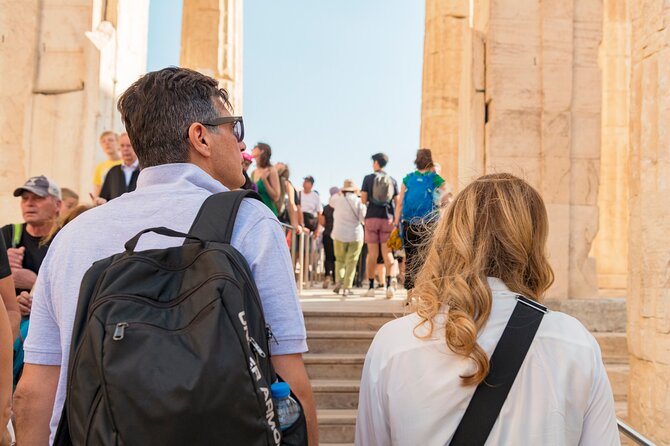
This is not a reason to skip the tour. It is a reason to plan your entry time carefully. Tickets may sell out days or weeks in advance, and entry is tied to specific time slots. If you want the tour to run smoothly and still protect your schedule, you should treat ticket timing as part of the tour itself.
One more practical tip: if you care about photos and comfort, aim for a slot that keeps you off the hill at the hottest or most crowded moment. Your guide can help you navigate crowds once you are on site, but timing still matters.
Whisper systems, private pacing, and why this tour feels different
Even though this is a private tour, the included whisper communication system for groups of 6 or more shows the provider is thinking about hearing, crowd noise, and keeping the group together. In Athens, that matters. You want to hear the guide when you are standing at a key view or listening for myth details.
The private element is what changes the vibe. You can ask questions, pause for pictures, and move at a pace that fits your group. Several guests mention that they got more time for looking and asking questions than they would with a regular audio format.
It also helps if you have mixed ages in your group. One family-style review highlighted that even a teenage son stayed engaged, which usually means the guide explained things in a way that did not talk down to younger travelers.
Value check: is $185.86 per person worth it?
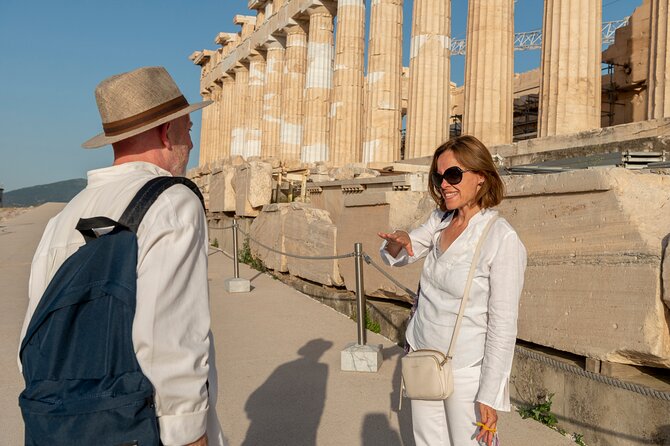
At $185.86 per person for about three hours, this is not the cheapest way to see Athens. But it is also not trying to compete with the low-cost “audio guide and go” crowd.
You are paying for three things:
- A licensed expert who explains what you are seeing, while also pointing out details you would likely miss
- A private format where you are not stuck matching someone else’s pace
- A time-efficient routing that covers both the Acropolis area and the Ancient Agora in one half-day style plan
If you are the type who enjoys learning while sightseeing, a guided approach usually wins because you spend less time turning confusion into understanding. You also avoid the silent frustration of standing in front of a monument and thinking, now what?
If you are traveling with someone who hates museums or guided tours, you might find the price harder to justify. But if you are excited by stories, architecture, myth, and the way ancient civic life worked, this pricing can feel fair because it compresses a lot of meaning into a short window.
Who should book this tour, and who might prefer something else
This tour is a strong match if you:
- Want a short, high-impact Acropolis visit without being rushed
- Also care about Athens beyond the postcard temples
- Enjoy asking questions and getting instant context
- Travel as a couple or small group who wants flexibility in pacing
It may be less ideal if you:
- Have reduced mobility, since there is walking between the Acropolis and Agora
- Are trying to do this day with zero planning, because tickets are not included and time slots matter
If you are traveling with kids, it is worth considering because the museum-plus-monuments format gives multiple ways to keep attention. If you are traveling solo and want maximum flexibility, you could still book it, but you might compare it to a smaller group option before committing.
Should you book this Acropolis and Ancient Agora private tour?
I think you should book this if your goal is clarity. You want to see the Acropolis highlights, then immediately understand the city context at the Agora, with a guide who can answer questions and keep the pace workable.
It is also a smart choice if you dislike the “walk in a line, move on” feel of big group tours. The private format and guide-driven storytelling are the reason most people end up feeling satisfied at the end, not just impressed by the view.
If you do book, plan ahead for tickets and time slots, and choose your meeting point timing carefully so you start on schedule. And if walking is an issue for you or your group, take that seriously, since the Acropolis and Agora are not side-by-side.
If that all checks out, this is an efficient way to get the most meaningful Athens loop in about three hours.
FAQ
Is the Acropolis and Ancient Agora tour private?
Yes. It is a private tour/activity, and only your group participates.
How long is the tour, and how is the time split?
The tour is approximately 3 hours. The schedule is roughly split into about 80 minutes on the Acropolis area and about 80 minutes on the Ancient Agora.
Where do we meet the guide?
Your guide meets you at street level at the Acropoli Metro Station. The meeting point address given is 7 Makrygianni Street, close to the Acropolis Museum.
Are admission tickets included in the price?
No. Admission tickets and their cost are not included. The provider can organize hassle-free tickets on request after booking for an extra cost.
Is there walking between the Acropolis and the Agora?
Yes, there is some walking distance between the Acropolis and the Agora. This tour is not suitable for persons of reduced mobility.
What language is the tour in?
The tour is offered in English.
More Private Tours in Athens


More Tours in Athens


More Tour Reviews in Athens
- All Day Cruise -3 Islands to Agistri,Moni, Aegina with lunch and drinks included
★ 5.0 · 4,958 reviews
Not for you? Here's more nearby things to do in Athens we have reviewed









Athens Acropolis & Parthenon Tours, compared.
 ★ 4.4Acropolis & up to 5 Archaeological Sites Combo PassFrom $4812,619 reviews
 ★ 4.2Acropolis Ticket with Optional Audio or Live GuideFrom $4211,055 reviews
 ★ 4.8Acropolis, Parthenon & Acropolis Museum Guided TourFrom $409,316 reviews
 ★ 4.6Acropolis and Parthenon Guided Walking TourFrom $385,882 reviews
★ 4.8Acropolis, Parthenon & Acropolis Museum Guided TourFrom $413,579 reviews
★ 4.6Acropolis and Parthenon Guided Walking TourFrom $385,882 reviews
★ 4.8Acropolis, Parthenon & Acropolis Museum Guided TourFrom $413,579 reviews
 ★ 4.0Acropolis Ticket with Audio GuideFrom $473,575 reviews
 ★ 4.7Acropolis: Acropolis and Parthenon Guided Walking TourFrom $363,442 reviews
 ★ 5.0Acropolis monuments & Parthenon Walking Tour with Optional Acropolis MuseumFrom $422,678 reviews
Browse the lists this tour appears in