
Reviewed · WALKING TOURS
Athens Social and Political Walk
One sentence can change your whole trip. This Athens Social and Political Walk turns the city’s government buildings into a story about how power works. I love the small-group format and focused Q and A with Isaac, a political-science guide who connects today’s headlines to major turning points. I also like how the route stays practical and walkable, with clear stops tied to Greece’s political system. A possible drawback is simple: this is moderate walking for 2.5 hours, so it may feel like a lot if you want a slower, sightseeing-only pace.
The best part is that you are not just looking at monuments. You are learning to read them, like symbols with dates and consequences attached. With a maximum of 15 people, you get attention, not just a headset narration, and you can ask questions about history and current events as you go. The tour is in English, and it uses a mobile ticket, which helps it feel smooth from the first minute.
Key things to know before you go

- Official seats, real explanations: You walk past the Prime Minister’s official seat, the President’s residence, and the Parliament area to understand how the state is organized.
- A political scientist style guide: Isaac’s background helps you connect political concepts to what you see on the street.
- Ask-and-answer friendly: The format is built for questions about Greek history and current events, not a one-way lecture.
- The 1973 turning point gets its moment: A stop tied to the Athens Polytechnic uprising on November 17, 1973 anchors the modern political story.
- Niche, not sightseeing-only: If you want postcard Athens, this is not that. It is Athens as a live political classroom.
- Good weather matters: The tour depends on conditions, so plan for flexibility.
Why Athens’ power buildings matter more than the postcard views
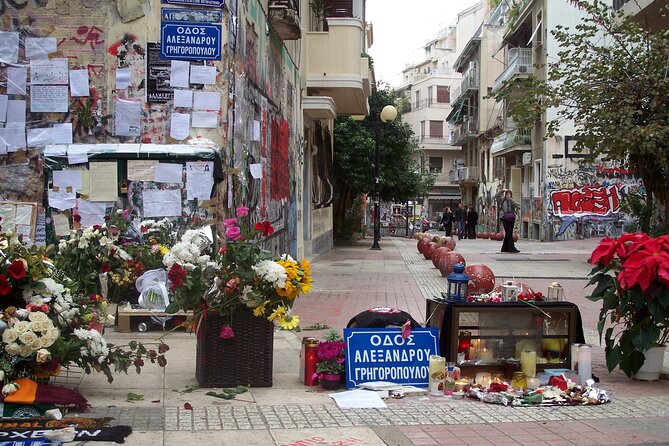
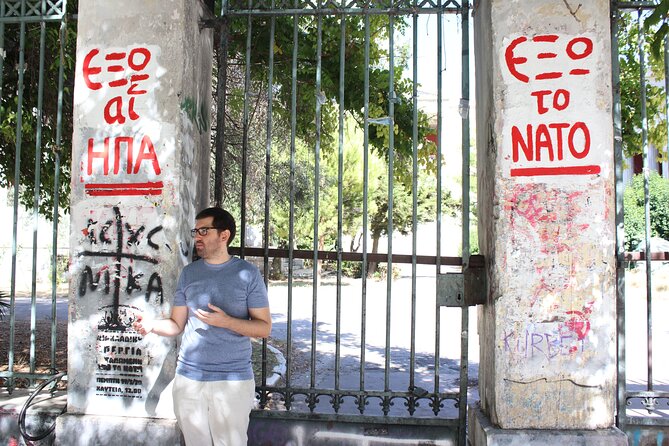
Athens can look timeless. But walk a few blocks toward power and the city stops feeling abstract. This walk takes you through the physical centers of Greece’s political life, so the names and institutions stop being vocabulary words and start being something you can point to.
What I like most is the way the guide helps you “translate” the setting. You learn what each site represents and why Greek politics cannot be understood without context. If you have ever wondered why debates feel intense, this is the kind of tour that makes those connections feel obvious.
You can also read our reviews of more walking tours in Athens


Getting started at Leof. Vasilissis Sofias: a politics-walk setup
The tour starts at Leof. Vasilissis Sofias 2-4, Athina 106 74. Meeting there puts you in an easy-to-reach area with near public transportation, which matters because you will be moving and you do not want your day derailed by a complicated arrival.
From the beginning, the tone is discussion-first. You are not expected to have a background in Greek institutions, and the guide frames ideas step by step. This is a big part of why it works as a first-timer’s entry point into a complex subject.
Also, you can set expectations: the tour runs about 2 hours 30 minutes, and it is a walk. Wear comfortable shoes, because the “curriculum” is delivered through walking, not through sitting in one place.
Prime Minister’s official seat: seeing how leadership is framed
One of the first stops is the official seat of the Prime Minister of Greece. Seeing it in person helps you understand that politics is not only speeches and elections. It is also the architecture of authority, the visible location where decisions are symbolically “made real.”
What the guide tends to emphasize here is how systems grow and change over time. You get a sense of why certain institutions carry weight and how they shape the public’s relationship to government. Even if you are not Greek, you can follow along because the explanations are structured and grounded in real events.
The President’s official residence: the other side of the state
Next you move to the official residence of the President of the Hellenic Republic. This stop matters because it adds balance to the story. Power is not only one person or one branch, it is multiple roles with different functions.
In a strong politics tour, you learn that institutions overlap but do not behave the same way. The President’s residence gives you that comparison point early, before the walk gets more focused on Parliament and major public confrontations.
Parliament of Greece and the Old Parliament House: where policy meets memory
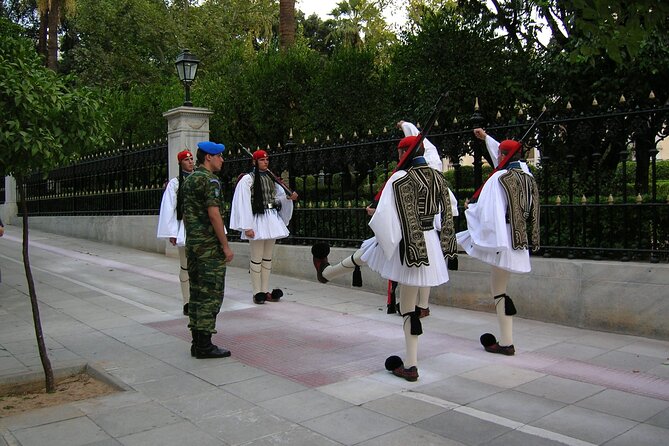
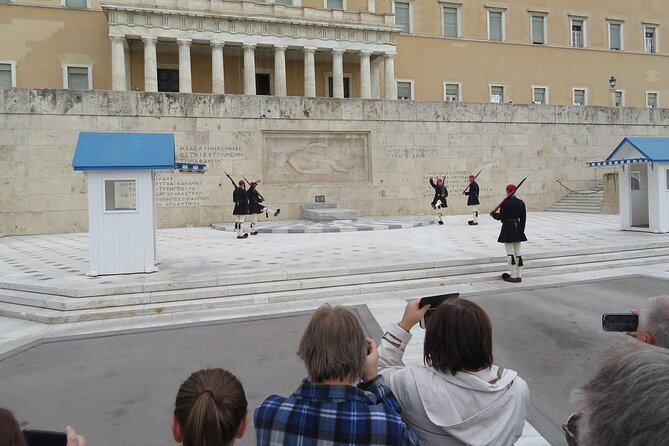
The route then brings you to the Parliament of Greece, followed by the Old Parliament House. This is one of the most interesting combinations because it lets you compare “present” governance with “historical” governance in the same political neighborhood.
The Parliament stop helps you understand the modern mechanism of debate and decision. The Old Parliament House helps you understand that Greece’s political development did not happen in a straight line. Buildings can carry memory, and the guide uses those contrasts to explain shifts in democratic practice over time.
One practical note: because this is a walk through politically sensitive areas, you should expect the focus to stay on what you can learn from the street-level context, not on getting inside buildings you might see from outside. The value is in interpretation, not access.
- All Day Cruise -3 Islands to Agistri,Moni, Aegina with lunch and drinks included
★ 5.0 · 4,958 reviews




November 17, 1973 at Athens Polytechnic: the day that shaped the modern era
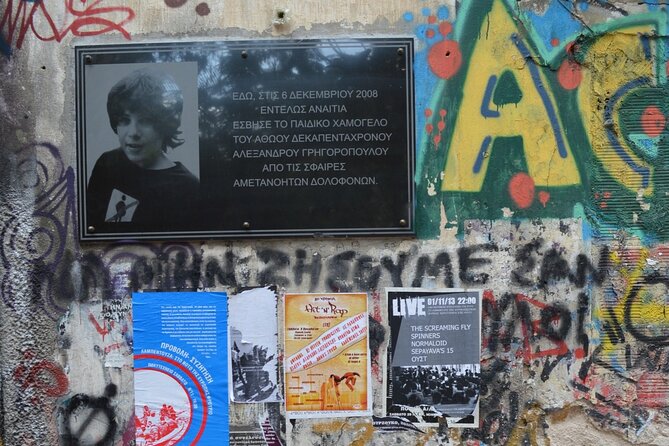
A key moment on the walk is the stop connected to the Athens Polytechnic uprising on November 17, 1973. This is not treated like a random date on a timeline. It is presented as a hinge point that helps explain why Greek society remembers certain political battles so sharply.
What makes this stop hit is the way the guide ties past events to later political developments. You get a clearer sense of how reform and polarization can grow from real conflicts, not just from abstract ideology. If you want to understand why current Greek political debates can feel personal, this is where the story starts to click.
How Isaac connects Greek politics to your own life

The guide, Isaac, is repeatedly praised for depth and clarity, and that shows in how he teaches. He uses comparisons to make concepts easier to grasp, so you are not stuck translating everything alone in your head. The goal is understanding, not memorizing.
You also get anecdotes that make the narrative feel real. Instead of treating Greek politics as something sealed in the past, the guide links major historical episodes to more recent news themes. One reason this tour earns such a strong rating is that it does not talk down to you, and it does not oversimplify either.
There is also a “question culture” built into the experience. If something feels confusing, or if you want to ask how an event connects to today, you can. That turns the tour from a lecture into a real conversation.
The route ends at National Technical University of Athens: a symbolic finish

The walk finishes at the National Technical University of Athens, sometimes known as Athens Polytechnic. Ending at the main entrance on Patision Avenue gives the last stop meaning, because the story you walked through reaches its physical reference point.
This ending is also practical for getting back into your day. The area is tied to that famous 1973 event, so it is not an arbitrary endpoint. It feels like closing the loop on what you came to understand.
Price and what you really get for $47.92
At $47.92 per person for about 2 hours 30 minutes, you are paying for a specialist guide and a focused, small-group learning experience. This is not a long bus tour where you pay for transportation and a generic overview. You are paying for interpretation, and for the ability to ask questions in real time.
The small group limit of 15 is a hidden value here. You are less likely to feel like you are being rushed, and more likely to get answers tailored to what you ask. In practice, that makes the time feel efficient, like you are getting something you cannot easily replicate on your own wandering.
If you are the type who likes to understand what you are seeing, this is good value. If you want lots of casual photos and minimal thinking, you may prefer a classic highlights tour instead.
Who this Athens politics walk fits best
This tour fits best if you enjoy history, politics, and cause-and-effect. It is also a good choice if you want a break from standard sightseeing and prefer a more “how the country works” angle.
You should also be ready for walking with moderate physical fitness needs. It is not described as strenuous, but it is still a 2.5 hour walk. Bring comfortable shoes and plan for a weather-dependent route.
If you travel with a service animal, this experience allows service animals. The tour is also near public transportation, which helps keep logistics sane.
A quick check before you book
You will get the most out of this Athens Social and Political Walk if you are curious about how modern Greece came to be, and why current debates have roots. If that is your style, this tour is an efficient way to turn government buildings into a coherent story.
If you hate lectures or prefer purely scenic routes, this may feel like too much “information per minute.” It is a niche experience, by design.
Should you book it?
Yes, book it if you want Athens with context. The combination of a political-science guide, a small group, and major stops tied to Greece’s power structures and the November 17, 1973 Athens Polytechnic uprising creates a learning experience that feels specific, not generic.
Skip it if you want a relaxed stroll with minimal discussion and you are not interested in political history or current events. This is built for people who like asking questions and making sense of institutions.
FAQ
How long is the Athens Social and Political Walk?
It runs for about 2 hours 30 minutes.
What language is the tour offered in?
The tour is offered in English.
How much does the tour cost?
The price is $47.92 per person.
Where does the tour start and end?
It starts at Leof. Vasilissis Sofias 2-4, Athina 106 74, Greece. It ends at the National Technical University of Athens main entrance on Patision Avenue, Athina 106 82, Greece.
How big is the group?
The tour has a maximum of 15 travelers.
Do I need a print ticket?
No. You get a mobile ticket.
Is the tour suitable for people with moderate walking ability?
It requires moderate physical fitness.
Is it dependent on weather?
Yes. The experience requires good weather. If it is canceled due to poor weather, you will be offered a different date or a full refund.
Can I cancel and get a full refund?
Free cancellation is allowed. You can cancel up to 24 hours in advance for a full refund. If you cancel less than 24 hours before the start time, the amount you paid is not refunded.
More Walking Tours in Athens



More Tour Reviews in Athens
- All Day Cruise -3 Islands to Agistri,Moni, Aegina with lunch and drinks included
★ 5.0 · 4,958 reviews
Not for you? Here's more nearby things to do in Athens we have reviewed








Walking Tours, compared.
 ★ 4.6Acropolis and Parthenon Guided Walking TourFrom $385,882 reviews
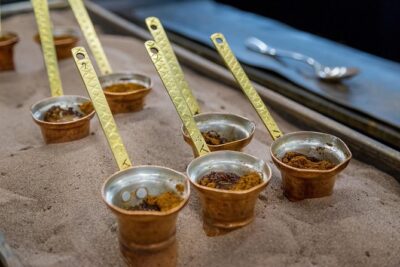 ★ 5.0Greek Food Walking Tour in AthensFrom $874,740 reviews
 ★ 4.7Acropolis: Acropolis and Parthenon Guided Walking TourFrom $363,442 reviews
 ★ 5.0Acropolis monuments & Parthenon Walking Tour with Optional Acropolis MuseumFrom $422,678 reviews
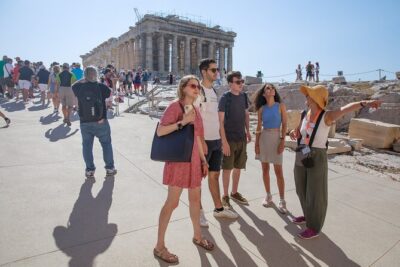 ★ 4.5Athens Acropolis and Parthenon Walking TourFrom $411,355 reviews
 ★ 5.0Athens Authentic Greek Food Walking Tour (Small Group)From $83809 reviews
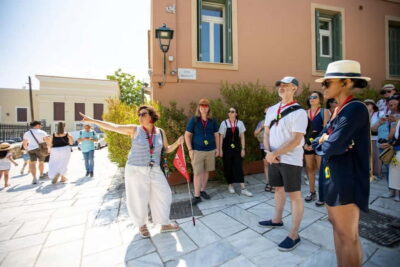 ★ 4.4Early Morning Acropolis & Old Athens Guided Walking TourFrom $28748 reviews
 ★ 4.9Ultimate Food Walking Tour with 15 TastingsFrom $93567 reviews
Browse the lists this tour appears in