
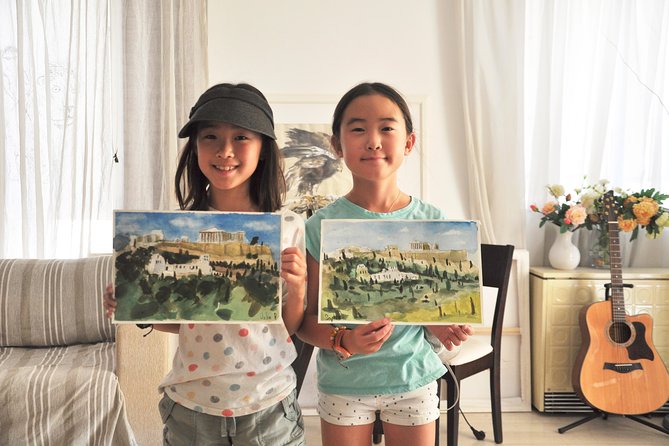
Reviewed · ATHENS ACROPOLIS & PARTHENON TOURS
workshop for painting acropolis/landscape with local artist
Two hours to paint the Acropolis, watercolor style. I like this workshop because you learn how to sketch and compose while working with light and shadow in watercolor, not just copying a final image. The standout is the step-by-step demo led by Ioanna, a professional watercolor painter, plus the fact that you end with a small finished piece that you can frame. One thing to consider: the session is only about 2 hours, so if you want slow and detailed brushwork, you may need extra practice afterward.
This is also beginner-friendly in the real sense. You do not need drawing skills, and the class focuses on practical fundamentals like tones, wash control, and how to build an atmosphere with Mediterranean light. The potential drawback is mainly logistical: it requires good weather, so if Athens is rainy, you should be ready for schedule adjustments.
Key things I’d plan around before you go
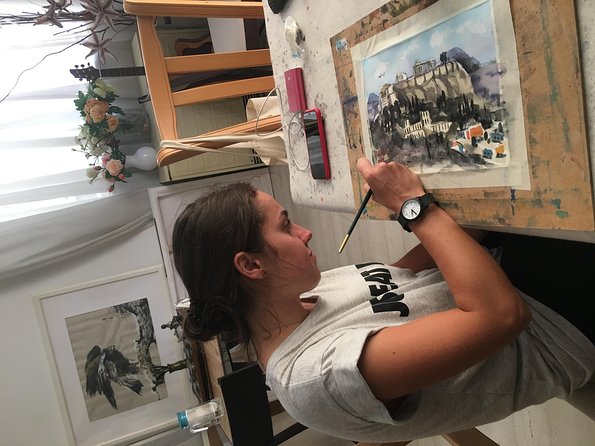
- Small group (up to 6), so you can actually get personal help while you paint
- Beginner-friendly sketching and composition, with guidance that starts from basics
- Watercolor techniques you use immediately, including washes and layering
- Greek subject matter that feels specific, like white-washed houses, blue-domed churches, coastlines, olive groves, and sunlit villages
- A quick, studio-based path to a frame-ready result, not a vague art lecture
Finding Ioanna Art Studio in Athens, and why the small setting matters
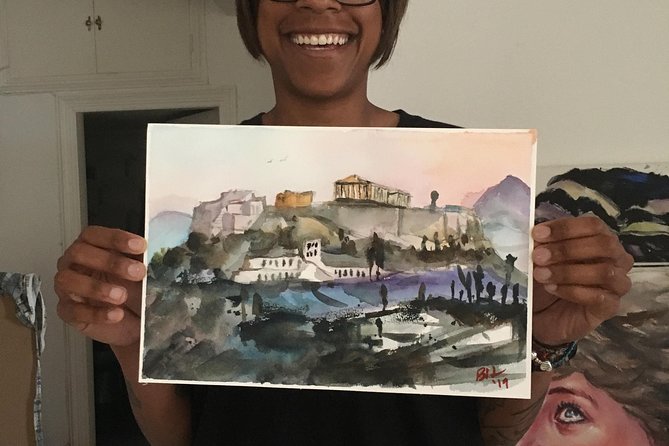
The workshop meets at Leof. Vouliagmenis 69A, Athina 116 36. It is near public transportation, which matters in Athens, because you do not want your day derailed by a long trek just to sit down and paint.
This is not a big class with dozens of people. With a maximum of 6 travelers, the studio stays calmer, and the instructor can watch what you do with your brush and your tone choices. That matters because watercolor is unforgiving in one way and forgiving in another. It is fast, and early decisions show up quickly. A small group helps you correct those decisions while the paint is still workable.
More Athens tours and experiences for the shortlist



What you learn in your first 30 minutes: sketching, tone, and composition
You’ll start with the core skills that make watercolor look intentional. Ioanna’s approach for beginners is very clear: first you learn how to sketch, how to compose, and how to control tone. That order is smart. If your sketch is messy or your composition has no clear focal point, the washes can look like color blobs instead of a scene.
Here’s what the lesson is aiming for:
- sketch the main shapes you see in the Greek scene
- set up the composition so your eye knows where to go
- master tone so the light feels real, not flat
Even if you are new to drawing, you’re not being asked to produce fine art realism. You’re learning a process, step by step, and that’s what lets you finish something you’re proud of.
The guided watercolor demo that turns confusion into a plan
One of the best parts of this class is the way the demonstration works. Ioanna paints while you follow along step by step, and she explains what she’s doing as she goes. This is not just watching someone make art. It is structured instruction, built for people who do not yet know how watercolor behaves on paper.
In watercolor, the “tone” you choose early affects everything after. If your shadows are too dark too soon, the painting can feel heavy. If your light areas are too weak, everything looks washed out. In this workshop, the lesson keeps coming back to how to handle those tonal decisions.
You’ll also get an explanation of brush and paper basics. That’s useful because different brushes and papers can change how a wash spreads and how edges look when they dry.
Watercolor techniques you’ll actually use: washes, wet-on-wet, layering, texture
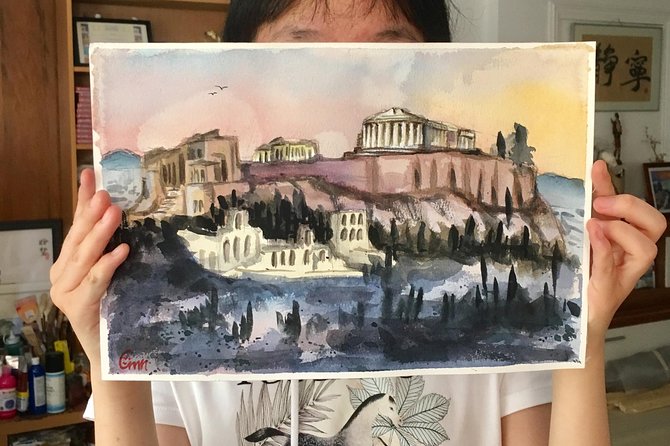
The class is centered on technique you apply during the session. You’re not just told vocabulary words. You work with:
- washes, so you can cover areas smoothly and set the overall color mood
- wet-on-wet, so soft transitions create that airy Mediterranean feel
- layering, so you build depth instead of trying to force everything in one pass
- texture creation, so forms and surfaces do not look like flat paint
Greek scenes are full of cues for texture. White-washed walls, stone edges, and the way light hits coastlines all benefit from small shifts in how you apply color. That is why texture matters here, even for beginners.
Also, the workshop emphasizes atmosphere. This is not only about painting objects. It’s about suggesting weather, light, and distance so your Acropolis view or Greek seaside scene has mood, not just landmarks.
Painting the Greek icons: houses, domes, coastline light, and olive groves
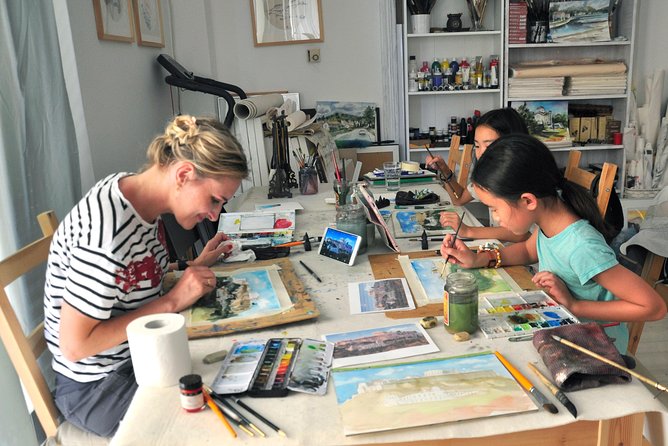
The subject focus is one reason this workshop feels more authentic than a generic “paint a sunset” class. You’ll learn to depict iconic Greek visuals like:
- white-washed houses
- blue-domed churches
- scenic coastlines
- olive groves
- sunlit villages
Even if you choose to paint the Acropolis, the skills connect to the wider scenery themes. You learn how to simplify shapes, place highlights, and keep the background lighter so the foreground can pop.
This is where composition becomes practical. Buildings and cliffs can easily turn into a jumble unless you decide what is near, what is far, and where the viewer’s eye lands first. The workshop guides that decision-making so your painting reads as a real place.
- All Day Cruise -3 Islands to Agistri,Moni, Aegina with lunch and drinks included
★ 5.0 · 4,958 reviews



Mastering light and shadow for that warm Mediterranean look
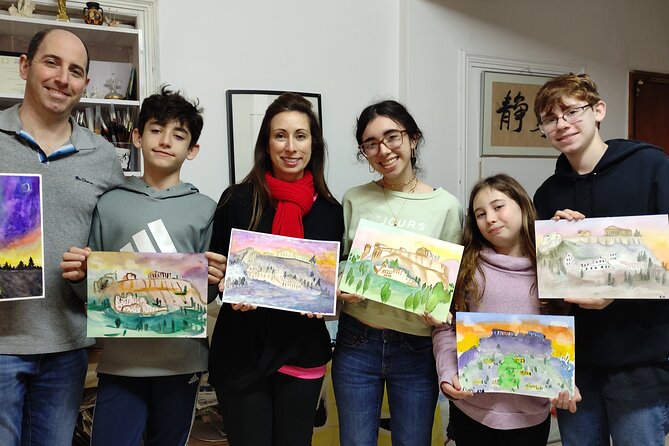
If there’s one goal you should understand upfront, it’s this: the class is training your eye to see light. Ioanna specifically focuses on techniques for light and shadow so your watercolor has believable depth.
Mediterranean light is bright, but it is also soft in many areas, especially when humidity and haze blur distant details. That’s why wet-on-wet and careful tone choices matter. If you keep your distance tones light and your shadows controlled, the scene feels sunlit rather than harsh.
The takeaway is more than one painting. After the session, you’ll have a framework for how to paint light in watercolor: where to place contrast, how to keep highlights clean, and how to build shadow without turning the whole page gray.
The “finished masterpiece” moment, and what you can expect at the end
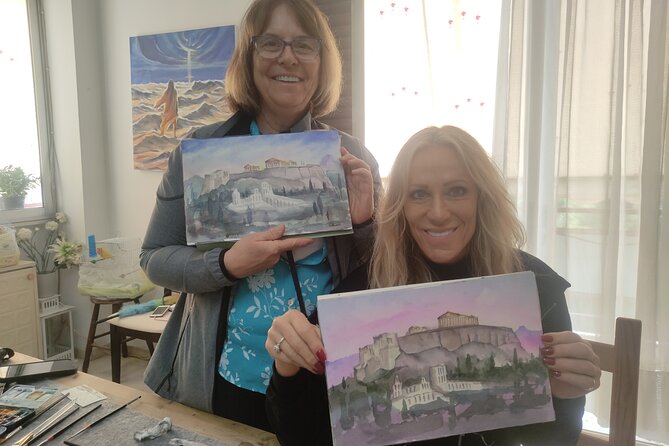
By the end, you should be able to produce a fabulous little masterpiece ready for framing and hanging. That is a key promise, and the structure supports it.
Because the class is guided step by step, you’re not stuck waiting for inspiration. You have a sequence to follow, with technique and corrections along the way. You also get to work in a cozy studio setting, so you are not racing the elements.
One practical advantage for beginners: when you can actually finish something in one sitting, it changes how you practice later. You stop thinking of painting as a talent lottery and start thinking of it as repeatable skills you can build.
A quick look at pacing, group size, and supplies you should plan for
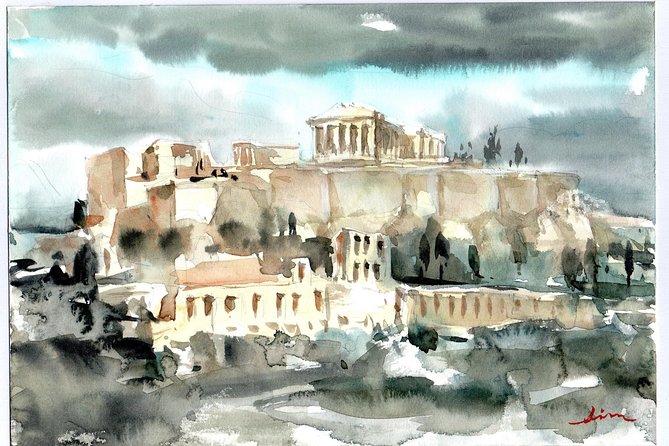
The workshop runs about 2 hours. That’s enough time to sketch, lay in your washes, and add a few key layers for depth, but it is not a full-day painting retreat. Think of it as a focused skill lesson with a strong finish, not a slow, meditative multi-session project.
With the group capped at 6, you can usually expect attention when you need it. That personal coaching is part of what makes this worth it for first-timers.
The class covers brushes and paper basics and uses watercolor during instruction, and you’ll sketch too. You should still arrive ready to work with what the studio provides, and bring your willingness to start with a rough sketch. In watercolor, the first attempt is often the most educational.
Drink and studio comfort, because art classes should feel easy
A drink is provided during the class. That sounds small, but in a 2-hour workshop it helps the whole experience feel relaxed. You’re there to learn, not to perform.
The studio setting is also the reason you can keep your focus. Athens is busy. A calm room where you can concentrate on tones, edges, and composition is a gift, especially if it is your first watercolor class.
Price and value: $78.72 for 2 hours of real coaching
At $78.72 per person, you’re paying for instruction plus guided technique with a professional artist. For Athens, that is a fair value for a small-group class because:
- you get hands-on help on your sketch and your tones
- you’re working with a guided demonstration, not self-guided craft time
- you leave with a finished piece that’s intended to be framed
If your goal is to spend money on a memorable activity that teaches you something transferable, this price makes sense. If your goal is to spend a few hours outdoors painting like a plein-air master, this might feel too short and too studio-based for your expectations.
Who this workshop is for, and who should skip it
This workshop is ideal if:
- you want to paint Greek landmarks or scenery but have no drawing confidence
- you want watercolor basics you can use again later
- you like step-by-step instruction and direct feedback
You might want to skip it if:
- you’re looking for a long multi-day art project
- you expect a deep dive into advanced watercolor theory with lots of experimentation beyond a single finished piece
Should you book Ioanna’s watercolor workshop in Athens?
Yes, if you want a beginner-friendly way to translate Athens into watercolor quickly and correctly. The strongest reason to book is the teaching method: sketching, composition, and tone, plus a step-by-step demo led by Ioanna, a professional with more than 15 years of experience and a fine arts background.
I’d book it if you also care about leaving with something you can hang on your wall. The class is designed to get you there within 2 hours, with guidance that helps your painting look like the place you came to see.
If you only care about watching other people paint or you want a long, unstructured studio session, you may not get what you want. But if you like practical coaching and a solid finished result, this is an easy win.
FAQ
How long is the watercolor workshop?
The session is about 2 hours.
How much does the workshop cost?
It costs $78.72 per person.
Where does the workshop meet in Athens?
It meets at Leof. Vouliagmenis 69A, Athina 116 36, Greece, and it ends back at the meeting point.
Do I need drawing or painting experience?
No. The class is designed for beginners, and it says no drawing skills or some experience are welcome.
What will we paint during the class?
You’ll work on watercolor Greek scenes, including ideas like the Acropolis/Greek landmarks, white-washed houses, blue-domed churches, coastlines, olive groves, and sunlit villages.
Is the class small?
Yes. There is a maximum of 6 travelers.
Will I get a drink?
Yes. A drink is provided during the class.
What if the weather is bad?
The experience requires good weather. If it is canceled due to poor weather, you’ll be offered a different date or a full refund.
Is there free cancellation?
Yes. You can cancel for a full refund up to 24 hours before the experience starts.
More Workshops & Classes in Athens



More Tour Reviews in Athens
- All Day Cruise -3 Islands to Agistri,Moni, Aegina with lunch and drinks included
★ 5.0 · 4,958 reviews
Not for you? Here's more nearby things to do in Athens we have reviewed






Athens Acropolis & Parthenon Tours, compared.
 ★ 4.4Acropolis & up to 5 Archaeological Sites Combo PassFrom $4812,619 reviews
 ★ 4.2Acropolis Ticket with Optional Audio or Live GuideFrom $4211,055 reviews
 ★ 4.8Acropolis, Parthenon & Acropolis Museum Guided TourFrom $409,316 reviews
 ★ 4.6Acropolis and Parthenon Guided Walking TourFrom $385,882 reviews
★ 4.8Acropolis, Parthenon & Acropolis Museum Guided TourFrom $413,579 reviews
 ★ 4.0Acropolis Ticket with Audio GuideFrom $473,575 reviews
 ★ 4.7Acropolis: Acropolis and Parthenon Guided Walking TourFrom $363,442 reviews
 ★ 5.0Acropolis monuments & Parthenon Walking Tour with Optional Acropolis MuseumFrom $422,678 reviews
Browse the lists this tour appears in