

Reviewed · HISTORICAL TOURS
Walk through the history of Athens
Athens history can be finished on your feet. This 2.5-hour walk ties together neoclassical Athens, the modern Greek state, and the long shadow of the Acropolis. I like how the route mixes free photo stops with a couple of optional ticket sights, so you control the time and cost.
You also get a tight story arc, starting on Panepistimiou Avenue and ending near Dionysiou Areopagitou with a view over the Parthenon. The only real drawback to consider is the Acropolis ticket is not included, so you’ll want a plan for that on the spot.
Why This Walk Feels Like Athens, Not Just Sights

This tour is built for people who like their history in layers. Athens is often treated like a single icon, the Acropolis, but this walk pulls you through the city’s other eras too. You’ll see how modern Athens was designed, how the Greek state shows itself in public, and how the Olympics and Roman power shaped what you see today.
It’s also a value-focused format. At about $31.13 per person for roughly 2 hours 30 minutes, you’re paying for a guided route and sensible pacing. Most stops are short, practical, and designed for quick context without swallowing your whole day.
One more point that matters: the group is capped at 14 people. That size is big enough to feel social, but small enough that you can actually ask questions when the guide is explaining things like architecture, symbols, and why certain buildings matter.
What You Really See on This Route (Stop by Stop)

You can also read our reviews of more walking tours in Athens


Panepistimiou Avenue and the Numismatic Museum area
The walk begins at the Titania Hotel area on Panepistimiou 52, where the city starts flexing its neoclassical muscles. This first segment is less about one monument and more about the streetscape: you’ll get a look at the Numismatic Museum and neighboring landmark buildings along the avenue.
What makes this stop worth it is the context. Neoclassical Athens looks “official” for a reason. This is where you start understanding that the modern capital wanted to echo older civilizations, while also building a Greek identity for the present.
The Numismatic Museum itself gets about 10 minutes, and an admission ticket is not included. If you’re curious, you might consider adding it later with an extra ticket, but you won’t be forced into a paid detour.
Practical tip: because this portion is street-based, it’s a good moment to get your bearings for the day. Wear comfortable shoes, and don’t expect a deep interior visit at this early stage.
Syntagma Square and the changing of the guard
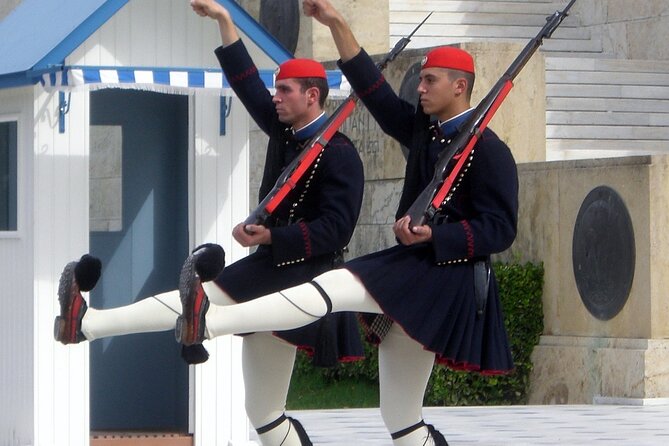
Next up is Syntagma Square, the political heart of modern Athens. You’ll have time near the Hellenic Parliament, and yes, you’ll have a chance to watch the changing of the guard with traditional soldiers.
This stop is one of those “small in time, big in meaning” moments. The ceremony is visual theater, but it also tells you something about how the state presents itself. The uniforms, the pacing, the formality, they all add up to a moment that feels distinctly Greek in tone even if you’re not into politics.
This is a great stop if you like people-watching and short, photogenic moments. It’s also efficient: the tour gives you time without dragging you through a long museum queue.
Kalimármaro Stadium, the white marble Olympic link
From Syntagma, the route shifts into sports history, and it’s more fascinating than it sounds. You’ll get a panoramic view of Kalimármaro Stadium, known as the “good marble.” This is the only stadium built entirely in white marble, and it was the site of the first modern Olympic Games.
What you get here is a reminder that Athens is not only about ancient ruins. It’s also a city that reuses its symbolism. The Olympics helped Athens rebrand itself globally, using famous stone and famous locations to connect modern ideals to classical Greece.
Admission is free for the viewpoint stop, and you get about 10 minutes. That’s enough for photos and for the guide to connect the dots between architecture, national pride, and international events.
Zappeion, still used for important gatherings
Zappeion is one of those buildings that feels “ceremonial” even if you walk past it quickly. The tour gives you a short look at this area, noting that it was the first building built specifically for the modern Olympic Games. Today, it’s used for official and private ceremonies and meetings.
This is a nice contrast after Kalimármaro. Instead of focusing on an athletic venue, Zappeion shows how the Olympics shaped the city’s built environment beyond the stadium itself.
If you enjoy architecture with a purpose, you’ll likely appreciate this stop. It’s also a good mental reset before the Roman-era spectacle later on.
You can also read our reviews of more historical tours in Athens




Temple of Olympian Zeus, Hadrian’s statue next to Zeus
Near the end of the walk, you pass by the Temple of Olympian Zeus. The guide talks about the Roman Emperor Hadrian’s presence here, including a statue of himself erected next to a monumental 13-meter-high statue of Zeus. The Zeus statue is described as decorated with gold and ivory and in the image of the one sculpted by Phidias.
Even if you only see it from outside, this stop matters because it changes the story. You start realizing that Athens is a timeline with overlapping rulers. Ancient Greece is not alone. Romans made their own claims here, and Athens kept absorbing and reinterpreting power.
This stop has about 10 minutes, and admission is not included for the temple site. If you want to go inside or spend more time on the grounds, you’ll need to add that separately.
Finishing with Acropolis views near Dionysiou Areopagitou
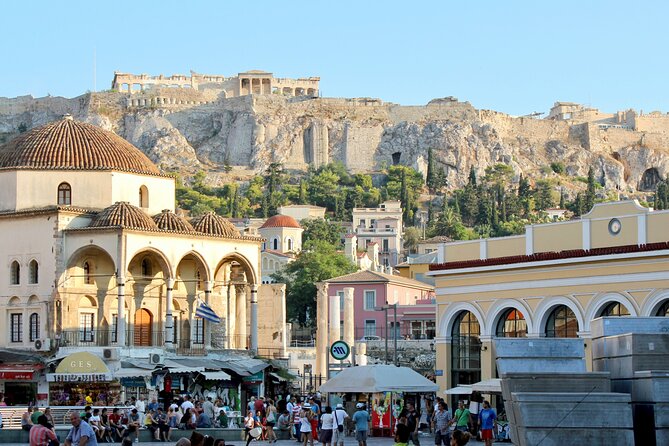
The tour ends at the Acropoli Metro Station, near the pedestrian street Dionysiou Areopagitou. This final part is built for the payoff: you’ll have an impressive view of the Acropolis, with the Parthenon on top.
There’s a clever practical angle here. Ending at a transit node means you can leave easily or stay close for more exploring. And starting your Acropolis day with a view from the city helps you understand the scale before you commit to tickets.
The tour also points out your next options. You can keep exploring the Acropolis and its museum with tickets of your own, or you can slip into Plaka for lunch at a taverna and browse local shops for typical souvenirs.
If you’re someone who gets overwhelmed by crowds, this structure can help. You arrive with a framework, then decide how long you want to stay.
Price and Value: What $31.13 Covers, and What It Does Not
At about $31.13 per person, you’re paying for guided orientation across multiple eras, plus a route that keeps you moving without exhausting you.
Here’s what that price typically means for your day:
- You get a Spanish or English assistant based on your selection.
- You get a structured walking route with timed stops, so you’re not guessing where to go next.
- You get access to the free segments like Syntagma Square and the panoramic view stops.
Here’s the part you need to budget for separately:
- Acropolis archaeological site tickets are not included.
- The Numismatic Museum has a ticket option not included.
- The Temple of Olympian Zeus is listed as not included for admission.
So the value depends on your style. If you mainly want the overview and the best photo windows, this tour stays very good value. If you want to fully tackle Acropolis site time that same day, you’ll want to plan additional ticket costs.
Guide Quality Is the Real Variable (And It Shows)

The itinerary is strong on paper, but the best part of a city walk is always the guide. In feedback tied to this operator, the guide quality gets specific praise, including names like Magdalene and Jenni for clear history and good answering of questions.
Even more telling is the kind of detail people mention: not just big facts, but small moments that make the rules and the place feel real. One example from the experiences shared includes a story about marble rules at the Acropolis, the kind of detail that helps you understand why certain areas are protected and why visitors are warned.
What I’d recommend: during the walk, ask your guide to connect two stops for you. For example, ask how neoclassical Athens links with the political symbolism of Syntagma, or how the Olympics used Athens as a stage again. If your guide is strong, you’ll walk away with a mental map that sticks.
Timing, Walking Pace, and Best-Day Planning
This is about 2 hours 30 minutes. That’s enough time to get real context, without the long grind of a full-day crawl.
You should also know the tour depends on weather. The experience notes it requires good weather, with an offer of a different date or a full refund if canceled due to poor weather.
A practical way to plan your day:
- If you’re also doing Acropolis visits, aim to keep the rest of your schedule flexible, since you end near the metro and you’ll likely decide on the spot how much more time you want.
- Bring water and sun protection. Even though each stop is short, you’re outside for most of the route.
- Start the walk ready to look at buildings. This tour rewards people who enjoy noticing façades, street composition, and architectural clues.
Who This Tour Suits Best

This tour fits best if you:
- want a tight overview of Athens across multiple periods, not only the Acropolis.
- prefer guided orientation with quick stops over long museum sessions.
- like architecture and public spaces, including the political theater of Syntagma Square.
- want a small-group experience, with a maximum of 14 people.
It’s also a good fit for first-time visitors who might feel lost trying to stitch together neoclassical Athens, Olympic-era sites, and the Acropolis on their own.
If you’re the type who wants hours at the Acropolis itself, you may use this as a warm-up. The tour ends near Acropolis, but it does not include the archaeological site ticket.
A Balanced Reality Check Before You Book

The average rating for this experience is 3.3 out of 5 based on 6 reviews. That rating suggests mixed outcomes, not a guaranteed perfect day for everyone.
One practical takeaway: when tour logistics depend on timing and meeting points, you should treat the start time seriously. Use the provided meeting location on Panepistimiou 52 at Titania Hotel, and plan to arrive early enough to stay calm.
If you travel with a service animal, the tour allows them. If you’re traveling with mobility constraints, the listing says most travelers can participate, but you should still consider how much standing and walking the route will involve since it’s a walk through multiple city blocks.
Should You Book This Athens Walk?
Yes, with two conditions.
Book it if you want a guided walk that connects neoclassical Athens, the modern state at Syntagma, Olympic-era landmarks like Kalimármaro and Zappeion, and then finishes with a strong Acropolis view. The route design is smart for orientation, and the focus on architecture and public spaces is a great match for travelers who like the city’s structure, not just its ruins.
Don’t book it (or book with a backup plan) if your top priority is a full Acropolis archaeological visit during the same block of time, because Acropolis tickets are not included and you may need to add that separately. Also, given the average rating, I’d go in with realistic expectations, arrive early at the meeting point, and be ready for weather to matter.
If you want your Athens to make sense fast, this tour is a practical way to do it, and it sets you up for either deeper Acropolis time or a smoother transition into Plaka for food and wandering.
FAQ
How long is the tour?
It runs about 2 hours 30 minutes.
Where does the tour start and end?
It starts at Titania Hotel Athens (Panepistimiou 52, Athina 106 78) and ends near the Acropolis at Acropoli Metro Station (Athens 117 42).
Is the Acropolis archaeological site ticket included?
No, tickets to the Acropolis archaeological site are not included.
Which stops have admission tickets that are not included?
The Numismatic Museum and the Temple of Olympian Zeus have admission tickets not included.
What stops are free for visitors?
Syntagma Square (including time to watch the changing of the guard), Kalimármaro stadium viewpoint, and Zappeion are listed as free.
What languages are available for the guide or assistant?
The assistant is available in Spanish or English, based on your selection.
How large is the group?
The group size is capped at a maximum of 14 travelers.
Is a mobile ticket used?
Yes, the tour features a mobile ticket.
What is the cancellation policy?
You can cancel for a full refund up to 24 hours in advance. The experience also requires good weather, and if it’s canceled due to poor weather you’ll be offered a different date or a full refund.
More Historical Tours in Athens
More Walking Tours in Athens



More Tour Reviews in Athens
- All Day Cruise -3 Islands to Agistri,Moni, Aegina with lunch and drinks included
★ 5.0 · 4,958 reviews




Not for you? Here's more nearby things to do in Athens we have reviewed









Historical Tours, compared.
 ★ 4.5Historical Delphi One Day Tour with Arachova Stop & Expert GuideFrom $341,247 reviews
 ★ 4.9Historic Athens: Small Group Electric Bike TourFrom $50740 reviews
 ★ 5.0The History of Athens: Greek Mythology Private TourFrom $199138 reviews
 ★ 5.0Athens Highlights by E-Bike: Small-Group Historic TourFrom $54131 reviews
 ★ 4.9Small-Group E-Bike Tour of Historic HighlightsFrom $43119 reviews
 ★ 5.0History of Rebellion Walking TourFrom $44110 reviews
 ★ 5.0Half Day Historical Athens City Private Taxi Service TourFrom $11079 reviews
 ★ 5.0Half day tour to Acropolis and the must-see historical sites and downtownFrom $18069 reviews
Browse the lists this tour appears in