
Reviewed · ATHENS PRIVATE TOURS
Private Tour of Apostle Paul’s Footsteps in Ancient Corinth
Corinth turns scripture into real street corners. This private tour follows Paul’s trail across the Isthmus, through ancient port and marketplaces, up to Acrocorinth for the big views, and ends at a modern church with a mosaic of his mission.
I love the way the itinerary anchors you at Ancient Corinth in the areas tied to Paul’s preaching and civic trouble, including the Bema platform in the Agora. I also like that you do not just look at ruins, you stop at the Archaeological Museum of Corinth to connect the artifacts to the places you walked.
One consideration: your day includes walking and extra site time, and the tour is more local-history grounded than a verse-by-verse biblical lecture. Also, archaeological site and museum entry is not included, so plan for an additional €15 per person.
Key highlights at a glance
- Private pacing for your group, with pickup and drop-off from your Athens hotel or port gate
- Isthmus of Corinth + the Diolkos, where engineering explains how goods moved long before trains or trucks
- Kenchreai (Kechrees), tied to Paul’s travel and the letter connection involving Phoebe
- Agora and the Bema, the core Corinth spots that help you picture Paul’s public moments
- Museum of Ancient Corinth, which adds context through curated collections (including Asklepios-related material)
- Acrocorinth Fortress, layered through Greek to Ottoman eras, plus the Temple of Aphrodite setting
Corinth’s “Paul Route” starts with geography, not speeches
Corinth makes sense when you understand its location. It sat on the crossroads between the Peloponnese and mainland Greece, and it was built to move people, trade, and ideas. That is why this tour begins at the Isthmus area instead of jumping straight to ruins. You start with the land bridge that controlled travel, then you add the ship-hauling concept of the Diolkos, so Paul’s world feels practical, not just spiritual.
I also like that the day is designed to show contrast. Corinth had deep pagan religious traditions, civic life, and everyday commerce. Then you bring Christianity into the picture through the places tied to Paul and the early community. The result is a tour where Christianity is not treated like a lonely story, it is placed inside the same city life where people argued, traded, and worshiped.
And because this is a private outing, your guide can slow down if you want photos at the right spots, or keep things moving if you prefer a quicker sweep. That matters on a half-day trip where heat and walking add up.
You can also read our reviews of more private tours in Athens


Price and time: what $169.03 per person buys you
At $169.03 per person for a private tour lasting about 5 to 6 hours (including travel time), this is priced like an all-day effort, not a quick shuttle. The value is in the structure: pickup included, air-conditioned vehicle, bottled water, and WiFi on board. For most travelers, the real win is the flexibility of a private format rather than squeezing into a larger group pace.
Here’s the cost reality you should plan for. Archaeological site and museum entry is not included, listed at €15 per person. The museum stop and the main ancient site time are where that fee applies. So while the base tour price looks clear, your final day cost will be base price plus the entry tickets.
If you like history explained with enough detail to connect the dots, this setup works well. If you want entry fees included and a licensed guide for every site, you might feel the cost separately. Also, the tour is in English, and the tour driver provides professional, history-focused context, but the listing notes there is not a licensed guide included to accompany you inside the archaeological sites.
Isthmus of Corinth and the Diolkos: engineering that shapes the story
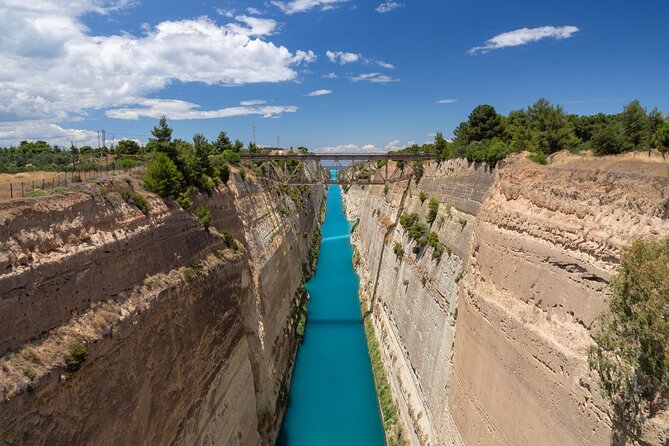
The day’s opener is the Isthmus of Corinth and then a short hop to the Diolkos. You will see the narrow land bridge and get introduced to the corridor that mattered in antiquity. Even today, the scene is visually strong: the Corinth Canal slices through the isthmus area since the late 19th century, making the Peloponnese feel like it is pulled away by water. That visual helps you picture why people cared about controlling movement here.
Then comes the Diolkos. This ancient ship-hauling trackway is one of those details that makes you go, oh, so the city was built around logistics. Ships did not need the long, risky trip around the Peloponnese when they could be moved over land across the isthmus. Walking along the remains gives you a better sense of how trade and travel were not abstract. They were engineered.
Practical note: this early stage is a lighter stop, timed around about 10 to 20 minutes in the schedule. It is a good way to warm up your legs before you commit to longer walking in Ancient Corinth and especially at Acrocorinth.
Kenchreai (Kechrees) and Phoebe: the port connection
After the canal and ship-hauling story, the tour shifts to the eastern port of Corinth, the Ancient Port of Kenchreai, also spelled Kechrees. This is where Paul is tied to Corinth through his travel patterns around the early 50s A.D. The key idea you should take away is connection. Ports are not just locations, they are networks. People arrive, letters go out, and communities take shape through those routes.
This stop also links to Paul’s later movement in the region. The tour highlights that he sailed from there and that his letter was sent via a prominent Christian woman in the local church, Phoebe, described as a deaconess. If you are a Bible reader, this moment tends to sharpen the mental picture of who carried messages and how early Christian networks worked beyond just one traveling preacher.
Do not expect a massive, perfectly preserved harbor. The schedule indicates only modest traces remain. Still, this is a spiritually meaningful place precisely because you are connecting movement to message. You can stand in a quieter setting and feel how a city’s edges mattered.
Ancient Corinth (Archaia Korinthos): Agora, the Bema, and the Temple of Apollo
Now you get into the core of the “footsteps” idea. Ancient Corinth is where the city’s civic and commercial life comes through in fragments. The schedule gives you about 40 minutes at the site, and that is usually enough time to orient yourself, cover the main areas, and still ask questions.
The big teaching point here is the Agora and the Bema. The Bema is described as a raised platform in the center of the city, tied to the belief that Paul addressed the community there and also faced trial before the Roman proconsul. Even if you never read a single footnote, standing in the area helps you understand how public Paul’s message had to be. This was not a private conversation. Corinth’s civic space was the stage.
You also spend time around the broader marketplace context, and the tour connects that to what Paul wrote to the Corinthians. Nearby you will also find the Temple of Apollo, a reminder that Corinth was religiously mixed long before Christianity became dominant.
A reality check: you will need to pay site entry here, and the tour listing says a licensed guide is not included inside archaeological sites. In practice, your driver provides the historical narrative, but you should still come prepared for the fact that museum and site entry are separate from your tour fee.
- All Day Cruise -3 Islands to Agistri,Moni, Aegina with lunch and drinks included
★ 5.0 · 4,958 reviews



Museum of Ancient Corinth: artifacts that make the ruins make sense
The Archaeological Museum of Corinth closes the loop between place and object. Without it, ruins can feel like sketches. With it, they begin to feel used, lived-in, and real.
You get about 45 minutes here. The museum, built in 1932, preserves finds from excavations connected to Corinth’s long arc of life. Highlights include prehistoric discoveries and items from the Sanctuary of Asklepios. That is valuable because it broadens the story beyond Paul’s specific moment. You get a sense that this city sustained multiple layers of belief and health-centered worship traditions, not only one religion at a time.
I also like that the museum galleries are described as curated to show everyday, religious, and artistic aspects across centuries. That means your time inside does not feel like random storage. It is meant to help you connect what you saw in the site to objects and themes.
If you are short on time during your Athens stay, this museum stop can feel optional. I’d argue it is not. It turns the day from a scenic drive into a clearer historical timeline, especially if you care about how ordinary people lived in the same city Paul visited.
Acrocorinth Fortress: views, layers of power, and Aphrodite
Acrocorinth is the physical payoff of the day. This fortified acropolis sits above ancient Corinth and dominates the horizon. The tour schedules about 40 minutes here, which is enough for a focused walk through the main viewpoints and key ruins.
What makes this stop so worthwhile is the layering. The fortress walls and structures were reinforced through multiple eras, including Greek, Byzantine, Frankish, Venetian, and Ottoman periods. In other words, this is not a single-era monument. It is a military and religious symbol that kept getting reused as power shifted.
The tour also connects Acrocorinth to the Temple of Aphrodite. It notes a famous sanctuary tradition linked to priestesses, with a community reported as large as 1,000. Even if you treat that number cautiously in a historical sense, the point stands: this high place was tied to major religious belief systems that shaped social life.
From a tour-experience angle, Acrocorinth is also the spot where the day’s energy can change. The views help you picture the distance between the ancient city and the surrounding region. And once you come back down mentally into the city spaces, Agora and port stops feel more grounded.
Wear shoes with grip. This is where you will feel the uneven ground.
Apostolos Pavlos Church: a modern mosaic with ancient context
You end at the modern Church of Saint Paul, known as Apostolos Pavlos Church, in the heart of ancient Corinth. The stop runs about 20 minutes. This part of the tour works like a quiet period after the fortress and ruins. You get a reflective transition from stone and gaps to a deliberate artistic tribute.
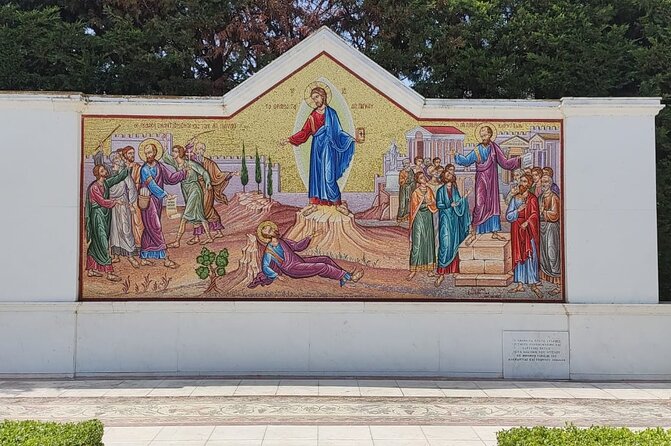
Inside, you will see a striking mosaic created by artists Pastorutti and Tsotsonis, depicting Paul’s journey and mission in the city. The tour frames it as a connection between the early Christian story and today’s place in the landscape. It is also a helpful moment if you want to sit with what you learned earlier rather than just continue walking.
This final church stop is free in the schedule. So it is a low-cost add-on after the paid sites, and it gives your brain a clean landing spot before you head back toward Athens.
How the best guides make the day work (and who you might get)
A lot of the quality in a private tour comes down to the guide. This route has strong feedback tied to people who handled both driving and explanation well.
Names you may see in the guide lineup include Nick, Ruslan, George, Giannis, Dennis, Johnny, and Fotis, among others. Across the reviews provided, what pops up again and again is practical care: guides who keep the day comfortable, explain clearly, and adjust pacing when you need it. One standout detail is that some guides were praised for safe, smooth driving and for helping older travelers in and out of the vehicle, including support for a mother traveling at age 84.
Another repeated theme: guides who connect the places to Paul’s world with specific site references. For example, Bema and Agora elements are frequently tied to scripture moments, and Acrocorinth is described as a favorite for its scale and setting. Some guides even help you recognize the people named in context connected to Paul in Corinth, like Aquila and Priscilla, and the port setting linked to Phoebe.
You should still come with your own expectations. One review notes the tour is not a verse-by-verse biblical experience. If you want that, you may need to do your own pre-reading or bring questions and ask your guide to focus more narrowly on the Acts storyline.
What to pack, and how to survive the heat and walking
This tour is built for real outdoor time. Even if the schedule is “half day,” you will be moving between stops and walking in uneven archaeological terrain.
Bring:
- Comfortable shoes for walking
- A hat and sunscreen, since Greece can be hot and sunny
- Your own water if you prefer, though bottled water is included on board
Think about your pace. If you want photos at every stop, you will feel it at Ancient Corinth and Acrocorinth. If you want the broad story, you can keep it smooth.
If you are traveling with kids, child seats are available upon request. If you have mobility concerns, Acrocorinth is the main spot that might feel challenging, because it is a fortress with outdoor ground and ruins.
Also, plan to charge your phone. There is a mobile ticket. Having your device ready can save time at checkpoints.
Should you book this private Paul in Corinth tour?
Book this if you want a tight Athens-area day that links geography, archaeology, and early Christian connections. The value is strong if you like clear site context and you appreciate a private format where your guide can pace the walk. It is also a smart choice if you want to understand why Corinth mattered for trade, public life, and religious conflict, not just because Paul visited.
Skip or reconsider if you need a purely biblical, verse-by-verse teaching style. The tour is described as using local history tied to the Acts of the Apostles, not as a full scriptural seminar. Also, factor in the €15 per person entrance fees for archaeological sites and the museum, since that is not bundled into the base price.
If you want a day that makes Paul’s story feel like it happened in real streets and real neighborhoods, this one is a strong bet.
FAQ
How long is the private tour?
The tour lasts about 5 to 6 hours, and travel time is included in that duration.
What is the price per person?
The price is $169.03 per person.
Is pickup included?
Yes. Hotel and port pickup and drop-off are included. If you stay at a hotel or apartment, the driver waits at the entrance. If you are at a port, the driver waits at the gate holding a sign with your name.
Are there entrance fees for archaeological sites or the museum?
Yes. Entrance fees to archaeological sites and the museum cost €15.00 per person and are not included in the tour price.
Does the tour include a licensed guide for the sites?
No. The tour does not include a licensed guide to accompany you into archaeological sites.
What language is the tour conducted in?
The tour is offered in English.
What if the weather is bad?
This experience requires good weather. If it is canceled due to poor weather, you will be offered a different date or a full refund.
Can I cancel for a full refund?
Yes, free cancellation is available. You can cancel up to 24 hours in advance for a full refund.
More Private Tours in Athens


More Tours in Athens


More Tour Reviews in Athens
- All Day Cruise -3 Islands to Agistri,Moni, Aegina with lunch and drinks included
★ 5.0 · 4,958 reviews
Not for you? Here's more nearby things to do in Athens we have reviewed





Athens Private Tours, compared.
 ★ 5.0Best of Athens Half Day Private TourFrom $913,714 reviews
 ★ 5.0Athens Full Day Private TourFrom $2442,903 reviews
 ★ 5.0Athens Greece Full Day private tourFrom $683785 reviews
 ★ 5.04 Hours – Athens & Acropolis Highlights Private TourFrom $181681 reviews
★ 5.0Athens Full Day Private TourFrom $205667 reviews
★ 5.04 Hours – Athens & Acropolis Highlights Private TourFrom $181681 reviews
★ 5.0Athens Full Day Private TourFrom $205667 reviews
 ★ 5.0Lake Vouliagmeni Thermal Spa And Temple Of Poseidon Private Full Day TourFrom $171578 reviews
 ★ 5.0Acropolis and Acropolis Museum Private Tour with Licensed ExpertFrom $188445 reviews
 ★ 5.0Athens Highlights Half Day Private TourFrom $305407 reviews
Browse the lists this tour appears in