
Reviewed · CORINTH DAY TRIPS FROM ATHENS
Biblical Corinth Taste Faith & History with wine & Oil Tasting
Corinth feels bigger than it looks. In one 5-hour day, you connect Biblical Paul sites with real ancient engineering, plus you can add wine and oil tasting for extra cost. I love the private mini-van feel with real time at the views from Acrocorinth, but plan for extra spend, since entrance fees and tastings are not included in the base price.
The drive is part of the value. This is an English-speaking private day with pickup from your Athens hotel or Airbnb, WiFi, A/C, and bottled water, and the guides I’ve seen praised by name include Nikos, Panos, Periklis, Andreas, and Christos for clear storytelling and good on-the-fly choices.
One caution for your calendar: the biggest Ancient Corinth stop can close on certain days due to filming and safety, so you may want to confirm what is operating right before you go. If that main site is shut, the day can still be excellent, but you might lose the chunk you were most excited about.
Key highlights you will actually care about
- Corinth Canal plus the ancient diolkos ship-transfer idea, linking two eras in one stop
- Paul and the Isthmian games connection, a Bible angle you can walk through on site
- Acrocorinth fortress views with commanding terrain that explains why it mattered
- Museum time at Isthmia and Corinth, not just rocks, but objects with stories
- Small-group private van (up to 7) with pickup and drop-off back where you started
- Optional wine and oil tasting add-ons (priced separately), so you control the total cost
Biblical Corinth: why this trip is about more than ruins
Corinth sits on a narrow strip of land that linked the Greek mainland to the Peloponnese, which meant control of Corinth meant control of movement. That is why both ancient powers and later Romans kept showing up. For Christians, the city is tied to Paul through the letters of First and Second Corinthians and through Acts, which makes Corinth feel like a place you are not just sightseeing, but also interpreting.
What I like about this tour is that it connects the “Bible on the page” feeling to geography you can see. You visit the Isthmian area where Paul is associated with the games, and you also spend time in Corinth itself, where Pausanias devoted writing and where Roman rebuilding turned an ancient city into a provincial capital. Even if you are not religious, the route still works because it tracks the same theme: trade, travel, and power.
If you do care about the Bible side, the tour’s focus on the Isthmian games is what makes it different from a standard ruins-only day. This route treats the games as a real public stage. That helps you understand why Paul’s presence there, even described in the context of tent-making for athletes and visitors, would have been noticed.
You can also read our reviews of more food & drink experiences in Athens



Getting picked up in Athens, then shrinking the crowds
This is not a big bus day. It is a small-group private experience, with only your group participating, carried out in a luxury mini-van with a capacity up to 7 people. That matters because your time at each stop is not competing with dozens of strangers.
Pickup and drop-off are included from your Athens hotel, Airbnb, or the Port, and the driver waits in the lobby or at the building entrance. If you arrive by airport, the data says flight monitoring and meeting at the arrival hall are handled as well, although that airport pick-up is listed as extra cost.
Inside the van you also get WiFi, A/C, and bottled water. It sounds minor until you hit a hot day and realize you are not stuck without basic comfort. Car seats are available if you book them in advance.
Language is also a practical detail: it is offered in English, and the tour driver is described as well-versed in Greek history. In the feedback, several guides were singled out by name, and the common theme is that they explain what you are looking at, instead of just pointing.
Corinth Canal and the diolkos: the ancient shortcut story
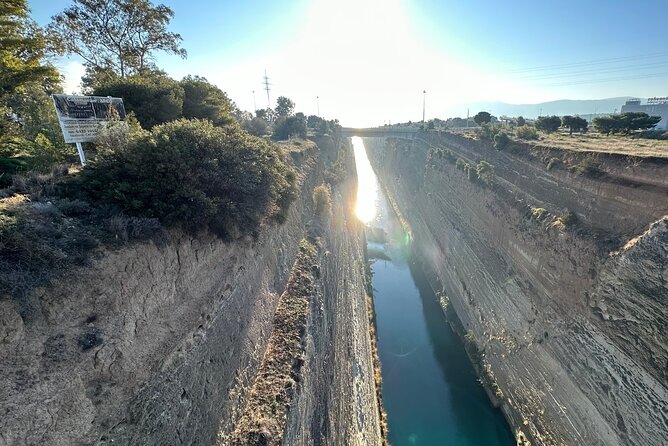
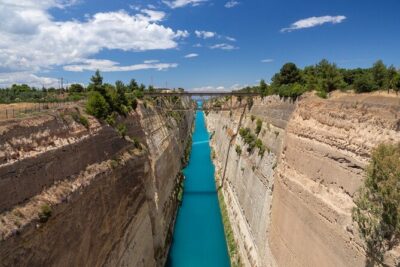
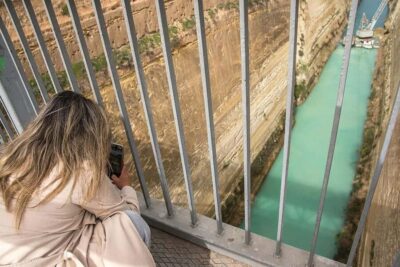
You start with a modern feat that was always chasing an older dream: the Corinth Canal. The canal cuts across the narrow isthmus to link the Gulf of Corinth and the Saronic Gulf. The payoff is immediate: it separates the mainland from the Peloponnese, and it changes shipping routes dramatically.
The deeper story is why people wanted this. Before the canal was built, ships had to go the long way around the Peloponnese, adding about 185 nautical miles. That is the kind of number that makes the canal feel like an economic miracle instead of just a scenic cut.
Then you get the ancient engineering bridge to that same idea: the diolkos. This was a paved trackway near Corinth where ships could be moved overland, avoiding the dangerous circumnavigation. The route mentions that Periander, the tyrant of Corinth around 602 BC, is believed to have first conceived the canal idea, and that the diolkos operated from about 600 BC until the middle of the 1st century AD.
Two things make this stop worth it. First, you get a rare chance to see how the Greeks solved logistics with the tools they had, using something closer to an overland transport system than a modern dock-and-crane setup. Second, the explanation of why it mattered in peacetime goods transport and in war helps you connect the canal and diolkos as a single long-term problem-solving thread.
Time-wise, these are quick stops (15 minutes at the canal and 20 minutes for the diolkos), but the story density is high, and you often get photos without feeling rushed.
Isthmia, the Isthmian games, and Paul’s presence
Next comes Isthmia, located near where the Peloponnese joins Central Greece. The tour frames the Isthmian site around the second most important games in the ancient world, after Olympia. That positioning is not trivia. When an ancient society ranked events, it also ranked money, attention, and travel patterns, and that means the route through Corinth becomes a route through culture.
The Bible connection here is the presence of the apostle Paul in the Isthmian region. The tour description stresses that the reference to Paul at the Isthmian games was considered very important because it is the first official presence of a Christian at these games. It also notes that Paul worked as a tent maker for accommodation of athletes and visitors, and that his preaching of Christ was part of what visitors and athletes would have encountered.
Even if you keep the religious angle neutral, this stop works because the games explain why people would gather in the first place. The geography tells you how a “halfway between Athens and Sparta” zone could become a magnet.
This stop is listed as free admission in the provided timing, and the pacing allows you to keep energy for what comes next.
Museum of Isthmia: objects that add texture to the story
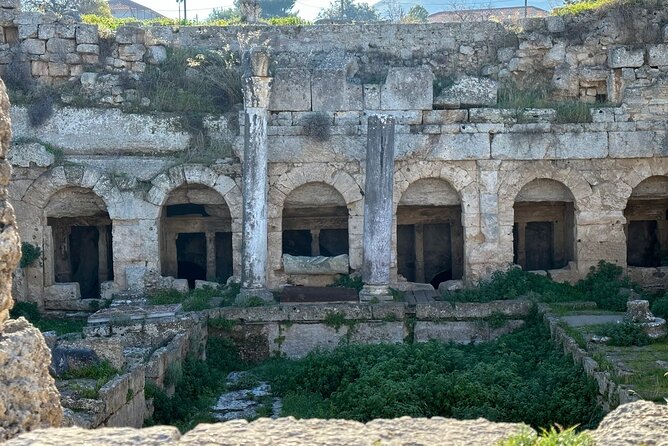
After Isthmia, you visit the Archaeological Museum of Isthmia. The stop is about 20 minutes, and admission is listed as not included, so build that into your budget if you want the museum portion.
What makes this museum practical is that it gives you specific artifacts to picture. The data highlights an archaic marble pediment dated to the end of the 7th century BC that was placed at the entrance of the first Temple of Poseidon. That is the kind of detail that makes the site feel anchored in physical evidence.
The museum also includes glazing of Kechreon, colored glass pieces that arrived packed in twos on a ship from Alexandria and were found submerged near a Temple of Isis on the south pier of the harbor. The description compares them to stained glass windows, which is an easy mental image: you are not just looking at objects, you are seeing how light and decoration might have worked in a sacred harbor setting.
Other highlighted pieces include an imperial statue in the type of Zeus from the mid-2nd century BC, an epinician stele with a portrait of the Corinthian musician Lefkios Cornelius (150 AD), and animal figurines like a golden bull vow to the sanctuary from the 6th century BC.
If you like museums, this is a good add because it keeps the day from becoming only outdoor walking. If you do not care much about museum objects, keep in mind you might spend more time here than you expected, since the stop is fixed at about 20 minutes.
You can also read our reviews of more historical tours in Athens



Ancient Corinth: the big site and the day’s main payoff
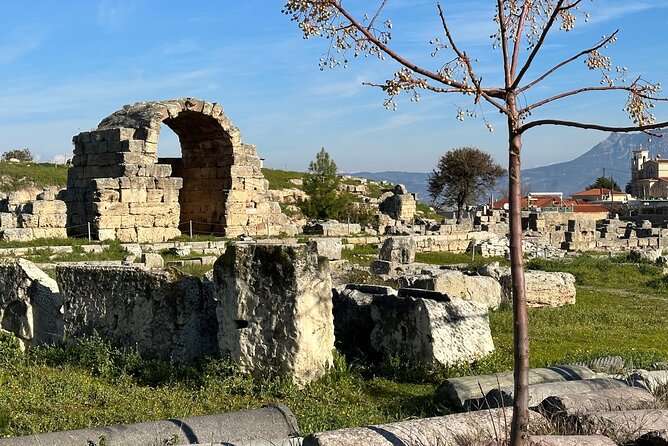
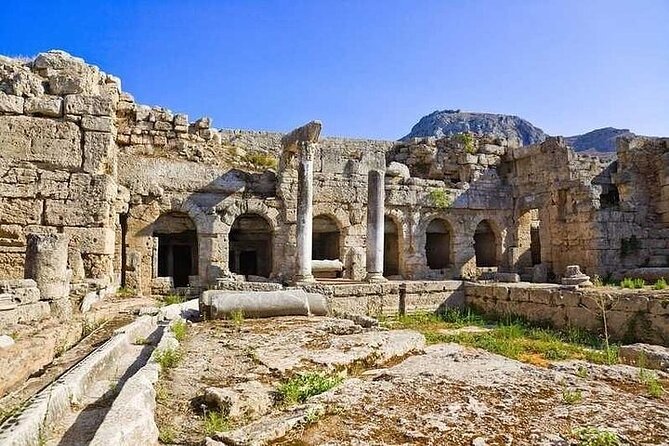
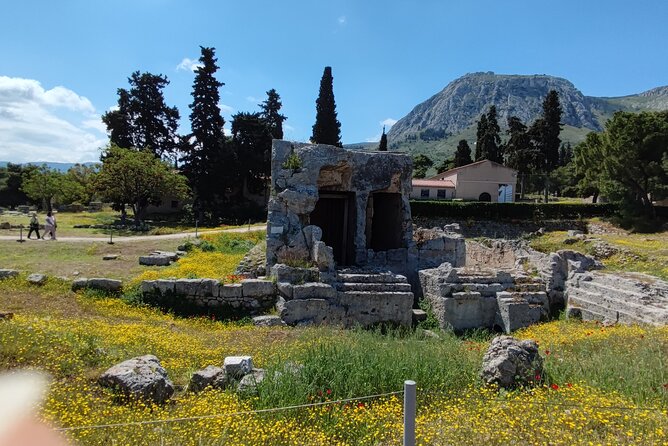
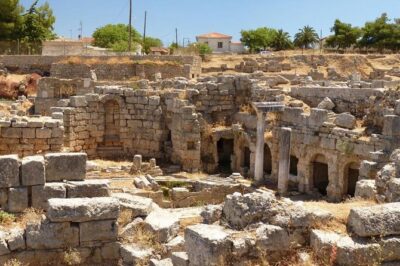
Then comes Ancient Corinth (Archaia Korinthos), where you get a full hour. Admission is listed as not included, and this is typically the portion people save their energy for. This is also where the Christianity and history themes fuse most visibly, because the city-state setting and Paul’s connections are central.
The tour description gives you major timeline anchors. Corinth was a large and important Greek city, with a population mentioned as 90,000 in 400 BC. Romans destroyed the city in 146 BC, then built a new city in 44 BC, later making it the provincial capital of Greece. These are big shifts, and seeing them as you walk helps the place make sense as more than a collection of ruins.
What I like here is the mix of “what you see” and “why it matters.” You are not just staring at stones. You are guided to understand Corinth as a node in the ancient world, not an isolated postcard.
One planning consideration, based on what you might experience: the site can be closed on some days due to filming and safety reasons. That kind of closure can happen because major productions require controlled access. If you are booking around a specific travel window, I suggest asking the operator or confirming the day-of plan so you know what is open.
Museum of Corinth and Temple of Apollo: the classics at ground level
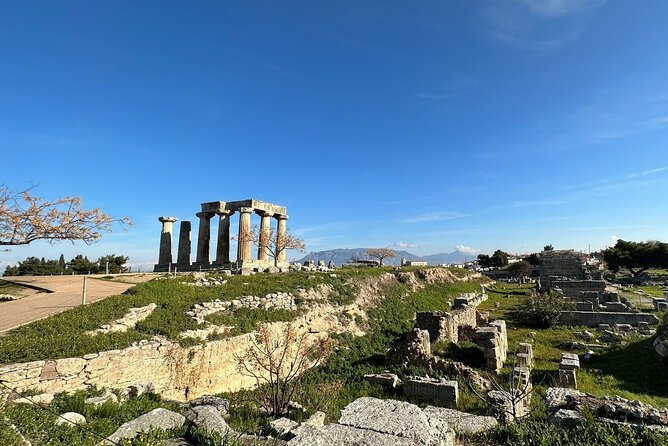
After Ancient Corinth, the route includes the Archaeological Museum of Corinth for about 30 minutes. Admission is listed as not included. The museum is described as constructed between 1931 and 1932, aimed at displaying archaeological excavations, and it sits within the archaeological site.
While you are there, you also get context for the larger complex around you. The data calls out the Hadgimoustafa spring, the Lechaion Road, the Basilica, the Fountain of Peirene, a Stoa, the Agora, and the Odeion. Even if you do not have time to absorb everything in one visit, hearing the names helps you read the site like a map instead of a maze.
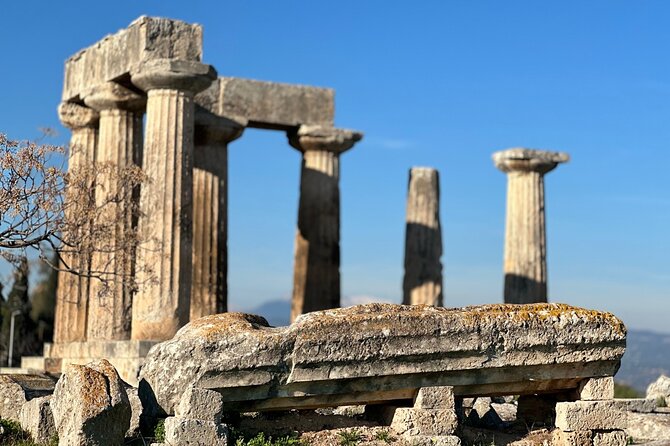
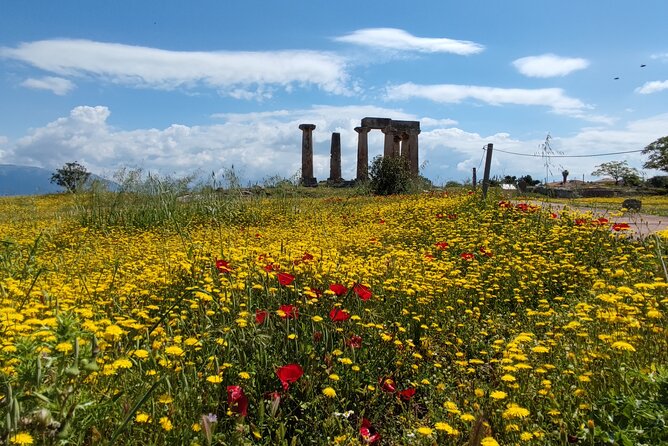
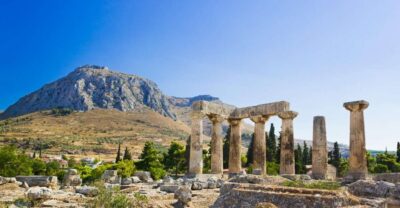
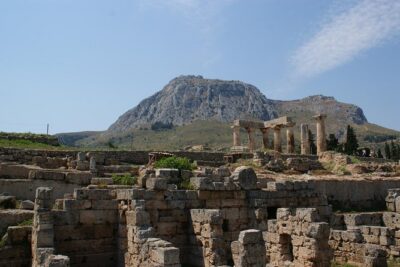
Then you visit the Temple of Apollo, constructed in 550 BC. The tour description notes it as one of the earlier Doric temples in the Peloponnese and on the Greek mainland, with monolithic columns that are rare. If you have seen other Doric temples, you will recognize the style, but the “monolithic columns” detail is a good one to keep in mind as you look.
The stop time is about 15 minutes, so treat it as a focused look rather than a long architectural lecture.
Lunch and shopping break near the ruins
You get free time for lunch and shopping for about 45 minutes. The lunch stop costs are not included. This break is useful because the day is dense, and you do not want to burn time deciding where to eat while you are also trying to keep up with the itinerary.
Here is the practical move: if you plan to do any add-on tasting later, keep your meal light enough to enjoy it. If you do not plan tasting, this is the moment to fuel up and slow down.
Since the ancient areas can be hot and walk-heavy, I also suggest you treat the bottled water from the van as part of your day plan, and then buy extra water if you run low during the site portion.
Acrocorinth: fortress views that make the whole route click
If there is one stop that feels like a reward, it is Acrocorinth. This is the “Upper Corinth” acropolis, a monolithic rock overlooking the ancient city. The description emphasizes why it was repeatedly used as a last line of defense in southern Greece because it controlled the Isthmus and could repel entry by land into the Peloponnese.
You get about 30 minutes here. That is not a full summit hike, but it is enough time to take in the scale and understand why this place could be held even when other parts of the city were lost.
For me, Acrocorinth is the stop that stitches the day together. Corinth Canal and diolkos tell you about moving ships and goods. Isthmia tells you about moving people for public events. Acrocorinth tells you what happens when someone wants to control the land route that makes those movements possible.
This is where I would spend extra attention on your photos. Even on a short stop, the view helps you orient yourself for everything you saw below.
Wine and oil tasting add-ons: worth it, but watch the totals
This tour is themed around “Taste Faith & History,” but the tastings are listed as add-ons, not included in the base price.
- Oil tasting (finger food) is listed at €80 per person.
- Wine tasting is listed at €15 per person.
So you should think of the $190.46 price as covering the core guiding and transportation, while the tastings are optional extras you choose based on your budget and your interest in food. Oil tasting at €80 is a meaningful upgrade. If you love olive oil culture and want a structured tasting experience, it can be a memorable cap to the day. If you are mainly here for Paul and the ruins, you might prefer to keep that €80 for another meal or another day trip.
Either way, check what you are paying for at booking, since the add-on pricing is separate, and entrance fees are also not included.
Price and value: how $190.46 can be a deal or not
At $190.46 per person, the base price can be good value if you care about comfort and context. You are paying for private pickup and drop-off in Athens, transportation in a modern vehicle with WiFi, A/C, and bottled water, plus an English-speaking driver who explains the sites.
What is not included is where the cost can surprise people:
- Entrance fees for attractions are listed as €15 per person, and the archaeological site of Ancient Corinth is also listed as €15 per person.
- The oil tasting and wine tasting have their own fees.
- A licensed tour guide is optional, at an extra cost of €140 per person.
- Meals are not included.
If you compare this to a standard bus excursion, the big difference is control. With a small group, you get more flexibility for photo stops and pacing. In the feedback, drivers like Panos and Periklis were praised for stopping for food and pictures and for recommending lunch spots, plus for answering questions during the drive.
The main value question is simple: are you the type who will take tastings and museum time seriously? If yes, your total spend rises, but the day feels richer. If not, you can still get a strong ancient and Bible-focused day without the add-ons.
Who this Corinth day trip fits best
This is a great match for you if:
- You want a Bible and ancient world day in one route, with Paul linked to the games and the Corinth site central to the story.
- You like engineering history as much as temples, so Corinth Canal and diolkos are not filler.
- You prefer a small-group private van over crowds and rushed listening sessions.
It may be less ideal if:
- You are very tight on budget, because entrance fees plus possible tastings can add up.
- You need guaranteed access to specific sites on a specific day. Occasional closures due to filming and safety can affect the main Ancient Corinth stop.
Should you book this tour?
I think you should book it if you want a guided Corinth day with comfort, a strong Bible connection, and real context for why the place mattered. The combination of canal engineering, Isthmian games and Paul, museum objects, and Acrocorinth fortress views gives the day shape, not just stops.
Before you pay, do two checks. First, add up the real total if you want both tastings, and compare it to your food budget. Second, confirm what the main Ancient Corinth stop will be doing on your travel day, since closures can happen for filming and safety.
If those two boxes work for you, this is an efficient way to turn one day in Athens into a very satisfying Corinth story.
FAQ
What is the duration of the tour?
The tour duration is approximately 5 hours.
Is pickup and drop-off in Athens included?
Yes. Pickup and drop-off are offered, including from Athens hotel, Airbnb residence, or the Port. The driver waits in the lobby or at the building entrance.
How large is the group?
This is a small-group tour where only your group participates, using a luxury mini-van with capacity up to 7 people.
What language is the tour offered in?
The tour is offered in English.
Are entrance fees included?
No. Entrance fees are listed as €15.00 per person, and the archaeological site of Ancient Corinth is also listed as €15.00 per person.
Are wine and oil tastings included in the price?
No. Oil tasting (finger food) is listed as €80.00 per person, and wine tasting is listed as €15.00 per person.
More Historical Tours in Athens
More Food & Drink Experiences in Athens



More Tour Reviews in Athens
- All Day Cruise -3 Islands to Agistri,Moni, Aegina with lunch and drinks included
★ 5.0 · 4,958 reviews


Not for you? Here's more nearby things to do in Athens we have reviewed





Corinth Day Trips from Athens, compared.
 ★ 4.6From Athens: Ancient Corinth Day Trip with Canal & VR GuideFrom $411,073 reviews
 ★ 5.0Private Biblical Tour Ancient Corinth & Isthmus Canal from AthensFrom $301762 reviews
 ★ 4.8Ancient Corinth & Nafplio Full Day Trip with SwimFrom $44523 reviews
 ★ 5.0Private Tour of Apostle Paul’s Footsteps in Ancient CorinthFrom $169275 reviews
 ★ 4.5Corinth Half-Day Trip from Athens with Entrance TicketsFrom $91242 reviews
 ★ 4.7Ancient Corinth & Nafplion Guided Premium TourFrom $34237 reviews
 ★ 4.4Corinth Canal, Mycenae and Nafplio Day TourFrom $33233 reviews
 ★ 4.6From Athens: Ancient Corinth Tour Official Guide & TicketsFrom $86208 reviews
Browse the lists this tour appears in