
Reviewed · ATHENS PRIVATE TOURS
Biblical Ancient Corinth Canal Epidaurus Nafplio Private Tour
A day that feels like three ancient worlds. This private tour strings together Corinth, Epidaurus, and the seaside old town of Nafplio with an air-conditioned ride and a driver who explains the big stories along the way. You start with the Corinth Canal, then move into ancient Corinth’s ruins and museums, and end in Nafplio’s fortresses, views, and harbor photos.
Two things I like a lot: the schedule is built for variety (big ruins plus town time), and the experience is truly private, so your driver can slow down when it matters, or adjust when you want more time in a place. One consideration is that several sites and museums have extra entrance fees and the tour does not include a licensed guide inside the archaeological areas, so you may want to plan for that if you want deep, site-specific explanations while you walk.
Key highlights that make this day work
- Private pacing for groups from 1 to 7, with sedan or mini van comfort and A/C
- Corinth Canal context that explains the centuries-long dream, not just the photo spot
- Ancient Corinth stops that connect Paul’s world, Roman rebuilding, and key architecture
- Epidaurus for real spectacle: the amphitheatre acoustics and the medicine sanctuary vibe
- Nafplio time for lunch, cafés, and classic viewpoints without feeling like a rush-job
- Fortress views at Palamidi with a step-count reality check and great harbor shots at Bourtzi
A full Argolis day: why Corinth, Epidaurus, and Nafplio fit together
This route makes sense if you like your Greece in layers. You begin with a piece of engineering history at the Corinth Canal, move into ancient city life at Corinth, and then shift to Epidaurus, where people came for performance and healing. Finally, you land in Nafplio, a town that feels lived-in, with Venetian-era defenses and postcard views.
What helps is that the experience is built around a comfortable drive. You are not swapping buses or timing multiple tickets. You’ll have WiFi in the vehicle, bottled water, and A/C, which matters because this region can be hot, and you do spend stretches outdoors.
The day is long. You’re looking at roughly 8 hours 30 minutes overall. So I’d treat this as a one-day sampler with the option to customize. If you’re the type who wants to linger, the private format helps, and people have pointed out that their guides didn’t rush them.
You can also read our reviews of more private tours in Athens


Corinth Canal: the shortcut fantasy that took 2,000 years
Stop one is a small stop in time, but it sets up the whole day. The Corinth Canal slices across the narrow isthmus that links Greece’s mainland to the Peloponnese. It’s the kind of place where, from one viewpoint, you get that island-feeling: the mainland and peninsula feel separated by water.
The best part is the story behind it. The canal was executed in the late 19th century, but the dream goes back about 2,000 years. Before the canal existed, ships that wanted to cross between the Aegean and routes toward the Adriatic had to circle the Peloponnese, adding roughly 185 nautical miles. That’s the kind of detail that turns a quick photo stop into an actual “aha” moment.
You also learn the technical workaround credited to Periander, the tyrant of Corinth around 602 BC. Since digging a canal was beyond the engineering of the time, he supported an idea called the diolkos, a stone road where ships could be transferred on wheeled platforms. It’s a reminder that Greeks solved logistics problems long before modern steel and cranes.
This stop is marked as free on the itinerary, and it only takes about 20 minutes. That makes it a good warm-up before you switch gears into ruins.
Ancient Corinth, the museum, and Paul’s Corinth: where one city keeps changing
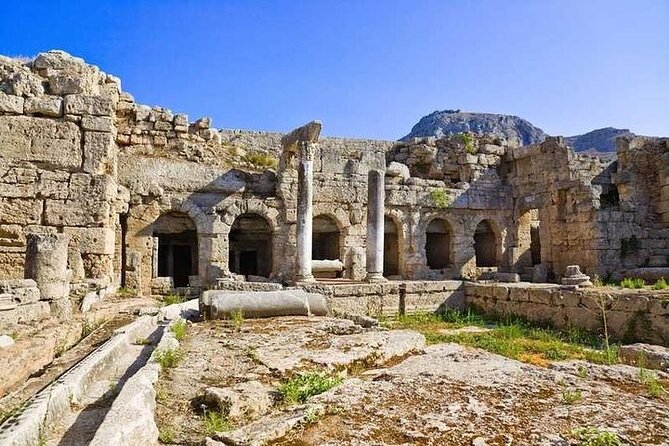
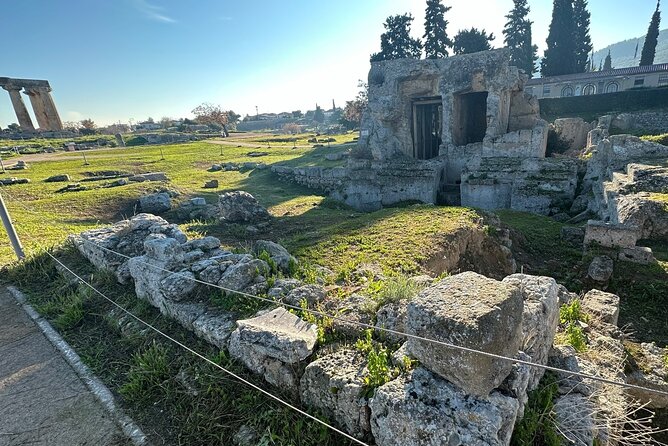
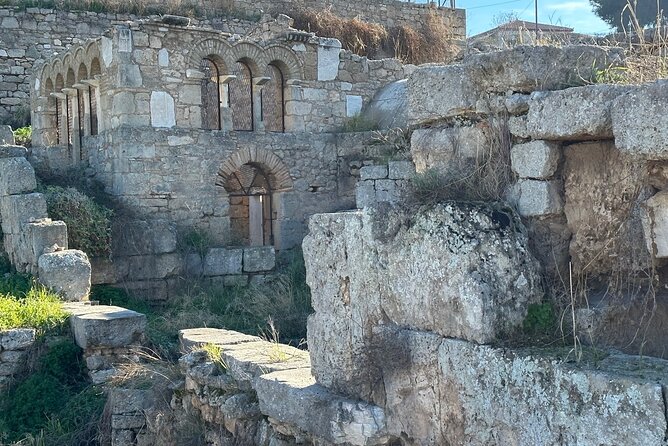
Ancient Corinth (Archaia Korinthos) is the “big one” for history lovers, and it hits two strong themes: city power and religious memory. Corinth was a major city-state on the isthmus, roughly halfway between Athens and Sparta. It’s the kind of location that mattered because geography mattered.
From a Christian-history angle, Corinth shows up in the New Testament through Saint Paul’s letters to the Corinthians and in Acts as part of Paul’s missionary travel. Pausanias also devoted major attention to Corinth later on. Even if you’re not thinking about Paul, it helps you understand why this place keeps getting revisited in books and stories.
The other theme is scale and continuity. Ancient Corinth was one of Greece’s largest cities, and the numbers given here suggest about 90,000 people around 400 BC. Then the Romans demolished Corinth in 146 BC, rebuilt it in 44 BC, and later made it a provincial capital. So you’re not looking at one “snapshot.” You’re looking at a city that kept getting remade.
Archaeological Museum of Corinth: excavations brought into the open
The Archaeological Museum of Corinth sits within the ancient site area, and it was constructed in 1931 to 1932 to display finds from excavations. The museum is under the jurisdiction of the Greek Archaeological Service, which helps explain why it feels organized and anchored to the site.
Time is tight here at about 40 minutes, so you won’t have time to read every label line-by-line. What you can do instead is focus on the museum’s anchor features tied to the site, like the Hadgimoustafa spring, the Lechaion Road, and big complexes such as the Basilica and the Fountain of Peirene. If you like architecture, you’ll also appreciate the way the museum helps you visualize the Agora, Stoa areas, the Theatre, and the Odien.
Temple of Apollo and the early Doric vibe
You then hit the Temple of Apollo, constructed around 550 BC. This stop is short at about 10 minutes, but it’s positioned as one of the earlier Doric temples in the Peloponnese and Greek mainland. The monolithic columns concept and rarity in the ancient world are the kind of detail your driver can point out as you look around.
- All Day Cruise -3 Islands to Agistri,Moni, Aegina with lunch and drinks included
★ 5.0 · 4,958 reviews



A practical tip for Corinth time
Wear shoes you trust on uneven ground. You’ll be walking in ancient-site terrain, and shade can be limited depending on where you stop. I’d bring sunscreen even if the forecast says mild, because you’ll still feel that heat while moving between stops.
Acrocorinth (Upper Corinth): fortress energy and the view factor
Acrocorinth, also called Upper Corinth, is the acropolis perched on a monolithic rock above the city. You get it for about 30 minutes, and the time is enough to feel the fortress logic.
The big idea: the fortress had a secure water supply and acted as a last line of defense for southern Greece. It controlled the Isthmus of Corinth, so it could repel enemies before they even moved into the Peloponnese.
From a visitor standpoint, this stop delivers in two ways. First, it helps you understand why Corinth mattered so much. Second, it offers big views that make the geography feel real. You’re not just reading about an isthmus anymore. You can see why someone would fight to control it.
The drawback is that short time plus fortress terrain can feel like a quick scan. If you’re into climbing and slow photography, ask your driver if you can add a few minutes. The private format is the reason to do that.
Epidaurus: amphitheatre acoustics, medicine myth, and museum context
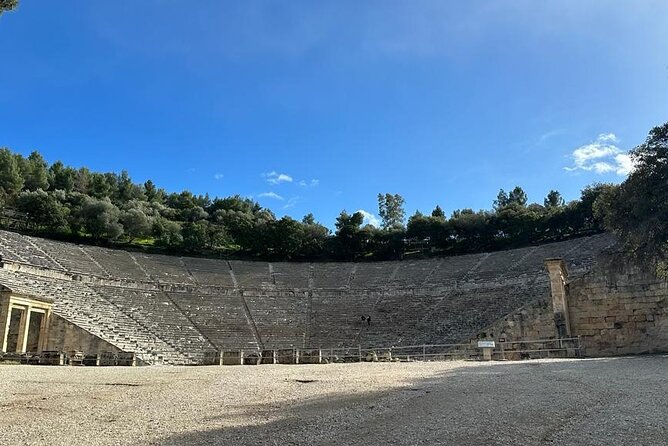
Epidaurus is the most “wow” stop on the day for many people, mainly because it’s a theatre first and a healing sanctuary second. The amphitheatre is described as classic Greek construction with astounding acoustics. You even get the memorable idea of dropping a pin or coin on the stage and hearing it from the last seats. That’s not the kind of thing you get from a typical ruin stop.
The itinerary gives you about 1 hour at the Epidaurus area, and it also references the Asclepius sanctuary and museum context in this broader stop. Even without getting stuck in technical details, the tone here is different. People came to Epidaurus not just to watch, but to be part of a ritual experience tied to performance and medicine.
Asklepios sanctuary: rival cult energy
The sanctuary dedicated to Asclepius is presented as a major holy site, rivaling other cult centers like Olympia and Delphi. The temple is described as built in the early 4th century BC. There’s also a note about how, if worship continued until the 4th century AD, later Roman-era persecution of non-Christian worship could have shut things down when Christian emperors issued edicts.
I like this part because it gives you the “why” behind the ruins. You’re not just seeing stone. You’re seeing a place designed around belief, health, and hope.
This stop is about 15 minutes. It’s short, but it’s enough to get oriented and appreciate the location’s purpose.
Epidaurus Archaeological Museum: reconstructions and inscriptions
Next is the Epidaurus Archaeological Museum for about 30 minutes. It’s established around 1902 and opened in 1909, with the mission of displaying artifacts unearthed at the site. What the description emphasizes is that the museum includes reconstructions of temples and columns with inscriptions.
That matters if you’re the type who likes to understand what you’re looking at outdoors. A quick museum stop can turn a “cool theatre” moment into a more complete story about the sanctuary complex.
Nafplio free time: lunch, cafés, and old-town wandering with a plan
After Epidaurus, you get to Nafplio with free time built in. This is where the day stops feeling like an exam review and becomes a real break. You’ll have about 1 hour for lunch coffee shopping.
Nafplio is a seaport town in the Peloponnese, built up along the hillsides near the north end of the Argolic Gulf. It’s been important across medieval periods, associated with the lordship of Argos and Nauplia. It also served as capital during the First Hellenic Republic and later during the Kingdom of Greece at the start of the Greek Revolution.
So you’re not just wandering a pretty harbor. You’re in a town with a political story.
The Lion of the Bavarians: history with local bite
Near Michael Iatrou Street, you’ll see the Lion of the Bavarians. It’s carved into rock above the street, with a small park under it. It was designed by German sculptor Christian Ziegel, commissioned by King Louis (father of Otto), in memory of Bavarian soldiers who died in Nafplio in 1833 from a typhoid epidemic.
The local twist here is the kind of street-level myth that often comes with monuments. Locals say those soldiers didn’t just die from the illness, they died from bitter things they ate, hence the unofficial name tied to that idea. I’d treat that as local folklore, not a medical journal, but it makes the monument feel human.
Palamidi Castle: the steps are real, but the views are worth it
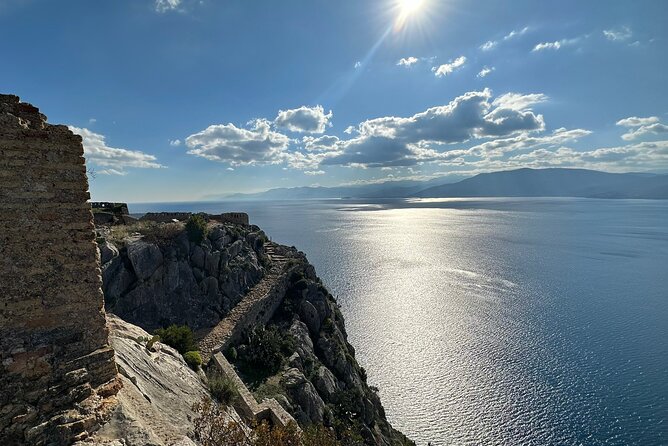
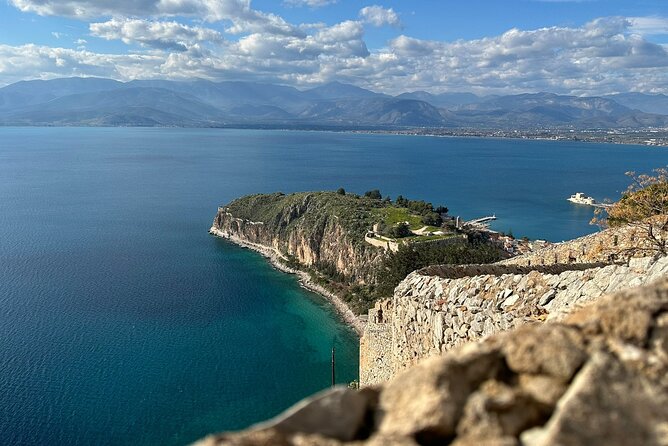
Palamidi Castle is one of Greece’s best-preserved castles, and it’s structured for dramatic views. You get about 30 minutes here, and that’s enough to appreciate the scale without turning it into a long hike day.
Palamidi sits on a hill about 216 meters high. The Venetians built it during their second occupation (1686 to 1715). It also includes the story of the Kolokotronis prison hole, which gives the place a darker edge than some other viewpoints.
The step-count reality check
The route includes the winding stair from town to fortress, described as 913 steps, with a local saying that it’s over 1,000 and sometimes told as 999. Either way, you should plan for real stairs.
If you have mobility limits or you just hate stairs, you’ll need to be honest with your driver before you head up. Ask about pace and what you can skip.
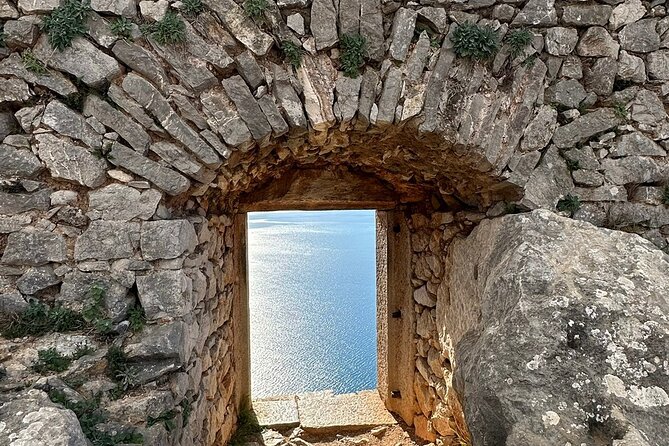
Fortress loopholes and photo timing
Even in 30 minutes, you’ll likely find good angles over Nafplio and the Argolic Gulf. This is a great “end of day payoff” stop, because the light in late morning or afternoon tends to flatter stone and water.
Bourtzi: quick harbor photos from the right side
Bourtzi is a Venetian castle in the middle of the harbor, and you get about 10 minutes for it. This is a short stop, but it’s designed for photos, especially from the harbor side.
If you care about pictures, this is one of those moments where you should take a few minutes to step around for angles. A quick shot checklist helps here: one wider view, one water-forward frame, and one where you include a landmark from the Nafplio side.
Price and value: what you’re paying for, and what you still need to budget
The price is listed at $240.93 per person, and it includes a lot of practical comfort and coordination. You get a fully private tour, pickup and drop-off from Athens hotels, Airbnb residences, or ports (and the program notes pickup time can be adjusted). Transportation is in a modern first-class private vehicle with WiFi, A/C, and bottled water. Fuel and tolls are included.
What you’re not getting is “all-in admissions.” Entrances are not included for several sites, including Ancient Corinth (listed as €15 per person), Palamidi Castle (listed as €20 per person), and the Archaeological Site of Epidaurus (listed as €20 per person). Other museums are listed as not included, even when amounts are not specified.
So value depends on how you travel. If you’d otherwise rent a car or pay for separate transport plus entrance fees, the private ride and sequencing start to look like good math. If you already planned to visit these places with a guide and pay multiple admissions anyway, you’ll likely feel the value more clearly.
My rule of thumb: treat this as a “transport and timing” package with curated stops. The driver helps you manage a long day. If you want deeper interpretation in every site, you may need to add licensed guidance on location, since a licensed guide to accompany you into archaeological sites is not included.
Comfort, flexibility, and the human factor that makes the difference
This tour format is private, and the reviews tied to this experience put a spotlight on driver quality. Names that come up include Giannis, Themos, and Chris.
What matters most is that these drivers are described as careful and flexible. People mention that they can make changes if you want to shift the day around your interests. That’s a big deal in a long itinerary, because the difference between a “good day” and a “great day” is often just having time where you want it and skipping rushed moments.
Air-conditioned transport is also not a small detail here. It’s one of the reasons the tour works even when it’s hot. You’ll have water, WiFi, and built-in breaks, including the free lunch and coffee period in Nafplio.
If you’re traveling with teens, older relatives, or mixed interests, this private structure can be a big win. One person can focus on ruins and the next person can drift toward cafés and shade breaks.
Who should book this private Corinth, Epidaurus, and Nafplio day
This is a great fit if you want to hit multiple major ancient sites plus a real town without juggling tickets or transfers. It’s also ideal if you value comfort and a driver who can explain the context while you travel between stops.
Book it if:
- You want a single-day route that connects engineering, ancient city life, and a theatre and healing sanctuary.
- You like the idea of choosing your pace within reason, and you’re okay paying extra for some sites.
- You’d rather spend money on a good vehicle and guidance than on stress.
You might choose a different option if:
- You want a full licensed guide in every archaeological area. This tour provides an English-speaking driver with historical knowledge, but it does not include a licensed guide to accompany you into sites.
- You know you cannot handle stairs. Palamidi is the main concern, since the climb involves about 913 steps to the fortress.
Should you book this tour?
I’d book it if your goal is a smooth, private day that covers the big hitters: Corinth Canal, ancient Corinth, Epidaurus, and Nafplio with its fortress viewpoints. The comfort features and the private format make this feel more manageable than trying to stitch the same route together yourself.
If you do book, plan for entrance fees and bring sensible walking gear. If you want deeper explanations while you’re standing inside the ruins, consider arranging a licensed guide at key sites. Done with that mindset, this is the kind of day that gives you ancient stories and real town atmosphere in one go.
FAQ
FAQ
Is this tour private?
Yes. It is a fully private tour, meaning only your group participates.
What does the tour include for transportation?
Pickup and drop-off are included, along with transportation in a modern first-class private vehicle. The car includes WiFi, A/C, and bottled water, and fuel and tolls are covered.
How long is the tour?
The duration is approximately 8 hours 30 minutes.
Do I need to pay entrance fees?
Several entrances are not included. Ancient Corinth (listed at €15 per person), Palamidi Castle (listed at €20 per person), and the Archaeological Site of Epidaurus (listed at €20 per person) are specifically noted as paid separately. Other museums are also marked as not included.
Where can the pickup happen?
Pickup is offered from Athens hotel lobbies, Airbnb building entrances, and also from ports. The description also notes optional airport pick-up is available at an additional cost.
What language is the tour conducted in?
The tour is offered in English.
Is there child or infant seating available?
Car seats are available if you book in advance and need infant or child seats.
What if weather is bad?
The experience requires good weather. If it is canceled due to poor weather, you will be offered a different date or a full refund.
More Private Tours in Athens


More Tours in Athens


More Tour Reviews in Athens
- All Day Cruise -3 Islands to Agistri,Moni, Aegina with lunch and drinks included
★ 5.0 · 4,958 reviews
Not for you? Here's more nearby things to do in Athens we have reviewed







Athens Private Tours, compared.
 ★ 5.0Best of Athens Half Day Private TourFrom $913,714 reviews
 ★ 5.0Athens Full Day Private TourFrom $2442,903 reviews
 ★ 5.0Athens Greece Full Day private tourFrom $683785 reviews
 ★ 5.04 Hours – Athens & Acropolis Highlights Private TourFrom $181681 reviews
★ 5.0Athens Full Day Private TourFrom $205667 reviews
★ 5.04 Hours – Athens & Acropolis Highlights Private TourFrom $181681 reviews
★ 5.0Athens Full Day Private TourFrom $205667 reviews
 ★ 5.0Lake Vouliagmeni Thermal Spa And Temple Of Poseidon Private Full Day TourFrom $171578 reviews
 ★ 5.0Acropolis and Acropolis Museum Private Tour with Licensed ExpertFrom $188445 reviews
 ★ 5.0Athens Highlights Half Day Private TourFrom $305407 reviews
Browse the lists this tour appears in