
One day, three ancient worlds. This private route from Athens packs in the Corinth Canal, ancient Corinth, and Mycenae without you juggling rentals, maps, and traffic.
I like this format because you spend daylight on the ruins, not stuck behind a steering wheel. You also get onboard Wi-Fi, plus bottled water and refreshing wipes, which matters when your day is mostly sitting in a car and then walking on stones.
The main trade-off is simple: entrance fees and museum tickets are not included, and the day ends with the Mycenae sites. If you love to linger at the earlier stops, you may want to plan your time so you still get to everything in Mycenae.
Key highlights worth your attention
- Private door-to-door pickup in Athens so you start the day without logistics stress
- Corinth Canal plus Ancient Diolkos in one stop, with time to take photos and understand the engineering idea
- Acrocorinth fortress views over the region, including traces of the Temple of Aphrodite and the Frankish Tower
- Ancient Corinth’s big moments: Temple of Apollo, the Agora, Roman buildings, and the Bema tied to Apostle Paul
- Mycenae’s iconic set pieces: Lion Gate, Cyclopean Walls, Treasury of Atreus, and gold-rich museum collections
- Driver flexibility that helps you control how long you spend at each location
Why this Corinth and Mycenae day trip works so well
If you are short on time in Athens, this tour is one of the most practical ways to reach the deep ancient sites around the Corinthian Gulf. The big win is pacing. You see major highlights of Corinth and Mycenae in a single long day, with a private driver doing the driving and navigation.
I also like that the itinerary builds connections across stops. The day starts with the isthmus itself, then moves up to Acrocorinth, drops into Corinth’s archaeological core, and finally lands in Mycenae’s Bronze Age world. Even if you are not a trivia machine, you start to feel how geography shaped trade, power, and settlement.
One more thing I appreciate: this is built around a private vehicle and your time. You are not fighting for position in a packed bus line. And because the driver provides the context, you get a clearer idea of why each location matters.
You can also read our reviews of more private tours in Athens


Getting picked up in Athens, then staying comfortable all day
The tour begins with pickup from your chosen Athens hotel, Airbnb, or apartment. You meet your driver at the lobby. If you are in an Airbnb, the driver contacts you after arrival so you can meet at the entrance of the building.
Once you are on the road, you get transportation by a private first-class vehicle with Wi-Fi onboard. Bottled water and refreshing wipes are included, which sounds small until you are on a long drive and the day gets warm. The tour is also offered in English, and the drivers are described as fluent in English and multi-lingual.
Practical tip: if you have your own must-do photos, tell the driver early. A flexible driver can usually help you time stops better, and you will feel less rushed later.
Corinth Canal and the Ancient Diolkos: the engineering stop you will remember
This is not just a quick look at a modern landmark. You visit the Corinth Canal, described as an important 19th-century engineering project with a catalytic role for Mediterranean trade. It is a strong opener because it reminds you that ancient geography and modern infrastructure are both about moving people and goods.
Then you continue to Ancient Diolkos, a paved trackway in ancient Greece used to move boats overland across the isthmus. That detail makes the canal more understandable. You are seeing two different solutions to the same geographic challenge: how to bypass the rougher route around the peninsula.
You get about 45 minutes here. Admission is marked as free for this stop area, so your time is more about walking, photos, and context than paperwork.
If you like the idea of trade routes and the practical side of history, this is one of the most satisfying stops of the day.
Acrocorinth: gates, towers, and a hilltop that dominates the region
Next comes Acrocorinth, the acropolis of ancient Corinth. The feel here is about scale. You are looking at a monolithic rock that overlooks the ancient city, and the fortress layout is tied to the way the site was defended.
You get about 1 hour, with admission marked free. The standout features listed for this stop include:
- A system of circuit walls reinforced by towers
- Traces of the Temple of Aphrodite on one of the mountain peaks
- The Frankish Tower at the southwest edge, part of fortifications from Frankish times
- Preserved remains of churches, mosques, houses, fountains, and cisterns
What I like about Acrocorinth is that it is not a single-layer “ancient only” experience. You can see how different eras left marks on the same commanding hill. That makes the ruins feel lived-in, even when they are quiet.
Practical consideration: since this is a fortress site, you will likely do more uneven-surface walking than at flat museums. Plan for comfortable shoes and slow pacing if you prefer not to rush.
Upper Peirene Fountain and Geraneia viewpoints: short stops that reset your eyes
After the big fortress, the day adds two smaller breaks, and they matter. They give you a change of pace before the heavy hitters of Ancient Corinth.
Upper Peirene Fountain is described as the Peirene Spring located within the encircling walls, a gift of Asopus to Sisyphus. It is short, about 15 minutes, and marked free. Even with limited time, these myth-and-place details help your brain attach stories to specific locations instead of just seeing stones.
Then you have Geraneia, a viewpoint stop focused on views of Geraneia Mountain with sightlines across the Corinthian Gulf and the southwest coast of the Peloponnese. Again, about 15 minutes and free. These viewpoints are a smart use of time because they show you the terrain that later settlements had to deal with.
If your legs feel heavy at that point, these quick stops are also a gentle reset.
- All Day Cruise -3 Islands to Agistri,Moni, Aegina with lunch and drinks included
★ 5.0 · 4,958 reviews



Ancient Corinth: Apollo, the Agora, and the Bema tied to Apostle Paul
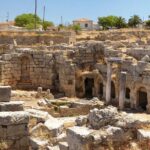
This is the main archaeological portion of the day, with about 3 hours at Ancient Corinth. Admission is marked as not included, which is a key part of planning your total budget.
The highlights here are stacked:
- Hadgimoustafa spring, a fountain built during the Ottoman empire
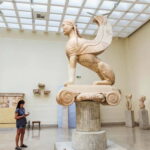
- The Ancient Corinth Archaeological Museum, with artifacts from the local site and nearby areas
- Temple of Apollo, described as one of the earliest Doric temples in the Peloponnese and mainland Greece, with monolithic columns, built around 560 BCE
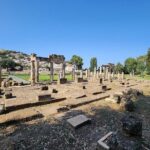
- The Agora, a rectangular space about 160 m by 70 m, with central shops, small temples, altar areas, and the Bema or podium where Apostle Paul addressed the Corinthians in 52 AD
- Roman buildings
- Theatre and Odeon/Asklepieion
- Lechaion road, facing the Corinthian Gulf and leading to the port of Lechaion
- St. Paul’s church, with a mosaic mural depicting Saul’s vision from Christ as he traveled to Damascus
I love how this combines religion, civic life, and travel routes in one area. The Agora and the Bema are especially helpful if you want a more human scale to the site. You can picture gatherings, speeches, and daily movement instead of just monumental architecture.
St. Paul’s church is also worth paying attention to because it connects the ancient city to later Christian storytelling. If you are the type who likes to understand how places keep meaning over time, this part will click.
Practical timing tip: because the stop is long, decide early whether you care more about the Temple of Apollo and the main ruins, or you want to allocate more time to the museum. Either choice is valid, but it changes how you feel after the 3-hour mark.
Lunch with a view, then Corinth village for souvenirs
Right in the middle of Ancient Corinth time, you get a “village style” lunch on a terrace overlooking the archaeological site and Temple of Apollo. Food and drinks are not included, but this is clearly built into the experience rhythm, so you are not stuck searching for lunch while hungry and overheated.
This terrace lunch matters more than people think. When a day is mostly ancient ruins, a pause with a view helps you absorb what you just saw. It also gives you a chance to cool down before the next drive.
After Ancient Corinth, you shift to Corinth town for about 1 hour. The focus here is strolling the village shops and buying handmade souvenirs. Admission is marked free, so this is not another ticketed time sink. It is the nice “human scale” ending to the day’s archaeology.
Mycenae: Grave Circles, Cyclopean Walls, and the Royal Palace core
Then the trip moves to Mycenae. You drive there, about 40 minutes, and entry at this stage is marked free for the transfer portion.
The Mycenae archaeological site portion is where you start seeing the classic Bronze Age icons. The time blocks you get are relatively short for each element, which is why your driver’s ability to manage pace is so important.
Key stops and what they mean:
- Grave Circles A and B, described as royal cemeteries south of the Lion Gate and outside the Bronze Age citadel
- Cyclopean Walls, made of huge limestone boulders, tied to the mythical Cyclopes strength story
- The Royal Palace, including domestic apartments, the Throne Room Suite, the Grand Staircase, officer or palace official rooms, and the Forecourt
This part is all about power and permanence. The walls and tombs are not subtle. You see investment in defense and status. And because the Royal Palace is described with specific sections like the Throne Room Suite and Grand Staircase, you have landmarks inside the ruin instead of an empty feeling.
One planning note: one person who did this route found they ran out of time to complete the Mycenae portion. That is a sign to keep your priorities straight. If Mycenae is your top goal, try not to let the earlier free stops steal too much time.
Lion Gate and the Tholos tombs: Treasury of Atreus and Clytemnestra
Next you visit Lion Gate, the main entrance of the Bronze Age citadel of Mycenae, erected during the 13th century BC. Time is about 15 minutes, and admission is marked not included.
After that, you move into the Citadel and Treasury of Atreus area:
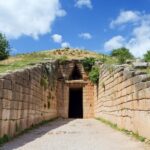
- The Treasury of Atreus is a large tholos or beehive tomb constructed around 1250 BC
- The Tomb of Clytemnestra is another tholos type tomb built around 1250 BC, named after Clytemnestra, wife of King Agamemnon
These sites are brief, but they are dense. When you are at the entrance gate and then moving to tombs, you understand the Bronze Age idea of how leaders represented themselves to the world, even after death.
If you love architecture, tholos tombs are one of those “how did they do that” moments. Just be ready: time here moves fast, and you may want to choose what to zoom in on, like tomb shapes versus the surrounding layout.
The Mycenae museum: gold grave goods and masks that stop you
The last major stop is the Archaeological Museum of Ancient Mycenae, with about 30 minutes and marked not included for admission.
This museum is described as the most important place for Mycenaean artifacts, and it leans hard into the visual shock factor. The items listed include gold grave goods, burial masks, jewelry, weapons, worship idols, and frescoes. If you want the Bronze Age to feel more than ruins, the museum is where your brain upgrades from stones to people and objects.
I also like that the museum is the final anchor. After walking tombs and walls, you get to see the material culture side: what these communities valued, what they buried, and how they expressed beliefs.
Price and value: what you pay for, and what you still need to budget
The price is listed at $299.78 per person for an 8-hour private tour. For many people, that number is less about the sites themselves and more about the full package: private vehicle, pickup and drop-off in Athens, and a driver who provides in-depth knowledge.
What’s included:
- Fully private tour
- Professional tour drivers with in-depth knowledge of Greek history
- Fluent English speaking and multi-lingual drivers
- Hotel or port pickup and drop-off service
- Transportation by private first-class vehicle
- Wi-Fi on board
- Bottled water and refreshing wipes
- Skip-the-line ticket service (on request)
What’s not included:
- Entrance fees to the sites
- Food and drinks
- Tips and gratuities
- A licensed tour guide to accompany guests into sites and museums (available on request)
So the real budgeting question is tickets plus meals. You also need to consider that some admission is not included for the big archaeology and museum portions, and those are exactly the parts you will likely want to see carefully.
Value-wise, I think it makes sense if:
- you do not want car rental stress
- you prefer flexibility in how long you spend at each stop
- you care about context and driver-led explanations
- you are traveling as a small group where a private vehicle still feels reasonable
If you are the type who wants a free-and-easy plan and you already have your own transportation, you might spend less by organizing it yourself. But if you want the day to flow, this price buys you time and ease.
Should you book this private Athens tour?
Book it if you want a structured, private day that covers the main Corinth and Mycenae must-sees without the mental burden of planning drives, parking, and ticket timing. I especially think it works well for people who like the story of the region, from trade routes around the isthmus to Bronze Age power centers like Mycenae.
Skip it or adjust expectations if you are trying to travel ultra-light on budget, since entrance fees and museum tickets are not included. Also, if Mycenae is your top priority, consider guarding your time earlier in the day so you do not run out of steam at the end.
If you do book, my best practical advice is this: wear comfortable shoes, bring some water habits, and tell your driver what you care about most. A good driver can make the same ruins feel like a guided conversation, and this tour is clearly designed around that kind of day-to-day control.
FAQ
How long is the Private Tour of Isthmus Canal, Ancient Corinth & Mycenae from Athens?
It is approximately 8 hours.
What is the price per person?
The price is listed as $299.78 per person.
Is the tour fully private?
Yes. It is a private tour, and only your group participates.
What stops are included in the itinerary?
The tour includes Corinth Canal (with Ancient Diolkos), Acrocorinth, Upper Peirene Fountain, Geraneia, Ancient Corinth (including museum time and major ruins), Corinth town, and Mycenae (including Grave Circles, Lion Gate, Treasury of Atreus and related tombs, and the Mycenae Archaeological Museum).
What is included in the tour price?
Included items are private transportation, professional drivers with English and multi-lingual capability, hotel pickup and drop-off in Athens, Wi-Fi onboard, bottled water and refreshing wipes, and skip-the-line ticket service on request.
Are entrance fees to the sites included?
No. Entrance fees to the sites are not included, and several specific museum and archaeological admissions are also marked not included.
Is a licensed tour guide included inside the museums and sites?
A licensed tour guide to accompany guests into the site and museum is not included, though it is available on request.
Is there food included?
Food and drinks are not included. Lunch is described as a village-style lunch on a terrace overlooking Ancient Corinth, but meals are not listed as included.
Do you get onboard Wi-Fi?
Yes. Wi-Fi is provided on board.
Can I cancel for a full refund?
The experience offers free cancellation, with full refund if you cancel at least 24 hours in advance of the start time.
More Private Tours in Athens


More Tours in Athens


More Tour Reviews in Athens
- All Day Cruise -3 Islands to Agistri,Moni, Aegina with lunch and drinks included
★ 5.0 · 4,958 reviews
Not for you? Here's more nearby things to do in Athens we have reviewed







Athens Private Tours, compared.
 ★ 5.0Best of Athens Half Day Private TourFrom $913,714 reviews
 ★ 5.0Athens Full Day Private TourFrom $2442,903 reviews
 ★ 5.0Athens Greece Full Day private tourFrom $683785 reviews
 ★ 5.04 Hours – Athens & Acropolis Highlights Private TourFrom $181681 reviews
★ 5.0Athens Full Day Private TourFrom $205667 reviews
★ 5.04 Hours – Athens & Acropolis Highlights Private TourFrom $181681 reviews
★ 5.0Athens Full Day Private TourFrom $205667 reviews
 ★ 5.0Lake Vouliagmeni Thermal Spa And Temple Of Poseidon Private Full Day TourFrom $171578 reviews
 ★ 5.0Acropolis and Acropolis Museum Private Tour with Licensed ExpertFrom $188445 reviews
 ★ 5.0Athens Highlights Half Day Private TourFrom $305407 reviews
Browse the lists this tour appears in