
Reviewed · CORINTH DAY TRIPS FROM ATHENS
Full Day Biblical Ancient Corinth Canal Mycenae Epidauvro Nafplio
Corinth, Mycenae, and Nafplio in one day is a big ask, and that is exactly why it works. You get a private driving day with comfortable transport, built around the places connected to Paul, Agamemnon, and Venetian fortresses. I love that the pacing is short and focused at each stop, so you can still enjoy the views without getting stuck in one place all day.
My other favorite part is the practical comfort, WiFi, A/C, bottled water, plus pickup and dropoff in Athens. The one drawback to plan for: you will be doing a lot of site walking and some steep climbs, especially at Palamidi, where the “999 steps” story is real enough to sweat a bit.
Key things that make this day special
- Corinth Canal views plus the 2,000-year dream behind it, including Periander and the diolkos concept
- Biblical Corinth stops tied to Paul, Gallio, and the Bema tradition
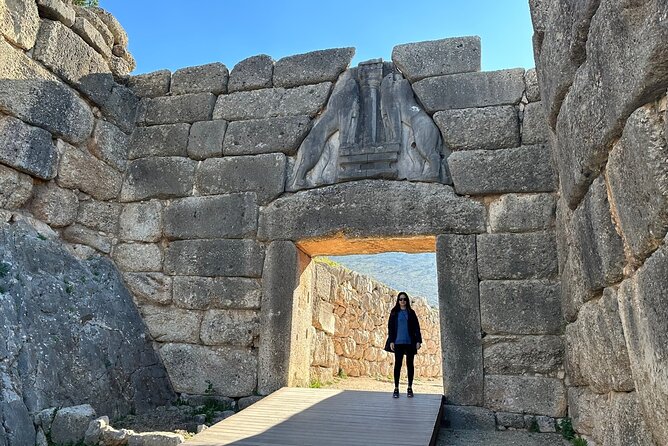
- Mycenae’s Bronze Age power you can see up close, from the Cyclopean walls to Lion Gate
- Treasury of Atreus (Tomb of Agamemnon), a massive tholos with a famous stone lintel
- Nafplio by layers old town strolls, Venetian fortresses, and a sunset-ready fortress on an islet
Value and logistics: what your $277.09 buys
At $277.09 per person for a 9 to 10 hour private day, the value is not in a long buffet of extras. The value is in the essentials: a private vehicle, pickup from wherever you are in Athens (hotel, Airbnb, or port), and a driver who can shape the day to your pace. Add in WiFi, A/C, and bottled water in the car, and it turns a long drive into something that feels manageable rather than punishing.
One important practical note: entrance fees are not included, and meals are only scheduled, not covered. That means you should budget a bit extra once you add museum and site tickets. Also, the tour does not include a licensed guide who walks you into the archaeological sites for interpretation. Your driver is the history-brain of the day, but if you know you want a guide inside every museum space, plan accordingly.
More Athens tours and experiences for the shortlist
- All Day Cruise -3 Islands to Agistri,Moni, Aegina with lunch and drinks included
★ 5.0 · 4,958 reviews
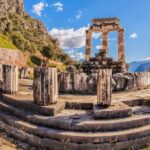

Corinth Canal: a modern cut through an ancient shipping headache
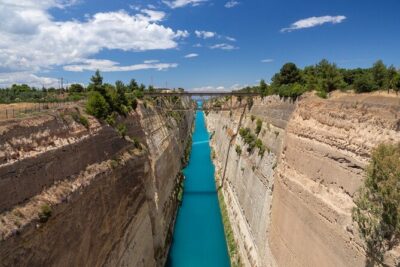
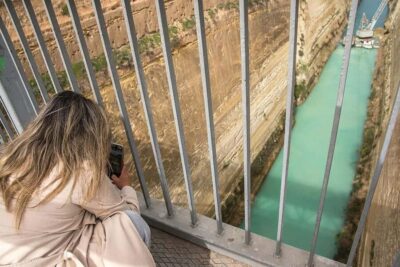
Your day starts with the Corinth Canal, a waterway that crosses the narrow isthmus and links the Gulf of Corinth to the Saronic Gulf. When you see it, the “mainland meets peninsula” geography makes instant sense, because the canal effectively separates Greece’s mainland from the Peloponnese like a giant shortcut.
Here is what I like about this stop: it is not just a photo moment. The canal may have been completed in the late 19th century, but the idea stretches back about 2,000 years. The story includes Periander of Corinth, around 602 BC, and the earlier workaround called the diolkos, a stone road that allowed ships to be moved overland on wheeled platforms. It is a clever reminder that travel problems get solved one way or another, even before modern engineering.
Kenchreai and Acts 18:15: biblical Corinth without the museum crowds
Next comes the Corinthia region stop at Kechries, tied to the ancient port town Kenchreai, also connected to Bible references. The key connection is Acts 18:18, where the Apostle Paul stops at Kenchreai during his second missionary journey. The account mentions Paul having his hair cut to fulfill a vow, likely a Nazirite-style vow.
This stop is brief, so you will not get a slow, interpretive walk. But for the biblical traveler, it is a grounded way to “place” the story geographically. If you care about the New Testament sites, I find even short stops like this worth it because they connect scripture to real terrain, not just names in a book.
Ancient Corinth: Paul before Gallio and the Bema you can still picture
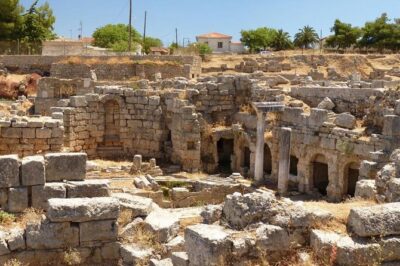
Then you move into Ancient Corinth, where Paul’s legal conflict shows up in the landscape. During Paul’s time in Corinth, tradition ties a hearing before the proconsul Gallio (Lucius Junius Gallio Annaeanus) to the public space known as the Bema. The Bema was an elevated rostrum in the middle of the Roman Forum area, where officials addressed people.
Why this matters is simple: when places are tied to a story you already know, you stop reading passively and start building images. You may also hear that the Bema later took on a Christian role in Byzantine times, which helps explain why the site carries that layered meaning.
Plan your time for this section. Your stops around Ancient Corinth and its museum spaces are short, so you will want to decide what you care about most in advance, Paul and the public court setting, or the architecture of daily civic life.
The museum hour: what you get and what you do not
The Archaeological Museum of Corinth is part of the Ancient Corinth area, with a construction period noted as 1931 to 1932. It exists to display finds from excavations in the region, and the site context includes places like Hadgimoustafa spring, the Lechaion Road, a Basilica, the Fountain of Peirene, the stoa, and the Agora area.
The real question for you is how the museum fits your style. With only about 30 minutes, it works best if you use it as a “fast orientation” tool. You will likely see representative objects and learn the names of key features, but you will not get slow, deep curatorial detail. If you are the type who wants to read every label, you might want more time on your own after the driver drops you.
- All Day Cruise -3 Islands to Agistri,Moni, Aegina with lunch and drinks included
★ 5.0 · 4,958 reviews



Temple of Apollo, Agora, and Acrocorinth: a classic triangle of ruins
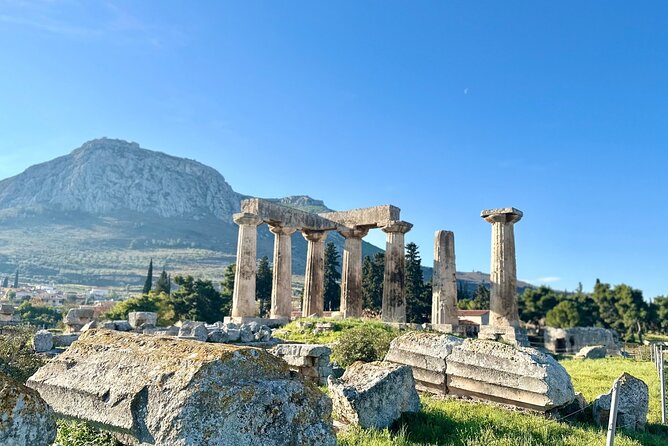
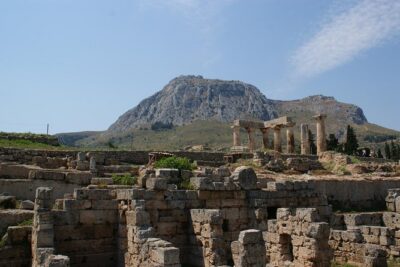
From the public forum area you move toward the Temple of Apollo and then back into the core civic spaces like the Agora. The Temple of Apollo at Corinth is dated to about 550 BC and is described as one of the earliest Doric temples in the Peloponnese and mainland. You will also see the note about monolithic columns, which are rare in the ancient world.
After that, the Agora gives you the civic layout: a rectangular space with shops, small temples, an altar, and the famous Bema podium connection. This is the part where Corinth stops feeling like a biblical backdrop and starts feeling like a functioning Roman city with public life happening in the open.
Then you head to Acrocorinth, the “Upper Corinth” acropolis. It sits on a huge rock above the city and functioned as a fortress with a secure water supply. The view and the defensive logic are the point here. This site is repeatedly used as a last line of defense because it controlled approaches into the Peloponnese. If you like military geography and big-picture strategy, you will appreciate this more than you might expect from a short stop.
Mycenae: where Agamemnon’s world turns from myth into stone
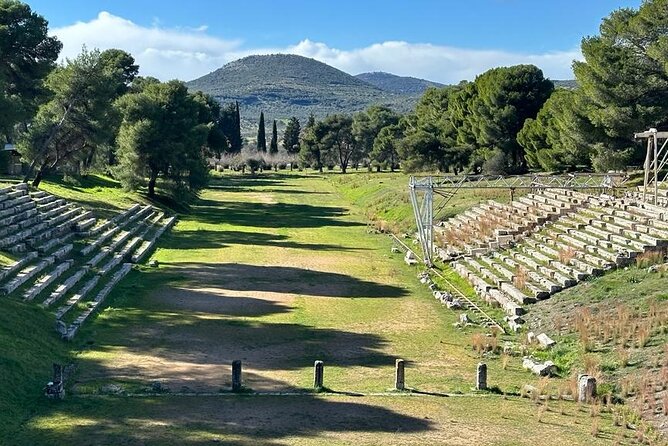
Next you reach Mycenae, the fortified citadel linked to King Agamemnon and the wider Mycenaean civilization. If you have seen photos of Lion Gate before, it is still worth it here. The place has a physical weight that images do not fully transmit.
Mycenae is famous for the Cyclopean walls, the Tomb of Clytemnestra, and the Lion’s Gate. It was a major power center in the second millennium BC, dominating influence across southern Greece, Crete, the Cyclades, and parts of southwest Anatolia. The site is dated across its peak around 1350 BC, when the citadel and lower town had an estimated 30,000 people and covered about 32 hectares.
If you want a quick way to understand why this site matters, focus on the fortification system. Mycenae was not just a palace. It was a defensible political statement.
Lion Gate and the tiny pause that still hits hard
The Lion Gate is the main entrance of the Bronze Age citadel, erected around the 13th century BC, around 1250 BC. It is named for the relief sculpture above the entrance, two lionesses or lions in a heraldic pose.
Two details I think are worth appreciating during your short viewing time. First, the relief is described as the sole surviving monumental Mycenaean sculpture and the largest surviving sculpture in the prehistoric Aegean. Second, it is noted as an iconographic motif that survived without being buried underground. Even if you do not know the art history, you can still sense why archaeologists care: this is a rare surviving statement from that era.
Mycenae museum: a useful add-on, not a full day plan
Your route includes the Archaeological Museum of Ancient Mycenae. The timing here is brief, about 15 minutes, so think of the museum as a supporting cast. The area focuses on the fortified acropolis and surrounding funerary and habitation sites, with most visible monuments dating to the center’s floruit around 1350 to 1200 BC.
If you want to leave Mycenae with clear names for what you saw outside, a quick museum stop helps. If you want museum-time obsession, you would likely need a separate visit on another day.
Treasury of Atreus: the beehive tomb that makes scale feel real
Then you reach the Citadel and Treasury of Atreus, often called the Tomb of Agamemnon. It is a large tholos, meaning beehive tomb, on Panagitsa Hill. It is dated to roughly 1250 BC, and it is famous for the stone lintel above the doorway, noted as weighing around 120 tons, with approximate dimensions around 8.3 x 5.2 x 1.2 meters.
This is one of those “wow” moments where I think time limits work in your favor. You get the surprise of scale without needing a long lecture. Just make sure you stand back far enough to appreciate the structure in context, not only the doorway.
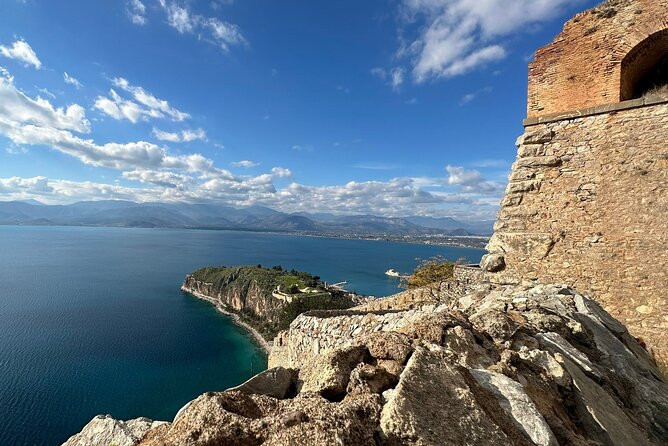
Palamidi Castle: the 913 steps, plus the 999 story
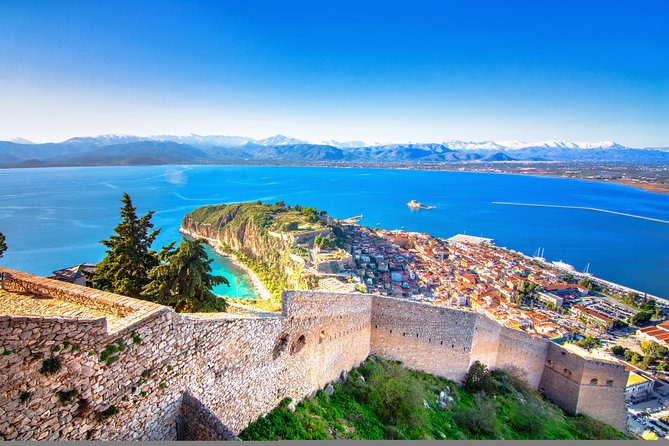
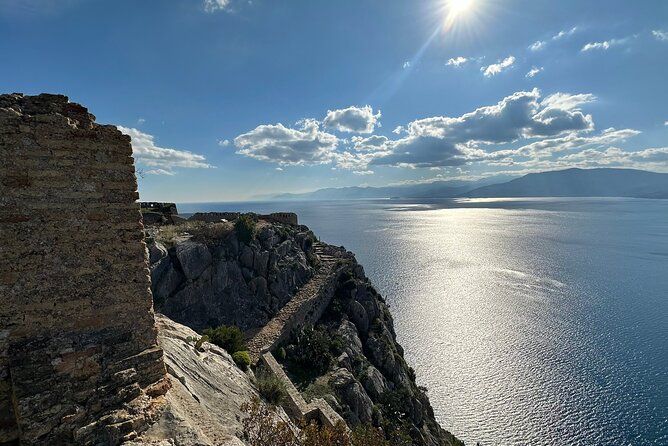
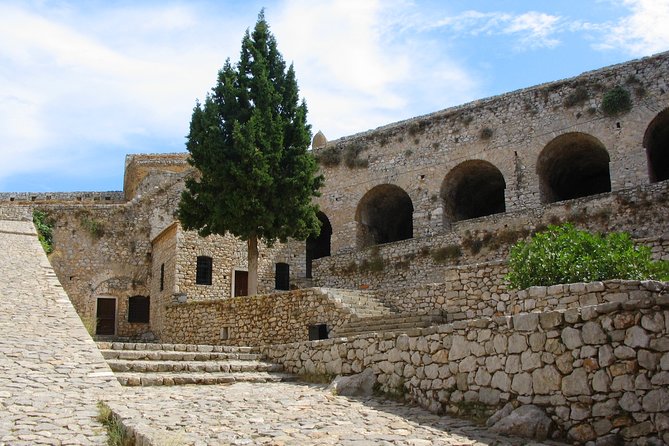
From Mycenae you shift into Nafplio, and the big physical highlight is Palamidi Castle. It is one of the best-preserved castles in Greece and offers spectacular views of the city and the Argolic Gulf. It was built by the Venetians during their second occupation, dated 1686 to 1715.
The key thing you should know before you go: the stair count is not a joke. You have about 913 steps from town up to the fortress, and to reach the top you may face over a thousand steps. Locals tell the story as “999 steps,” and the difference between the official count and the legend is exactly the kind of local flavor you want on a day trip like this.
If you are fit, go at your pace. If you are not, consider taking it slow and treating it like a scenic climb rather than a sprint. Comfortable shoes are not optional here.
Nafplio Old Town: Venetian, neoclassical, and that postcard quiet
After Palamidi, the day turns softer with Nafplio Old Town. This is the part where people often say they could spend longer, because cobbled streets, doll-like mansions, and flowered balconies create that weekend feeling fast. You also get the navigational anchor of Syntagma Square, described as the zero point of the old town.
Nafplio is noted as the most scenic city and also served as capital of Greece until 1834. Architecturally, you see a mix of Venetian, neoclassical, and oriental elements. This blend is not random style. It reflects who controlled the region across different eras.
You will also have a lunch stop at a traditional tavern by the sea. Keep in mind lunch costs are not included, so this is where your day budget becomes real. The benefit of eating here is atmosphere. You are not just fueling up, you are absorbing place.
Bourtzi and the islet prison turned sunset hotel
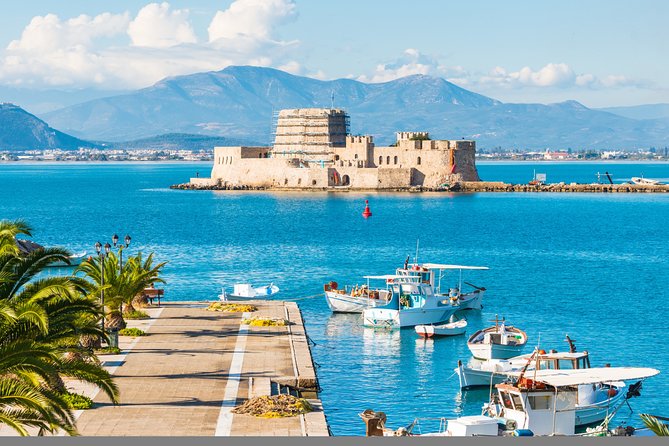
Then you go for Bourtzi, the famous small fortress on the islet of Agioi Theodoroi. The Venetians built it in 1473, and it was called Castello dello Soglio, meaning Castle of the Throne. Later, the Ottomans used the name Bourtzi, and it stuck.
This is a classic “arrive, photograph, breathe” stop. The fortress has functioned as a prison and later as a luxury hotel in the honored 60s. Today, it is especially known as a sunset postcard setting. You can reach it by boat in less than 10 minutes, and that short ride is part of the payoff.
Syntagma Square, Akronafplia Fortress, and the Lion of the Bavarians
Your Nafplio time also includes Syntagma Square and its local stories. There is a note about two Venetians searching for a treasure hidden by their father when he was governor, meeting a Turkish Aga, and finding the treasure only to have a darker end. The story continues with construction linked to Kapodistrias and a Greek state parliament building, and the municipal gallery being visitable on the ground floor.
After that, you visit Akronafplia Fortress, the oldest part of the city. Until the 13th century it was its own town, and later the Venetians and Franks incorporated it into wider fortifications. Part of it was used as a prison, and then a hotel complex was built with an emphasis on the views.
Finally, you end at the Lion of the Bavarians, a huge carved lion above Michael Iatrou Street with a small park beneath it. It is described as the work of German sculptor Christian Ziegel, commissioned by King Louis for Bavarian soldiers of Otto’s dynasty who died in Nafplio in 1833 from a typhoid epidemic. Locals have an unofficial explanation tying the deaths to bitter foods, which is the kind of human detail that makes monuments feel connected to real life.
Price and pacing: how to make this kind of day feel good
The stops are packed, but in a smart way. Many are around 10 to 30 minutes, with a few longer moments like Mycenae and Nafplio Old Town. That means you should treat the day like a greatest hits tour, not a slow wandering tour.
Here is how I recommend you handle it:
- Pick your top two “must photograph” moments. For most people it is Palamidi views and one Mycenae monument like Lion Gate.
- Be realistic about how much reading you can do. Short stops mean quick context, not long museum sessions.
- If stairs are an issue, plan your Nafplio time accordingly. Palamidi is the big step challenge of the day.
On the service side, this is repeatedly praised for reliability and clear communication. You might meet drivers like Chris, Ioannis, Yiannes, Costas, Michael, or Dimitrios, with feedback highlighting professionalism, patience, and the ability to adjust the day so you spend time where you care most. The common thread is that the day does not feel rushed, and the driver keeps you comfortable in transit.
Should you book this private Corinth, Mycenae, and Nafplio day trip?
If you want one long day that strings together biblical Corinth, Bronze Age Mycenae, and a genuinely charming coastal old town, I think this is a smart booking. The private car makes a big difference because you are not stuck with rigid group timing between remote sites, and the comfort extras like WiFi, A/C, and bottled water help on a 9 to 10 hour day.
I would think twice if you need a slow, guided-by-a-licensed-expert museum experience at every stop. This day leans on your driver for explanation and on your own time for deeper reading inside attractions. Also, if your mobility is limited, Palamidi’s steps are a major factor, so plan for that early in your decision.
FAQ
Is this a private tour?
Yes. This is a private tour where only your group participates.
What is the duration of the experience?
The tour runs about 9 to 10 hours.
Do I get pickup and drop-off in Athens?
Yes. Pickup and drop-off are offered from Athens hotel, Airbnb residence, or the port, and it returns you to the same meeting point or another preferred point.
What vehicle will I ride in?
It depends on group size. Groups of 1 to 3 travel in a luxurious sedan, and groups of 4 to 7 travel in a comfortable mini van. The vehicles have WiFi, A/C, and bottled water.
Is there a licensed guide included inside the archaeological sites?
No. A licensed guide to accompany you into archaeological sites is not included.
Are entrance fees included?
No. Entrance fees for attractions are not included.
Is lunch included?
Lunch is not included, though there is a scheduled lunch stop at a traditional tavern by the sea in Nafplio.
Is the tour offered in English?
Yes, the tour is offered in English.
Can I customize the program?
Yes. Since it is a private tour, you can customize the program according to your needs.
FAQ
What if the weather is bad?
The experience requires good weather. If it is canceled due to poor weather, you will be offered a different date or a full refund.
How far in advance can I cancel for a refund?
You can cancel up to 24 hours in advance for a full refund. If you cancel less than 24 hours before the start time, the amount paid is not refunded.
More Full-Day in Athens
- All Day Cruise -3 Islands to Agistri,Moni, Aegina with lunch and drinks included
★ 5.0 · 4,958 reviews

More Tour Reviews in Athens
- All Day Cruise -3 Islands to Agistri,Moni, Aegina with lunch and drinks included
★ 5.0 · 4,958 reviews
Not for you? Here's more nearby things to do in Athens we have reviewed





Corinth Day Trips from Athens, compared.
 ★ 4.6From Athens: Ancient Corinth Day Trip with Canal & VR GuideFrom $411,073 reviews
 ★ 5.0Private Biblical Tour Ancient Corinth & Isthmus Canal from AthensFrom $301762 reviews
 ★ 4.8Ancient Corinth & Nafplio Full Day Trip with SwimFrom $44523 reviews
 ★ 5.0Private Tour of Apostle Paul’s Footsteps in Ancient CorinthFrom $169275 reviews
 ★ 4.5Corinth Half-Day Trip from Athens with Entrance TicketsFrom $91242 reviews
 ★ 4.7Ancient Corinth & Nafplion Guided Premium TourFrom $34237 reviews
 ★ 4.4Corinth Canal, Mycenae and Nafplio Day TourFrom $33233 reviews
 ★ 4.6From Athens: Ancient Corinth Tour Official Guide & TicketsFrom $86208 reviews
Browse the lists this tour appears in