

Reviewed · ATHENS ACROPOLIS & PARTHENON TOURS
Best of Athens & Acropolis Full Day Private Guided City Tour
Athens has a way of grabbing you by the collar. This private day tour strings together the Acropolis highlights with the Agora and classic neighborhoods, so your brain keeps clicking from one big idea to the next. I like how the route is built for your feet and your photos, with short museum-style stops where the details matter, then longer walks where Athens feels like a living city.
Two things I really love: first, the guide-led pacing up the Acropolis, where you notice carved quarry marks and drainage channels instead of just posing in front of monuments. Second, the pickup and communication style reported in the company’s service, with fast WhatsApp coordination and punctual meetups like the ones described with drivers such as Nikos and Stefanos. The main drawback to plan for is simple, this is a long, stone-heavy day, so if your mobility or stamina is limited, you may feel the climb and the repeated getting on and off city streets.
Key Highlights You’ll Feel on the Day
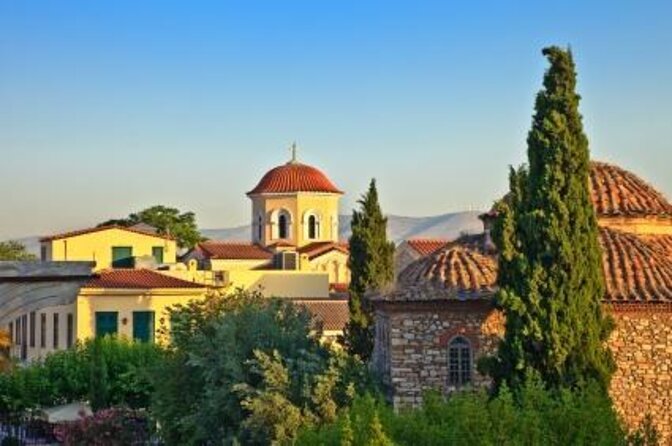
- Acropolis story, not just stops, with the “why” behind optical symmetry at the Parthenon and the sacred layout of the precinct
- Marble-specific tips, including grippy footwear for smooth surfaces on the hill
- Original details with honest context, like pigment traces on sheltered stones and Caryatids being faithful casts in the worn spots you see
- Ancient Agora plus working Athens, with stoas, everyday artifacts, boundary stones, and cart ruts you can spot if you look
- Classic Athens neighborhoods after the big monuments, especially Plaka and Monastiraki for that lived-in feel
- Pickup coordination that aims to reduce stress, using WhatsApp or Apple iMessage to lock down the meet spot
Private Pickup and WhatsApp Coordination in Athens
This is set up as a true private outing, meaning it’s only your group, not a busload of strangers funneling you through lines. Pickup is offered, and the coordination runs through WhatsApp or Apple iMessage, so you can usually reduce that first-day Athens panic of Where do we meet?
You’ll also want to know the tour runs in a wide daily window, 9:00 AM to 6:00 PM, and it operates year-round across the listed dates. If your hotel is tucked into a side street, message coordination matters. Based on the provider’s past service style, you can expect punctual, organized help and clean, comfortable vehicles, including the kind of meet-and-greet that shows up on time with luggage support.
Where this matters for you: a private format plus clear pickup comms buys back energy. Athens is easiest when you do fewer things wrong at the start.
You can also read our reviews of more guided tours in Athens

Acropolis Climb to the Parthenon, and How Your Feet Matter
You start with the Acropolis, climbing along the pedestrian promenade where the city opens up behind you. The big idea here is that you’re not just walking to landmarks, you’re climbing toward the political and religious center of Classical Greece. Your guide points out small infrastructure tells in the bedrock, like ancient quarry marks and carved drainage channels, which helps the site feel engineered, not just monumental.
A key practical note: the surfaces are smooth marble, and the tour specifically flags that grippy footwear is essential. Don’t show up in soft sneakers you’d wear on a flat sidewalk. I’d bring shoes with real tread, because you’ll feel the slope and you’ll be stepping around protected areas.
The photo rhythm is built in too. You get a moment midway up for a dramatic Parthenon frame with the Saronic Gulf in the background. The best part is that you learn where to stop and what angle makes the whole hill look “real,” not like a postcard cutout.
Inside the Parthenon, Optical Tricks and Color Traces
At the Parthenon, you’ll learn to look like an architect. The Parthenon is described as a masterpiece of perfect proportions, but the real mind-bender is the “optical refinements” your guide explains: subtle curvature and slightly tilted columns that create the illusion of absolute symmetry.
You’ll also hear how the sculpted friezes delivered civic storytelling, not just decoration, and that they were once painted in vivid color. Even now, traces of pigment can appear on sheltered stones, so the guide’s prompts help you notice what the eye might otherwise miss.
If you’re thinking photos, the advice is to shoot along the colonnade to capture the rhythm and the scale. If you’re thinking comfort, note that this stop is short. You’re here for focus, not wandering.
Propylaea Gate Framing: Fortress, Procession, Arrival

Next comes Propylaea, the monumental gateway that orchestrates your entrance into the sacred precinct. What’s interesting is how it balances fortress and flourish, with Doric columns and Pentelic marble shaping the whole approach.
Your guide also leans into a detail that makes it feel more human: the asymmetry of the design as practical adaptations for the terrain and nearby shrines. That explanation helps you see the gate as a tool for movement, not just a static stage set.
For photos, there’s a specific shot you can try: step just inside, then turn back and frame the city through the columns. It’s one of those “do this now or you’ll forget later” moments, which is why I like having a guided day.
Temple of Athena Nike and Erechtheion’s Myth Rooms

Temple of Athena Nike is compact, but packed with symbolism. The point here is victory, both military and civic. You’ll learn about the friezes and the winged Nikes (Victories) that once animated the storytelling.
There’s also a very practical museum logic: one of the famous motifs, like Nike adjusting her sandal, appears as a replica at the site, because originals are preserved in the Acropolis Museum. That’s helpful for you, because it stops you from feeling like you’re missing something. You’re seeing the “site version,” not the permanent archive.
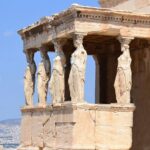
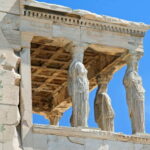
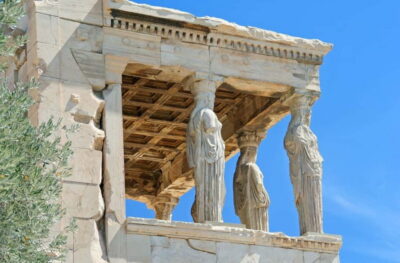
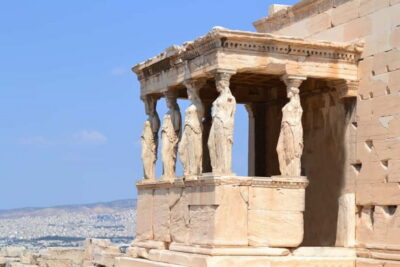
Then you move to Erechtheion, which feels like multiple myths stacked into one sacred building. You’re told about Athena’s olive tree, Poseidon’s salt spring, and the memory of legendary kings. The layout is asymmetrical to wrap around holy spots, and the famous Caryatids (maiden statues) carry the roof like living columns.
Two important “don’t get surprised” points: you’ll look at faithful casts, while originals are preserved in museums. And the west side points you toward the olive tree linked to Athena’s founding myth. For photos, the guide suggests framing two Caryatids with the Parthenon blurred behind to add depth.
This pair of stops is why I’d choose a guided day over a self-guided dash. The monuments are close, but the meaning is layered. A guide helps you catch it in real time.
You can also read our reviews of more city tours in Athens



Ancient Agora and Hephaistos Temple for the Athens That Worked

After the Acropolis, the day turns more civic. The Ancient Agora of Athens is where democracy, philosophy, commerce, and everyday gossip met under colonnades. The biggest value here is walking a place where big ideas were argued in the same streets where people bought things and handled daily business.
Your route includes the Stoa of Attalos as a museum stop, with artifacts that tether grand principles to ordinary life, including items like coins, weights, and inscriptions. You’ll also get prompts for site archaeology you can physically spot, like boundary stones marking zones and cart ruts worn into the ground.
Then comes the Temple of Hephaistos, listed as Temple of Aries on this tour. It’s highlighted as the best-preserved Doric temple in Greece and dedicated to Hephaistos (craft) and Athena Ergane (handiwork). That craft angle is a nice counterweight to the political drama of the Acropolis.
For photos, try the three-quarters view from the southeast corner to catch the clean column rhythm. The elevated position also gives a panoramic look back across the Agora, which helps you connect the city’s layers before you move into modern Athens.
Syntagma, the Unknown Soldier, and the Academy’s Intellectual Face
Once you’ve had your “ancient core” hit, you shift into modern civic Athens. Syntagma is described as the capital’s civic living room, with boulevards, polished stone terraces, and gatherings around fountains and flowerbeds. Your guide points out the layered reality under your feet, including classical remains found during metro construction, with displays visible from the concourse.
Then you visit the Monument to the Unknown Soldier, guarded by the Evzones with their distinctive ceremonial uniform, including fustanella pleats and pom-pom tsarouhia. The changing of the guard is treated as a time marker in the capital with quiet dignity.
There’s also clear etiquette: stay behind the line, don’t touch guards, and don’t obstruct their path. If you want photos, stand side-on to capture synchronized steps without blocking others.
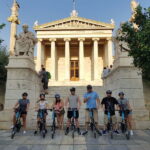
Finally, you reach the Academy of Athens, a temple-like neoclassical façade with statues including Athena and Apollo, plus Socrates and Plato seated in the front. It’s presented as an intellectual emblem and a deliberate conversation with the ancient past. If you like dramatic angles, the suggested photo tip is a low angle from the steps to emphasize the statuary and pediment.
The Athenian Trilogy: University, Library, and Panathenaic Stadium

The route continues through neoclassical Athens with the National and Kapodistrian University of Athens and the National Library of Greece, both part of what’s called the Athenian Trilogy.
At the University, you’ll see a frescoed portico and symmetrical plan tied to 19th-century classicism. The guide points you toward the allegorical pediment figures and elegant ironwork at the forecourt. This stop is shorter, so it’s more about getting the visual “grammar” of how Athens dressed itself after independence.
At the Library, you get the twin curving staircases, Doric columns, and temple-like pose on Panepistimiou. There are also decorative motifs, like owls and laurel symbolism for wisdom, and guidance to center yourself for symmetry shots. The modern library services are run at a separate contemporary cultural center, but your stop here is about façade and classic form.
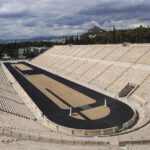
Then you hit Panathenaic Stadium, the white marble arena known as the Kallimarmaro. It hosted the first modern Olympic Games in 1896 on the footprint of an ancient stadium tied to the Panathenaic festival. The track and finish line markings give you that physical sense of where the modern era started.
Entry into higher areas is optional. The tour flags an optional paid admission where you can climb higher and visit a small exhibit. If you’re short on energy or time, you can still enjoy plenty from where you can stand without the extra ticket.
Olympeion Ruins and the Quick Hadrian’s Arch Snapshot
You then get a stop at the Olympeion, described as once the largest temple in Greece and completed over centuries. Even in ruins, the tall Corinthian columns communicate imperial ambition, linked to Roman ambition under Hadrian.
Your guide points out the solitary fallen column and the fluted “drum” segments that show how ancient builders constructed it. The photo approach here is pragmatic: you may capture it through a coach window, and the plan even calls out that a look at Hadrian’s Arch depends on traffic.
This is a good reminder that the day is designed for variety. Not every stop is meant for an extended wander. Some are quick because the goal is to see more Athens in one go.
Plaka and Monastiraki: Village Under the Rock, Then Market Energy
After the big-ticket monuments, you end with the parts of Athens that feel like a place you could get lost on purpose.
Plaka is called the village under the rock, and the description is accurate in spirit: a maze of neoclassical houses, flower-draped balconies, tiny chapels, and cafés spilling out into lanes. The guide also steers you toward Anafiotika, whitewashed Cycladic-style houses clinging to the Acropolis slope, built by island craftsmen. If you’re a light person, early afternoon light bouncing off pale walls makes colors look stronger.
This area isn’t about rushing. Cobblestones and stairs mean you’ll slow down, take small turns, and find quiet corners for ice cream or a quick browse in artisan shops. You get a full hour here, which is enough time to enjoy it without turning it into a chore.
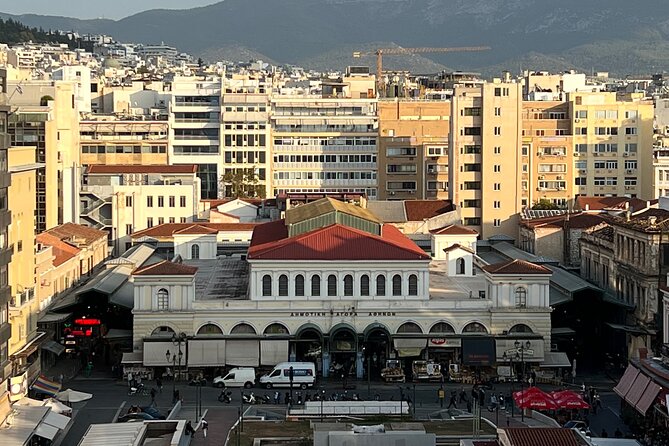
Then comes Monastiraki, where eras overlap in a lively square. You’ll see a mix of a mosque and a church, Roman Agora remains, and lots of flea-market stalls selling everything from leather sandals to antiques. The square hum is part of the experience.
The photo tip is to aim for Acropolis views from the square. If you time it right, Monastiraki can deliver a golden-hour skyline where the Parthenon glows above. Practical note: keep small valuables zipped, because crowds are the tradeoff for that energy.
Time, Pace, and What This Route Really Gives You
This day is built around “important first, then explore.” Some stops are short, like 5 minutes at neoclassical landmarks, while others are deeper, like about an hour at the Acropolis and the Ancient Agora, plus longer wandering time in Plaka and Monastiraki.
For you, that pacing has a benefit: you get context fast. The guide’s explanations at the Acropolis make later stops more understandable, and the city landmarks after feel less random because you’re still tracking Athens’ civic identity.
The tradeoff is that you won’t have unlimited time in every single courtyard. If you’re the type who wants to sit for 30 minutes and sketch, you’ll likely want a second day for slower exploration.
Also, think about comfort planning. Expect to move across uneven ground, especially with marble surfaces and old paving. Bring water and a layer if the weather shifts, and wear shoes you’re confident walking in for several hours.
Price and Value for a Private Full Day
At $600.12 per person for a private 5 to 7 hour experience, this isn’t a budget option. But value is not only about cost, it’s about what you avoid.
You’re paying for:
- Private, guided interpretation at the places where details get lost without help
- Pickup offered, with coordination by WhatsApp or Apple iMessage
- Admission tickets included for many of the key sites listed, including major Acropolis stops and the Ancient Agora
- A route that combines ancient, neoclassical, and neighborhood Athens instead of doing only monuments
If you tried to do this yourself, you’d spend time stitching together tickets, orientation, and transportation, and you’d likely waste some energy figuring out what matters most at each stop. For groups that want a strong return on time, the price can start to make sense.
The main question is your priorities. If you want a deep, relaxed archaeological experience at one site only, you might prefer a narrower plan. If you want the “best of” day with guidance and structure, this route is tailored for that.
Should You Book This Private Acropolis and Athens Day Tour?
Book it if you want a guided, time-efficient Athens that hits the Acropolis, Agora, and the city’s later civic landmarks, then cools down with neighborhood walking in Plaka and Monastiraki. It’s also a strong pick if you value smooth logistics, because pickup coordination is built around messaging and punctual meetups.
Skip it or consider a different format if you hate long days on your feet or you need more time lingering at a single monument. The pace is designed to show you lots of Athens, not to maximize hours in one place.
If you’re excited by details, this tour is the kind of day where the story sticks. The marble, the optical tricks, the gate framing, and the Caryatids all make more sense when someone helps you notice what’s right in front of you.
FAQ
How long is the Best of Athens and Acropolis full day private tour?
It runs about 5 to 7 hours.
Is this tour private?
Yes, it’s private. Only your group participates.
What language is the tour in?
The tour is offered in English.
Is pickup included, and how do I coordinate it?
Pickup is offered. You’ll need WhatsApp or Apple iMessage to coordinate the exact pick up spot.
Do I need a mobile ticket?
Yes, the tour offers a mobile ticket.
Which admissions are included, and is anything not included?
Admission tickets are listed as included for the Acropolis (including Parthenon-related sites like Propylaea, Temple of Athena Nike, and Erectheion), the Ancient Agora, and the Temple of Aries (Hephaistos). Panathenaic Stadium has optional paid entry and is listed as not included.
What happens if the weather is poor?
The experience requires good weather. If it’s canceled due to poor weather, you’ll be offered a different date or a full refund.
Can I cancel for a full refund?
Yes. Free cancellation is available, and you can cancel up to 24 hours in advance for a full refund.
More Guided Tours in Athens

More Tours in Athens

More Tour Reviews in Athens
- All Day Cruise -3 Islands to Agistri,Moni, Aegina with lunch and drinks included
★ 5.0 · 4,958 reviews



Not for you? Here's more nearby things to do in Athens we have reviewed







Athens Acropolis & Parthenon Tours, compared.
 ★ 4.4Acropolis & up to 5 Archaeological Sites Combo PassFrom $4812,619 reviews
 ★ 4.2Acropolis Ticket with Optional Audio or Live GuideFrom $4211,055 reviews
 ★ 4.8Acropolis, Parthenon & Acropolis Museum Guided TourFrom $409,316 reviews
 ★ 4.6Acropolis and Parthenon Guided Walking TourFrom $385,882 reviews
★ 4.8Acropolis, Parthenon & Acropolis Museum Guided TourFrom $413,579 reviews
★ 4.6Acropolis and Parthenon Guided Walking TourFrom $385,882 reviews
★ 4.8Acropolis, Parthenon & Acropolis Museum Guided TourFrom $413,579 reviews
 ★ 4.0Acropolis Ticket with Audio GuideFrom $473,575 reviews
 ★ 4.7Acropolis: Acropolis and Parthenon Guided Walking TourFrom $363,442 reviews
 ★ 5.0Acropolis monuments & Parthenon Walking Tour with Optional Acropolis MuseumFrom $422,678 reviews
Browse the lists this tour appears in