
Reviewed · CORINTH DAY TRIPS FROM ATHENS
Exploring Corinth: In the Footsteps of the Apostle Paul
The apostle’s footsteps turn history into a story. This half-day trip ties together major Corinth landmarks and specific places connected to Paul, and you get easy Athens pickup plus onboard Wi-Fi to plan the rest of your day. I especially like that it is private, so you can ask your driver questions at each stop, not just hear a lecture. One thing to consider, the stops are mostly outdoor and ancient-site walking, and the museum entry is not included.
You will move through the Isthmus of Corinth and the famous ship-transport trackway, then to an ancient port tied to Paul’s journey, and finally up to Acrocorinth and the Apostolos Pavlos Church. You get bottled water, air-conditioned comfort, and a driver who speaks English well enough to answer your questions in real time.
This is a great match if you want a faith-linked, place-by-place day that feels like you are following routes in the Bible, not just checking boxes on an ancient Greece map.
Key things that make this tour worth your time

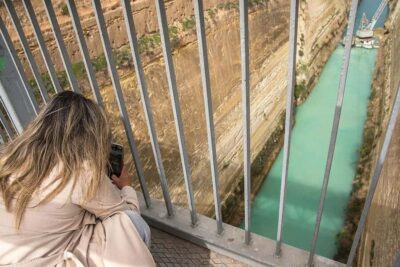
- Isthmus engineering you can actually picture, including the Corinth Canal shortcut and the Diolkos ship trackway
- Kenchreai port stops the Paul story on the water, connected to the route toward Ephesus
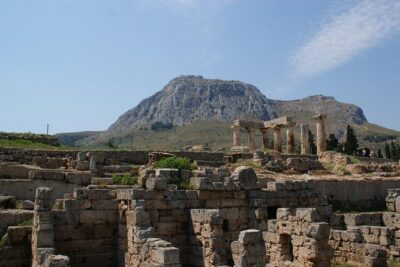
- Archaia Korinthos is full of Paul-related conversation points, with stops at areas like the Bema and key fountains
- Acrocorinth delivers the big view factor, with a hilltop citadel feel that makes Corinth’s importance click
- The Apostolos Pavlos Church adds art and reflection, including a mosaic created by Pastorutti and Tsotsonis
- You get onboard Wi-Fi and a private ride rhythm, so you are not scrambling for data or moving with a big crowd
Following Paul in Corinth: why this day feels different
Corinth can feel like a blur if you only see it as ruins and stones. This tour slows the pace down by connecting sites to the Paul story, so the places have names, movement, and purpose.
You start with the ground-level geography of the region, the kind that shaped shipping, trade, and travel. Then you move into the parts of Corinth where a new community formed and where public life played out. By the time you reach the hilltop citadel area and the church dedicated to Saint Paul, the city starts to feel like a living system instead of a quick stop.
What I like best about this style is that it gives you a framework you can carry into the rest of your trip. When you later look at Corinth on your own, you will remember how the Isthmus links regions, how ports moved people, and how public space worked in a city like this.
You can also read our reviews of more tours and experiences in Athens.


Athens pickup and the practical ride details that matter
The logistics here are genuinely traveler-friendly. You get hotel or apartment pickup in Athens, and the driver waits for you at the entrance. If you are arriving by port, the driver waits at the gate holding a sign with your name. That reduces the most stressful part of a day tour, finding each other when you are already busy.
The vehicle is air-conditioned, and you get bottled water. On a hot day, that alone can keep your energy for the ancient stops.
The other practical win is onboard Wi-Fi. You can use it to check your next bookings, read up on what you just saw, or get your bearings for the rest of Athens while you are in transit. The tour is scheduled at about 6 to 7 hours, so having that downtime organized helps.
Finally, this is a private tour/activity, meaning only your group participates. That can matter a lot if you like asking questions, taking extra photos, or moving at your own pace.
Stop 1: Isthmus of Corinth, Canal views and the shortcut idea
The Isthmus of Corinth is a narrow stretch that connects the Peloponnese to mainland Greece. You do not need a map app to feel why it mattered. It is the choke point where routes either take the long sea path around the peninsula or cut across.
At the Corinth Canal area, you get a look at the engineering logic of the shortcut. Even if you only spend around 30 minutes here, the point lands quickly: controlling this narrow land corridor meant controlling movement between seas and regions.
Tip for getting value in a short stop: take a moment to stand back and look at the wider geography from a safe viewing area, then mentally connect it to shipping and travel. Once you see the isthmus as a funnel, the rest of the day makes more sense.
Stop 2: Diolkos trackway, how ships crossed overland
Next comes the Diolkos, a paved trackway used from as early as the 6th century BC. This is one of those ancient engineering stories that changes how you picture travel. Instead of rounding the Peloponnese and dealing with a long, risky sea voyage, ships could be transported over land across the isthmus.
The tour gives you about 20 minutes here, which is a good length for absorbing the concept without turning it into a lecture. The Diolkos stop works best if you are curious about infrastructure and practical solutions, not just temples and tombs.
Practical consideration: at trackway-style stops, the details are easier to understand if you ask questions. If anything feels unclear, this is a perfect moment to prompt your driver for context.
Stop 3: Ancient Port of Kenchreai, the Paul story turns toward Ephesus
Cenchreae, often connected to modern discussions as Kenchreai, was one of Corinth’s key harbors. It sat on the Saronic Gulf and served as a major hub for trade and transportation.
But this stop has an extra layer because it is tied to early Christian movement. The place is mentioned as a point connected with the Apostle Paul’s travels, including his final journey to Ephesus.
Spending about 35 minutes here is enough time to focus on two things at once:
1) the practical role of ports in an ancient city’s life, and
2) the way routes show up in Paul’s travel narrative.
If you like Bible geography, this is where you start to connect dates and directions in your head. If that is not your thing, you can still enjoy it as a lesson in how cities worked.
- All Day Cruise -3 Islands to Agistri,Moni, Aegina with lunch and drinks included
★ 5.0 · 4,958 reviews

Stop 4: Archaia Korinthos sites, the Bema and the city’s public rhythm
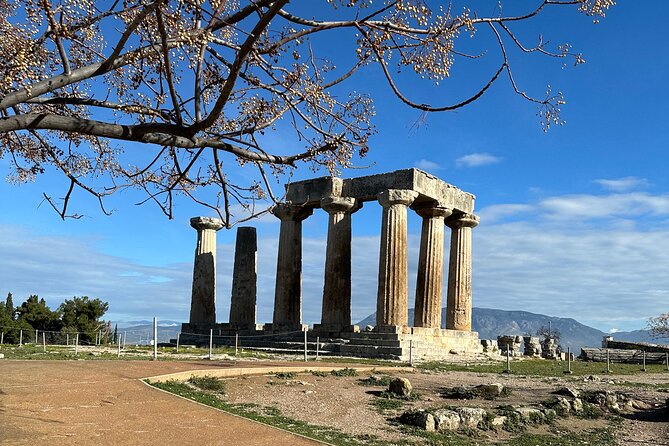
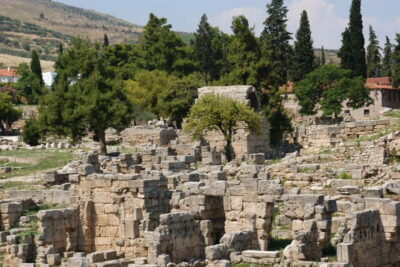
Now you shift into the archaeological core. At Archaia Korinthos, the tour passes by several major areas, including:
- Temple of Apollo
- Ancient Theatre
- Roman odeon
- Glauke fountain
- Temple E
- Bema
- Peirene fountain
(and more in the same zone)
This is where the Paul connection turns concrete. In Corinth, public spaces and civic life were not separate from everyday religious life. The tour also anchors your understanding by pointing out that Paul spent significant time in Corinth, building a Christian community there, and that his letters to the Corinthians (1 Corinthians and 2 Corinthians) reflect real issues the early church faced.
About 1 hour 30 minutes in this area gives you room to wander thoughtfully. Your biggest advantage here is the question-friendly format. Since you do not have a separate licensed guide included to accompany you inside archaeological sites, you want your driver to be your interpreter of what you are seeing from the outside and in the general areas you reach.
Possible drawback to keep in mind: without a specialist guiding you inside every ruin, your experience will depend partly on how much you ask. If you like lots of back-and-forth, this is a tour designed for you. If you want someone to do all the explaining automatically, you might feel slightly under-led, especially inside museum-style settings.
Stop 5: Archaeological Museum of Corinth, artifacts that explain the economy
The Archaeological Museum of Corinth is a strong mid-tour reset. You get about 40 minutes, which is long enough to hit the most important rooms without feeling rushed, but still short enough that you likely will not see everything.
This stop is also where you learn how Corinth worked beyond religion. The museum includes pottery, jewelry, and other artifacts that show the city’s cultural and economic significance. Even if you came for Paul, these objects help you understand what people owned, traded, and used.
Important cost note: museum entrance is not included. That is not a deal-breaker, but it does affect value. If you are the type who cares about understanding everyday life in the ancient world, you will be grateful this is on the route. If you would rather spend that time outdoors, you can treat the museum as optional weight, but with only 40 minutes, you might still want to go in.
Stop 6: Acrocorinth, fortress views that make the city feel real
Acrocorinth is the hilltop citadel overlooking Corinth. Think of it as the part of the city that had a military mindset, the high-ground logic. The tour includes about 1 hour here, which matters because hilltop sites change the experience as the light and angles shift.
When you are at Acrocorinth, you start to see Corinth’s strategic value in a way that ruins at street level do not always communicate. From above, you get a better sense of how a city with major trade routes could defend itself and control movement.
Admission here is listed as free, so you will not have an extra ticket cost to add friction to the day.
Walking note: a citadel stop can mean stairs and uneven ground. Wear shoes you trust. This is one of those times where comfort helps your photos and your questions stay focused.
Stop 7: Apostolos Pavlos Church, a Paul-themed space with a mosaic by Pastorutti and Tsotsonis
The Apostolos Pavlos Church is dedicated to Saint Paul and sits in the heart of ancient Corinth. You get about 20 minutes here.
What makes it memorable is the mosaic created by Pastorutti and Tsotsonis, depicting the Apostle’s journey. It is a reflective end point after the broader geography and the archaeological zones.
This church stop works for different kinds of travelers:
- If you are coming from a faith perspective, it gives you a quiet, interpretive moment.
- If you are more museum-minded, it is a reminder that Corinth’s story did not stop in antiquity. People have continued to build meaning here.
Admission is listed as free, so it is a low-cost, high-impact spiritual and artistic punctuation mark at the end of your route.
Price and value: what $171.52 covers, and what it does not
At $171.52 per person for a 6 to 7 hour experience, this sits in a mid-range zone for a day trip that includes transportation, onboard Wi-Fi, and pickup/drop-off across Athens.
Here is what helps justify the price:
- Pickup and drop-off are included, and the driver waits for you at the entrance or gate with your name
- You ride in an air-conditioned vehicle, with bottled water
- You get onboard Wi-Fi, so the time spent between stops is not wasted
- It is private, so you do not feel stuck in a schedule designed for strangers
- You have a question-friendly guide format, and English is handled well by the driver
Here is what you should plan for before you book:
- Entrance fees to archaeological sites and the museum are not included (the museum is specifically called out as not included)
- Food and snacks are not included
- Airport pickup/drop-off costs extra, if you need it
Also, and this is a subtle one: the driver is included, but a licensed tour guide who accompanies you into archaeological sites is not included. In practical terms, you may want to rely on your driver for explanations more than you would on a fully guided museum tour.
If you are okay with that trade, you get good value for a structured day that links major Corinth locations to the Paul story.
Who should book this Corinth Paul tour, and who might not love it
This is best for you if:
- You like religion and history tied to specific locations, not generic background
- You enjoy asking questions and want a private atmosphere to do it
- You want an itinerary that covers engineering, ports, public spaces, and a church end point
- You care about practical logistics like pickup, Wi-Fi, and water
You might not love it if:
- You prefer a specialist guiding you inside every archaeological stop with detailed narration on-site
- You dislike time spent on outdoor ruins and hill viewpoints
- You want a day that is mostly indoor with minimal walking
Still, even for non-faith travelers, the mix of engineering (Isthmus/Diolkos), ports (Kenchreai), city life (Archaia Korinthos), and fortifications (Acrocorinth) creates a satisfying ancient-world picture.
The most praised experience details you can count on
A standout theme here is how interactive the experience can be. The private setup means your questions matter, and the driver is there to answer them.
One guide name you may hear is Theodore. When Theodore is on your route, expect clear, patient English and thoughtful responses when you ask about Paul and the Corinth context.
Another highly valued detail is the combination of pickup convenience and onboard Wi-Fi. It removes a lot of friction from a half-day trip. You spend less time coordinating and more time absorbing.
And finally, the end stop in the Apostolos Pavlos Church is not just a photo stop. The mosaic by Pastorutti and Tsotsonis gives you a moment to connect the physical place with the story theme.
Should you book it? My straightforward take
Book it if you want a place-connected Corinth day with Paul as your thread, and you appreciate a private ride with time to ask questions. The included transportation, water, and Wi-Fi make it smoother than many self-guided options, and the route covers the main ingredients that explain why Corinth mattered.
Skip or think twice if you expect a licensed specialist to accompany you through every archaeological site with deep, inside-the-ruins storytelling. In this format, your driver does a lot of the interpretive work, so your experience will be even better if you come ready with questions.
If you are trying to do one strong Corinth-focused day from Athens, this is a solid way to get it done without turning your day into a logistics puzzle.
FAQ
What is the duration of the tour?
The tour runs about 6 to 7 hours.
Is pickup from Athens included?
Yes. Hotel or Airbnb pickup is included, and the driver waits at the entrance. If you are at the port, the driver waits at the gate holding a sign with your name.
Does the tour include onboard Wi-Fi?
Yes. There is Wi-Fi on board, which you can use during the drive between stops.
Are entrance fees included?
Entrance fees to archaeological sites and the Archaeological Museum of Corinth are not included. Many stops list admission ticket free, but the museum is specifically not included.
Is food or snacks included?
No. Food and snacks are not included.
Is this tour private?
Yes. It is a private tour or activity, so only your group participates.
Is child seating available?
A child seat is available upon request.
More Tour Reviews in Athens
- All Day Cruise -3 Islands to Agistri,Moni, Aegina with lunch and drinks included
★ 5.0 · 4,958 reviews
Not for you? Here's more nearby things to do in Athens we have reviewed







Corinth Day Trips from Athens, compared.
 ★ 4.6From Athens: Ancient Corinth Day Trip with Canal & VR GuideFrom $411,073 reviews
 ★ 5.0Private Biblical Tour Ancient Corinth & Isthmus Canal from AthensFrom $301762 reviews
 ★ 4.8Ancient Corinth & Nafplio Full Day Trip with SwimFrom $44523 reviews
 ★ 5.0Private Tour of Apostle Paul’s Footsteps in Ancient CorinthFrom $169275 reviews
 ★ 4.5Corinth Half-Day Trip from Athens with Entrance TicketsFrom $91242 reviews
 ★ 4.7Ancient Corinth & Nafplion Guided Premium TourFrom $34237 reviews
 ★ 4.4Corinth Canal, Mycenae and Nafplio Day TourFrom $33233 reviews
 ★ 4.6From Athens: Ancient Corinth Tour Official Guide & TicketsFrom $86208 reviews
Browse the lists this tour appears in