
Reviewed · ATHENS ACROPOLIS & PARTHENON TOURS
Acropolis and Museum Tour With Early Entry Ticket
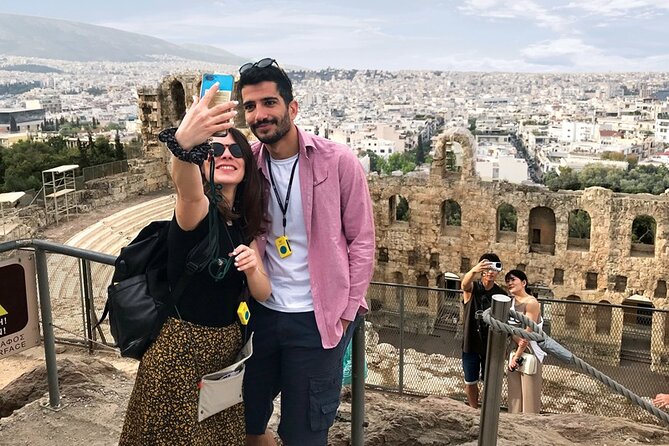
Early access turns the Acropolis into a story. This early entry tour pairs skip-the-line convenience with a guided route through the key ruins and the Acropolis Museum. You get a licensed local guide, clear audio headsets, and a tight plan that helps you beat the worst of the crowds.
I like how the pacing stays efficient. Each stop is long enough to look closely, then you move on before you melt in the sun. I also love the earsets. The audio makes the storytelling easy to follow even when the site is noisy and bright.
One thing to plan for: entrance fees are mostly not included, so your final spend depends on which ticket option you pick. Also, it is a moderate uphill walk, and there is a fair amount of it.
Key highlights you will actually feel
- Early entry plus skip-the-line options helps you get to the main sights before the biggest crush
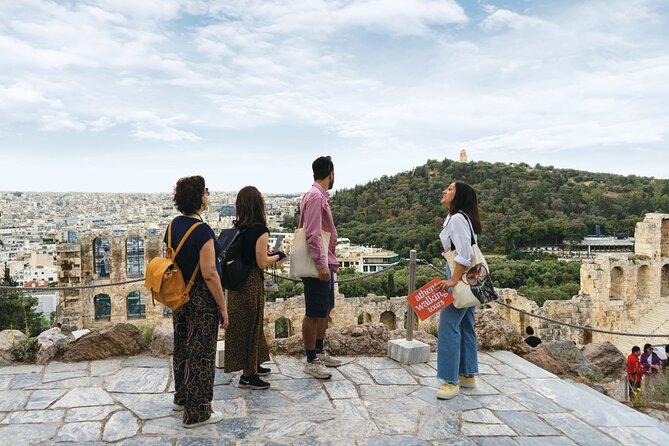
- Headsets (earsets) keep the guide’s narration clear, even with crowds around you
- Stop-by-stop storytelling connects theatres, temples, and myths into one route
- Small group size, up to 24 people makes it easier to hear the guide and keep together
- Museum timing gives you a chronological view after the hilltop sights
- Parthenon entrance included (with this tour option), so one big ticket piece is handled
Early entry at the Acropolis, what you gain beyond convenience
The biggest value here is that you get to see the Acropolis while it is still manageable. If you have ever tried to see the Parthenon area after the late-morning crowd hits, you know how quickly “a quick look” turns into slow inching and dodging camera arms. This tour is built around early access, so you spend more time looking and less time waiting.
Skip-the-line is also a real money-and-time saver. Even if you buy a ticket, the real friction at the Acropolis is the waiting. This tour adds a guided plan plus a ticket-handling pathway if you choose the WITH ticket option. Translation: you get to focus on the ruins instead of standing in a line.
I also like that the guide helps you read what you are looking at. The Acropolis is not just pretty stones. When your guide ties each building to its purpose, you stop seeing “random rocks” and start seeing a working city in stone.
More Athens tours and experiences for the shortlist



Where you meet, where you end, and what 3.5 hours feels like
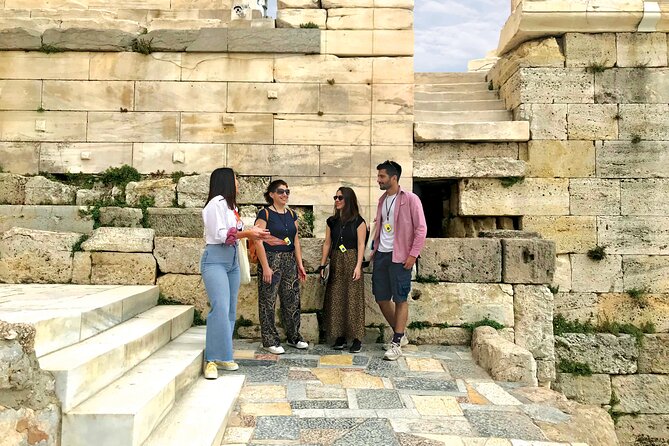
The tour starts at Acropolis Canteen (Athens 105 58, Greece) and finishes at the Acropolis Museum (Dionysiou Areopagitou 15, Athina 117 42, Greece). That one-way flow matters. Instead of doing a back-and-forth walk across the same streets, you climb the hill with the group, then transition into the museum afterward.
Plan on about 3 hours 30 minutes total. The itinerary moves through several major stops with short guided segments, then some time for you to take in views and photos. Expect walking that includes uphill sections and stairs. One of the clearest practical notes from the experience is that it is worth it, but it is still work.
Group size is capped at 24 travelers, which is small enough to stay social but big enough for a lively atmosphere. You will also be near public transportation, which helps if you want to continue exploring after the tour ends at the museum.
Theatre of Dionysus: the day you start with drama
You begin at the Theatre of Dionysus, a key starting point because it sets the tone for what Athens did best: turning ideas into public events. This theatre is tied to the birth of drama. The tiered seating carved into the hillside gives you a sense of how an audience would have experienced tragedy and comedy, not just watched from somewhere convenient.
The stop is about 15 minutes, so you are not doing a long dig here. It is a fast primer. Still, it works because it primes you for the rest of the Acropolis. Once you hear why drama mattered in the city, you notice how “performance space” shows up again and again in Athenian life and architecture.
A small consideration: this first stop is not where the big iconic photos are. But I think that is the smart part. You get context before the headline monuments.
Herod Atticus Odeon: ancient Rome, still singing today

Next up is the Herod Atticus Odeon, an ancient Roman theatre built into the Acropolis. The best practical thing about this stop is that you can connect the architecture to modern use. It still hosts music concerts and performances today, so it is not just history behind glass.
Your time here is about 10 minutes. That is enough for a look, a sense of scale, and the guide’s explanation. If you like when ancient structures still have a living function, this is a stop you might enjoy more than you expect.
Drawback to note: because it is short, you should not treat this as your only chance to photograph the Odeon angle. If you are a serious photo person, the early entry helps because you have less competition while you frame shots.
Ionic Temple of Athena Nike: winning, in stone and view
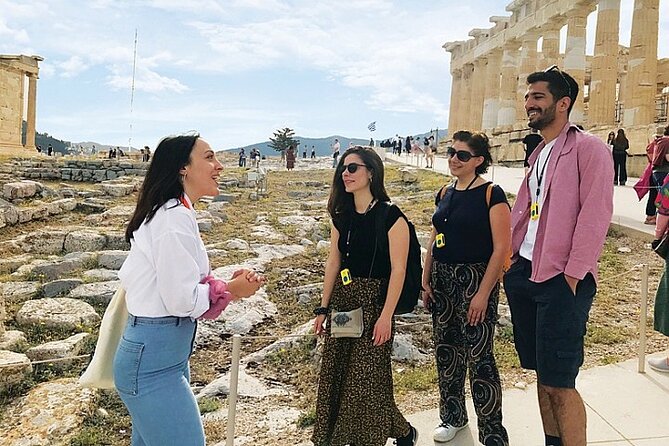
The Ionic Temple of Athena Nike is where the tour connects fine details to a big perspective. Athena Nike is associated with victory, and the temple is known for its friezes. You will also get panoramic views from this part of the Acropolis, which is one reason the stop matters even if you are not a detail-spotter.
This portion is designed to give you two things at once: visual texture and sightlines. The Ionic style is more delicate than the heavier Doric columns you will see later, so it is a nice change of pace. Plus, views here help you understand why the hilltop layout makes sense in the first place.
If you are traveling in hot weather, this is a stop where you might feel the sun quickly. Early access helps, but you still want to pace yourself. Take breaks in shade when you can, and drink whenever you find a sensible moment to do it.
You can also read our reviews of more museum experiences in Athens




Erechtheion with the Caryatids: myths you can see
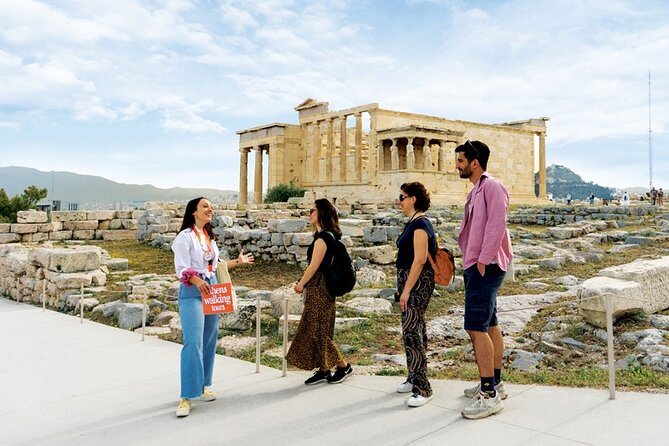
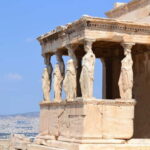
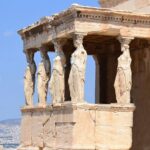
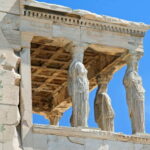
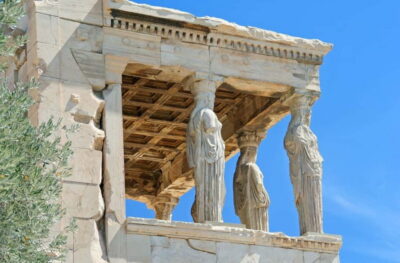
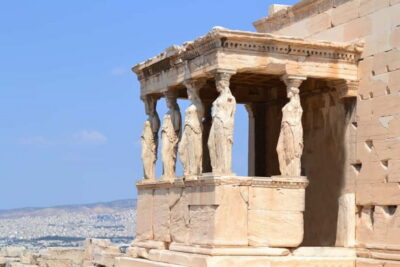
The Erechtheion stop is about 15 minutes and is focused on the myths tied to the Acropolis. It is also famous for its Caryatid maidens, the sculpted female figures that act as architectural supports.
This is one of those stops where your guide’s narration really matters. The Erechtheion is visually striking, but the stories make it feel real. You get that sense that the Acropolis was not only a monument park. It was a sacred place full of meaning and competing legends.
One practical note: because you are walking between carved stone surfaces, your eyes can start to blur if you move too fast. Slow down just a little. Look at the Caryatid figures and the way the space is shaped around them. That is the moment when your brain goes from seeing statues to understanding composition.
Parthenon time: the iconic moment, with the right context

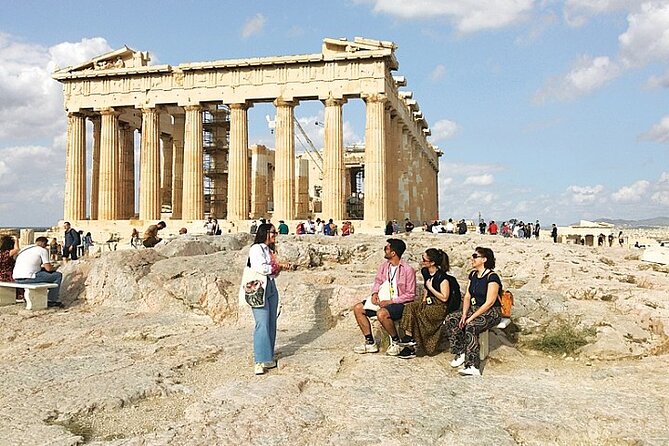
The Parthenon is the headline. You spend about 20 minutes here, and the Parthenon admission ticket is included. That is a notable value piece because the Parthenon area is where you often feel the most time pressure.
What you will appreciate is not only the famous Doric columns, but also the intricate friezes and the city views. Even with a limited time slot, you can do two smart things if you manage your energy: first, stand back for the full form, then move closer for the carved details when your eyes are freshest.
This is also a great place to notice contrast with earlier stops. The theatre and odeon feel like stages. The Parthenon feels like a state statement. If your guide is strong, this transition clicks fast.
The Acropolis hill walk: your self-time on sacred ground
After the key monuments, you get about 1 hour 15 minutes for the Acropolis area itself. This is where you start to connect the dots you heard earlier. You are not only looking at one building. You are experiencing the sacred hill as a system.
Why the self-time matters: a guide can tell you what to notice, but you need a little room to look at what you personally find interesting. Early entry helps here, because you spend more of that 1 hour 15 minutes actually exploring instead of waiting at bottlenecks.
You should also expect uphill effort. Even if you are fit, the Acropolis will still make you pay attention to your pace. The tour’s total length plus walking means you cannot treat it like a casual stroll.
Acropolis Museum: where the story gets chronological
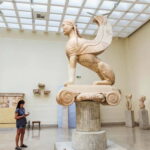
The tour finishes with the Acropolis Museum, with about 1 hour 15 minutes for your visit. The museum is where many people finally connect what they saw on the hill with the objects made for that place.
You get a chronological journey through Athenian history and artifacts from the Acropolis. That matters because on the hill you are seeing shapes in space, but in the museum you start seeing how time and craft fit together. It is one of the reasons pairing a hill tour with the museum helps so much.
One important practical caution from the field: the entrance with this kind of tour may not include the ruins that are discovered underneath the museum. If you want to see those under-museum remains, you might need to pay for another entry. If that ruins section is a must for you, budget for it so you are not surprised later.
Guides, headsets, and small group energy
This tour is run by Athens Walking Tours, and what consistently improves the experience is the human piece. Guides named Rina, Pan, Marguerite, and Helene are specifically called out in the experience details you were given, and the common thread is storytelling that holds attention.
The guide factor is not just trivia. When someone ties the Theatre of Dionysus to drama, then walks you toward the Erechtheion and explains why those figures matter, the Acropolis stops being a checklist. It becomes a reasoned route.
The clear audio headsets are the unsung hero. On busy days, trying to hear a guide without audio is tiring. With earsets, you can focus on the ruins instead of turning your head every time a bus passes.
Also, the group limit of 24 helps. You are not squeezed into a huge herd, and that makes it easier to pause and look without constantly bumping into people.
Price and value: is $59 money well spent?
At $59 per person for about 3 hours 30 minutes, this tour sits in the “good value if it matches your priorities” category. Here is why.
You are paying for a licensed guide, earsets, and a planned route through the main sites. You also get Parthenon admission included as part of the itinerary design, and you may get ticket-line help if you choose the WITH ticket option.
What is not included: entrance fees for many parts are not included by default, plus hotel pickup is not offered. There is also food and beverages not included. That means your total day cost depends on which ticket option you select and what you choose to add for the museum ruins section.
My quick rule of thumb: if you want structure, storytelling, and time savings at a high-demand site, $59 is a fair deal. If you are the type who loves independent wandering and you already have your tickets lined up, you might question paying extra for guidance. But for most first-time Acropolis visits, the early access and guide guidance do real work.
Practical fit: who should book (and who might not)
This experience fits best if you want the Acropolis done in a smart order. It is ideal for first-timers who want clarity fast, and for anyone who prefers a guide’s narration to reading signs and guessing connections.
You should also be comfortable with moderate physical fitness. The route includes uphill walking and several stops. One review note highlights that there is a fair amount of uphill walking, and it is completely worth it, but that is still a clue you should not schedule this on a day you feel tired.
If you have mobility limits, this might feel like too much. The itinerary involves multiple outdoor stops where the pace depends on the group and the site flow.
Should you book this Acropolis and Museum early-entry tour?
Yes, if you want the Acropolis experience to feel organized, and you care about beating crowds while enjoying a guided narrative. The combination of early entry, skip-the-line options (when you select the WITH ticket option), and headsets makes this a smoother day than trying to piece it together on your own.
If your budget is tight and you are set on buying only the absolute minimum tickets, check the ticket option details carefully. Entrance fees are not fully included, and the museum has a practical note about under-museum ruins that may require extra entry.
Overall, this is a strong choice for a limited time Athens visit. You get the big monuments, you get the museum payoff, and you do not waste the morning standing in lines.
More Tickets in Athens

More Tours in Athens


More Tour Reviews in Athens
- All Day Cruise -3 Islands to Agistri,Moni, Aegina with lunch and drinks included
★ 5.0 · 4,958 reviews



Not for you? Here's more nearby things to do in Athens we have reviewed









Athens Acropolis & Parthenon Tours, compared.
 ★ 4.4Acropolis & up to 5 Archaeological Sites Combo PassFrom $4812,619 reviews
 ★ 4.2Acropolis Ticket with Optional Audio or Live GuideFrom $4211,055 reviews
 ★ 4.8Acropolis, Parthenon & Acropolis Museum Guided TourFrom $409,316 reviews
 ★ 4.6Acropolis and Parthenon Guided Walking TourFrom $385,882 reviews
★ 4.8Acropolis, Parthenon & Acropolis Museum Guided TourFrom $413,579 reviews
★ 4.6Acropolis and Parthenon Guided Walking TourFrom $385,882 reviews
★ 4.8Acropolis, Parthenon & Acropolis Museum Guided TourFrom $413,579 reviews
 ★ 4.0Acropolis Ticket with Audio GuideFrom $473,575 reviews
 ★ 4.7Acropolis: Acropolis and Parthenon Guided Walking TourFrom $363,442 reviews
 ★ 5.0Acropolis monuments & Parthenon Walking Tour with Optional Acropolis MuseumFrom $422,678 reviews
Browse the lists this tour appears in