
Delphi has a way of feeling unreal. This private day trip from Athens pairs a scenic drive through mountain towns with a focused walk through ancient Delphi, including the oracle story and the main temple areas. You also get real comfort for a long day: hotel pickup, an air-conditioned car, and WiFi on board, plus bottled water.
What I like most is how the route gives you more than just ruins. You stop for a look at Iliki Lake, then head to Arachova for a short mountain-town break before arriving at ancient Delphi around noon. One practical caution: site tickets and entrance fees are not included, and the day is long (about 10 hours), so budget time for lines, extra costs, and some uneven ground.
Key reasons this Delphi trip works
- Small group, private ride (max 3), so you are not stuck with strangers’ pacing
- Driver-led history with an important limit: the driver is not a licensed site guide
- Iliki Lake fact stop with a real-world hook about Athens drinking water since 1958
- Arachova break in a mountain town known for traditions and walnut-tree roots
- Ancient Delphi highlights in one sweep, including Apollo sites, the sacred way, treasuries, and the old theater
- Delphi Museum time to see the bronze Charioteer and other major finds
Delphi From Athens, The Real-World Value of Doing It in One Day
If Delphi is on your Greece wish list, doing it as a day trip can be a smart move. Athens to Delphi is a long haul, and that is the main reason a private tour makes sense: you get one clean plan, one vehicle, and a schedule built around getting you there at a workable time. The drive itself matters here. You head through mountains and fertile valleys, passing towns like Levadia and Arachova, and that gives context for what Delphi’s setting feels like, not just what it looks like on a postcard.
You also arrive at ancient Delphi around noon. That timing helps because you can see the main areas while you are still awake and energized, then cool down with museum time afterward. And since the tour includes a return drive to Athens after lunch in Delphi, you avoid the classic problem of getting stuck deciding how to get back.
The biggest value for me is that the tour does not try to cram everything into a tiny window with constant rushing. You are given a couple hours for ancient Delphi and about an hour for the museum. That is enough time to get your bearings, slow down in the places that matter most, and still make the day feel manageable.
You can also read our reviews of more private tours in Athens


Road-Trip Comfort: Pickup, Air-Conditioning, WiFi, and a Driver Who Can Adjust
A day trip lives or dies on transportation. This one starts with hotel pickup and drop-off, plus a private, air-conditioned vehicle with WiFi on board. For a roughly 10-hour outing, that comfort is not a luxury. It is what lets you arrive ready to walk.
The other big plus is the human factor. The driver is described as having knowledge of history, and the standout review feedback points to George specifically, with praise for being attentive and flexible. The practical takeaway for you is simple: if you have a question or a small request, this format is built for adjustment. One review also mentions a stop for Greek honey when that was requested, which tells you the day is not totally rigid once you are on the road.
There is one important limit to understand. The driver is not licensed to accompany you in any site. That matters because it affects how much formal guiding you will get while you are inside specific archaeological areas. You will still have the benefit of historical context from the driver, but you should be ready to manage parts of the visit as a self-guided experience once you are at the monuments. If you want a fully licensed guide for interpretation in every section, you would need to plan for that separately.
Iliki Lake Stop Near Thebes: A Brief Break With a Big Athens Connection
This tour adds a stop at Iliki, a large natural lake in Boeotia. It is located about 8 km north of Thebes, at an elevation of 78 m. The detail I find most useful is the reason it is famous: it has been an important source of drinking water for Athens since 1958.
Why this is worth a quick pause: it connects what you see on the road to what you use back home. You get a real sense that Greece’s geography is not just scenery, it is infrastructure and everyday life. Even if you only get a short stop, it makes the journey feel less like a transfer and more like a slow build into your day at Delphi.
If you are sensitive to long stretches of driving, this kind of break helps. It gives you a chance to stretch and reset, without derailing the overall timing.
Arachova: Mountain-Town Atmosphere Before the Oracle Sites
Before Delphi, you stop in Arachova. This is a tourist ski resort destination, placed in the mountains with strong local traditions and close proximity to Delphi. There is also an interesting name origin piece: it comes from South Slavic, and it denotes a place with walnut trees.
You get about 30 minutes here. That is short, but it fits the rhythm of a day trip. Think of it as a quick taste of place rather than a full town exploration. If you want a small souvenir or a snack, this is the time to do it. If you want just a few photos with the mountain backdrop, that also works.
The practical upside is that Arachova helps you mentally transition from modern Greece into ancient Greece. You are still in a lived-in mountain village, not a sealed museum. That makes arriving at Delphi feel like a stronger “then and now” contrast.
Arriving at Ancient Delphi: The Oracle Setting You Can Actually Walk
Ancient Delphi is famous for one reason above all others: it was the most famous oracle of the ancient world, and it was regarded as the center of the world. The core story revolves around Pythia, the priestess who sat on a tripod, inhaled ethylene gases, and delivered future-predicting utterances that were described as incomprehensible.
Whether you take the myth literally or treat it as a window into ancient belief, the setting is what makes the story stick. You do not just read about Delphi anymore. You move through the space where people believed answers were received. That physical experience is why Delphi is so hard to replicate from a distance.
Your time at ancient Delphi is about 2 hours. That is enough to cover the main areas without feeling like you are sprinting. You will visit several key elements in a planned order: the Temple of Athena Pronaia, the Castalia Spring area, the Stadium, the Temple of Apollo, the Sacred Way, the Treasury House of the Athenians, the Old Theater, and then you shift to the museum for the next act.
One caution for your planning: archaeological ground can be uneven, and sites like the theater and stadium areas often involve natural slopes and steps. The tour asks for a moderate physical fitness level, so comfortable walking shoes really matter.
More Athens tours and experiences for the shortlist




Athena Pronaia, Castalia Spring, and the Stadium: What to Notice on the Ground
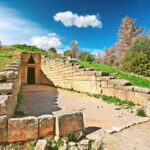
You start with the Temple of Athena Pronaia. This is one of those locations where your brain starts sorting the pieces into a map. You get the sense of how Delphi’s religious world was structured, not just how it looked.
Next is the Castalia Spring. This spot is tied to Delphi’s sacred life, and it helps explain why Delphi was not only about speeches and answers. It was also a place of rituals and daily sacred practice. Even if you do not fully memorize every ancient detail, it is an important stop for getting the “oracle landscape” right.
Then you reach the Stadium. It is a reminder that Delphi was more than prophecy. Games and public events mattered there too. For many visitors, the stadium area provides a helpful scale reference because it is a different kind of space than the temples and treasuries.
The main practical tip here is pacing. In a day trip, it is easy to rush to the most photographed ruins. Instead, take a minute at each stop to look around before you move on. Delphi reads best in layers, and these early stops are where that layering starts to make sense.
Temple of Apollo and the Sacred Way: The Heart of Delphi’s Religious Power
The Temple of Apollo is the emotional center of the visit. This is the place you connect directly to Delphi’s identity as the oracle site tied to Apollo’s worship.
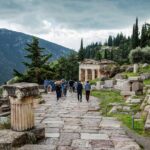
From there, you move to the Sacred Way. This is one of those routes you can almost feel as a processional path. It is where you understand that Delphi was experienced in motion, not just seen from one point. Walking along the sacred route concept is helpful because it turns the ruins into a story about how people traveled, prayed, and participated.
The Treasury House of the Athenians adds another layer. Treasuries at Delphi reflected the pride and public statements of different city-states. Standing around these architectural remains is a good moment to think about Delphi as a shared religious platform for the Greek world. It explains why it could be seen as the center of the world, even when it was one location with its own sacred rules.
If you like symbolism, this is the part of the day that rewards slowing down.
Old Theater and Museum Time: Turning Ruins Into Real Art
After the sacred and temple areas, you reach the Old Theater. This is where Delphi stops feeling purely ceremonial and starts looking like a place where public life happened too. The theater space makes the entire site feel more human. People gathered. They watched. They listened.
Then the tour goes to the Delphi Archaeological Museum for about an hour. This timing is smart because it lets you shift from outdoor architecture to objects you can study without wind, sun angles, or constantly changing light.
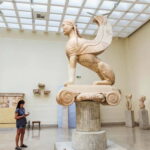
The museum visit includes treasures, and the star mentioned is the world-famous bronze Charioteer, a masterpiece of classical Greek art. If you only take one museum object as a memory, this one will likely be it. Seeing it in a museum setting often helps you understand what the ancient Greeks made and valued, not just what they built.
The biggest practical benefit of an hour is that you can actually absorb key pieces instead of doing a rushed scan. If you are the kind of visitor who wants to read labels, aim to spend a bit longer near the highlights. If you prefer faster viewing, you can still cover the museum without feeling behind.
Lunch in Modern Delphi: How to Keep the Day Smooth
After exploring ancient Delphi, you head to the modern city of Delphi for lunch in traditional taverns. The tour does not list specific restaurants, so you should expect your lunch choice to be guided by what fits the schedule and location that day.
For a long day, keep lunch simple. Choose something you can eat comfortably without needing a lot of recovery time. This is also where you can reset your energy before the return drive to Athens. The route is long enough that you want to keep your final hours feeling relaxed, not sluggish.
If you are interested in local food, modern Delphi is a decent place to look for it, since you are still in the region where people genuinely live and cook, not just operate for day visitors.
Price and Value: What $688.31 Gets You (Up to 3 People)
The price is $688.31 per group for up to 3 travelers, with booking commonly made about 209 days in advance. Put differently, you are paying for a private vehicle, a full day plan, and a driver who can adjust within reason.
Here is the value math. If you split the group price with 3 people, that is about $229 per person for a full day that includes hotel pickup, drop-off, tolls, bottled water, WiFi, and a long-distance drive plus multiple stops. Even at 2 people, it is roughly $344 per person. That can be a good deal compared to buying separate transport and then trying to coordinate tickets and timing on your own.
What you should still budget for: archaeological site tickets and entrance fees are not included, and food and drinks are also not included. Also, there is no licensed tour guide included, so interpretation is driver-led rather than formal site guiding.
To decide if it is worth it for you, ask what you want to avoid. If you want to avoid logistical stress, want comfort for a 10-hour day, and like having your time planned while still getting a bit of flexibility, then the price can make sense.
Who This Tour Suits Best (And Who Might Want a Different Format)
This tour fits well if you want structure and comfort. The private vehicle, hotel pickup and drop-off, and the planned progression through Delphi’s main sites make it a strong option for first-timers.
It also works if you like a driver who provides context but still gives you space to explore. The driver’s historical knowledge can be helpful, and the flexibility shown in the George honey-shop story is a good sign that you are not locked into an ultra-frozen schedule.
It may not be ideal if you want a fully licensed guide walking you through every site with deep narration inside each archaeological area. Since the driver is not licensed to accompany you in any site, you may want to add another guiding option if that is your top priority.
The tour asks for moderate physical fitness, so if walking uneven ground is a concern, consider your comfort level. If you are generally okay with ancient sites, stairs, and walking for a few hours total across multiple areas, you will likely do fine.
Should You Book Andrew’s Unique Tours to Delphi?
I would book this if your top goal is a stress-light day that hits the major Delphi stops without making you plan transportation. The private size limit, the comfort setup (AC, WiFi, bottled water), and the fact you also get Iliki Lake and Arachova as warming-up stops makes it more than just a “ruins only” trip.
If you are the type who hates extra costs, read this part carefully. You will pay for tickets and entrance fees, and you will pay for lunch and drinks. That is normal for archaeological day trips, but it is still a reason to budget ahead so there are no surprises.
Finally, pay attention to the weather requirement. This experience requires good weather, and if it gets canceled due to poor weather, you will be offered a different date or a full refund. Delphi outdoors is a weather story, so pick a day when you feel optimistic about conditions.
FAQ
How long is the Delphi day trip from Athens?
The tour duration is approximately 10 hours.
What is the group size for this tour?
The tour has a maximum of 3 travelers.
Is hotel pickup and drop-off included?
Yes, hotel pickup and drop-off are included.
Are tickets and entrance fees included?
No. Tickets to the archaeological sites and entrance fees are not included.
Is the Delphi Archaeological Museum ticket included?
No. Admission to the Delphi Archaeological Museum is not included.
Is a licensed tour guide included during visits?
No. A licensed tour guide is not included. The professional driver has knowledge of history, but is not licensed to accompany you in any site.
Is the tour dependent on weather?
Yes. This experience requires good weather. If it is canceled due to poor weather, you will be offered a different date or a full refund.
What is included in the price?
Included items are hotel pickup and drop-off, professional drivers with knowledge of history, tolls, an air-conditioned vehicle with WiFi on board, bottled water, and private transportation.
What is the cancellation policy?
You can cancel for free up to 24 hours in advance for a full refund. If you cancel less than 24 hours before the experience start time, the amount paid is not refunded.
More Private Tours in Athens


More Tours in Athens



More Tour Reviews in Athens
- All Day Cruise -3 Islands to Agistri,Moni, Aegina with lunch and drinks included
★ 5.0 · 4,958 reviews


Not for you? Here's more nearby things to do in Athens we have reviewed








Athens Private Tours, compared.
 ★ 5.0Best of Athens Half Day Private TourFrom $913,714 reviews
 ★ 5.0Athens Full Day Private TourFrom $2442,903 reviews
 ★ 5.0Athens Greece Full Day private tourFrom $683785 reviews
 ★ 5.04 Hours – Athens & Acropolis Highlights Private TourFrom $181681 reviews
★ 5.0Athens Full Day Private TourFrom $205667 reviews
★ 5.04 Hours – Athens & Acropolis Highlights Private TourFrom $181681 reviews
★ 5.0Athens Full Day Private TourFrom $205667 reviews
 ★ 5.0Lake Vouliagmeni Thermal Spa And Temple Of Poseidon Private Full Day TourFrom $171578 reviews
 ★ 5.0Acropolis and Acropolis Museum Private Tour with Licensed ExpertFrom $188445 reviews
 ★ 5.0Athens Highlights Half Day Private TourFrom $305407 reviews
Browse the lists this tour appears in