
Reviewed · PELOPONNESE TOURS FROM ATHENS
“A Day in Ancient Olympia:The Cradle of the Olympics Games”
Ancient Olympia in one day sounds impossible, until you see how it works. This trip strings together Olympia’s top ancient sights plus museum time, with round-trip transfers so you spend less effort on logistics and more time looking up at Zeus. I like that the drive is comfortable and practical, and the day keeps moving so you cover two major sites without feeling rushed at every single stop. One thing to consider: key ticket costs are not included, especially the Olympia site admission, so your final total depends on the season price.
What really makes this feel worth it is the “get there, then get value” rhythm. You travel in an air-conditioned Mercedes-Benz with Wi-Fi, water, and charging built in, and you get help with skip-the-line ticket purchasing. The driver is English speaking and history-aware, but they are not a licensed museum guide inside each site, so you may want a licensed guide only if you know you want deep commentary as you walk.
Key highlights at a glance
- Two world-class stops in one day so you can do Isthmus of Corinth and Olympia without a second trip
- Mercedes-Benz comfort with A/C, Wi-Fi, water, and chargers for a long day
- Skip-the-line ticket help to cut down time where it matters most
- Olympia’s major landmarks including the Temple of Zeus and the stadium
- Museum pairing gives context before and after you walk the ruins
- Driver support with pickup options from Athens or Port Piraeus and clear contact details ahead of time
Your ancient-athletics day: Olympia from Athens, done efficiently
If you only have one full day and you want to feel the real weight of ancient Greek sport, this is a smart plan. Olympia is not just a ruin site you glance at. It is a whole setting where religious power and athletic competition mixed every four years, and you can still sense that scale even when you’re standing in modern shoes.
The efficiency matters because the day is about 8 to 10 hours. You are not zig-zagging by public bus or trying to time ferries and shuttle transfers. Instead, you get private transportation, and you can focus on the places themselves, like the stadium where runners once chased glory and the temples tied to Zeus.
I also like that the stop at the Isthmus of Corinth is short but meaningful. It acts like a geographic warm-up before Olympia, so the day feels like a story, not a random checklist.
You can also read our reviews of more tours and experiences in Athens.


Comfort on the road: Mercedes-Benz transfers with Wi-Fi and charging
A long drive can turn a cultural day sour fast. Here, your ride is set up to keep you functional. You travel in a Mercedes-Benz with air-conditioning, Wi-Fi, bottled water, and mobile chargers. That is the difference between spending the ride browsing your phone for survival and actually arriving with energy.
The tour is private, meaning it is only your group in the vehicle. That sounds like a small detail, but it changes the vibe. You are not listening to a dozen different preferences at every turn. You can keep things simple and settle in.
A practical note: this is a pickup-and-drop service from your chosen location in Athens or from Port Piraeus. If you are coming from a cruise, you meet the driver outside your ship with a sign that shows your name. That matters more than people expect, especially in busy port traffic.
From the service side, I appreciate the human reliability angle. One recent experience described a minor electronics problem with the car that got handled professionally, with no big disruption to the day. That kind of calm competence is exactly what you want when you are far from home.
Stop at the Isthmus of Corinth and the Corinth Canal story
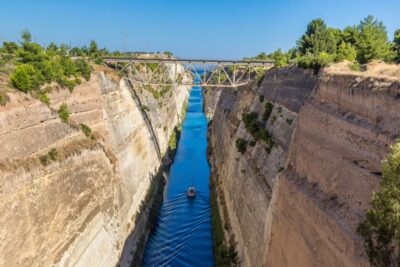
Your day starts with a scenic drive through the Peloponnese peninsula, then you get a first stop at the Isthmus of Corinth. This narrow strip is famous because it connects Central Greece with the Peloponnese, and the Corinth Canal, opened in the late 19th century, links the Saronic Gulf with the Gulf of Corinth.
Even if you only spend about 15 minutes here, it is a useful pause. It gives you context for why this area mattered strategically long before modern boats. The tour also points out that ancient defenses existed here, including a wall built in ancient times and preserved until the Byzantines, known as the Hexamilion.
This is the kind of stop that works well for most people because you are not asked to do much besides look and get your bearings. It also breaks up the drive so the rest of the day feels less like “sit and suffer” and more like a real outing.
If you want a small hack: bring a hat and keep water handy. Even when the walk is short, the sun can be surprisingly honest in Greece, and Olympia later is outdoors.
Walking the sanctuary of Zeus at the Olympia archaeological site
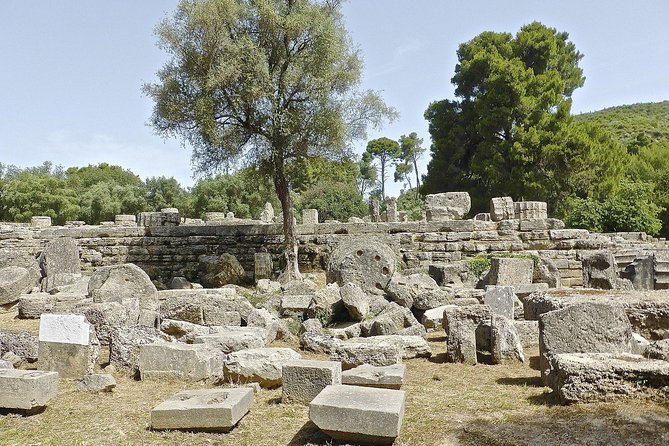
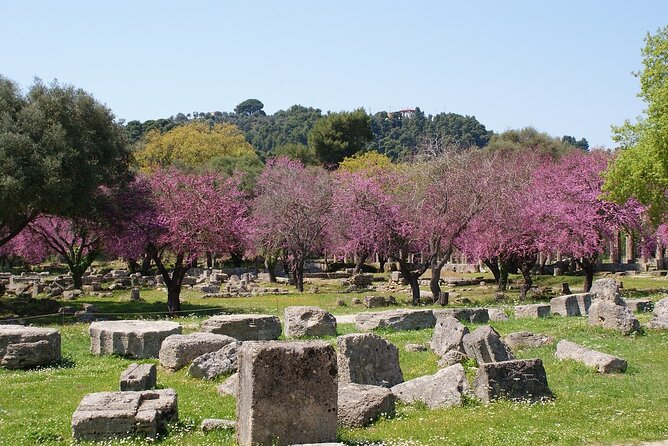
This is the main event. Olympia sits in the valley of the Alpheios River, in a lush setting near Mount Kronios. Long ago, it was one of the most important Panhellenic sanctuaries in Greece, tied to Zeus and the Olympic Games held every four years across the Classical world.
You get about 1 hour at the archaeological site, which is a tight window considering how many important pieces there are. The trick is to focus on the highlights that connect to the story of the games: the stadium for athletic competition, the temples for religious authority, and the surrounding buildings that supported training and ceremony.
Here are the big anchors you will see and what they mean as you stand there.
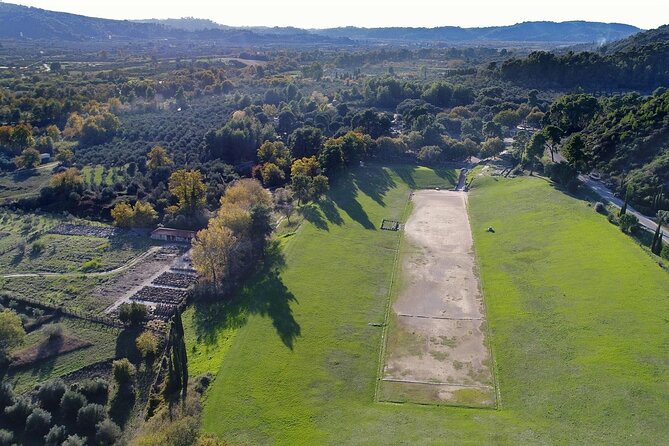
The stadium, where runners chased glory
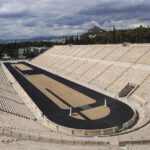
The stadium is the center of the athletic imagination. It is over 200 meters long and about 30 to 34 meters wide. When you face the track, it helps to remember that the Olympics were not just a sport event. They were a major festival with religious grounding and political significance.
Even in 2026, you can still get a sense of how intense the experience must have been for spectators and athletes alike. You’re looking at a place built for endurance, speed, and spectacle.
- All Day Cruise -3 Islands to Agistri,Moni, Aegina with lunch and drinks included
★ 5.0 · 4,958 reviews

Temple of Zeus, the power symbol
Near the stadium, you have the Temple of Zeus built in the 5th century BC by a local architect. The materials listed for the structure are limestone and marble, and historical records describe a giant golden statue of Zeus inside. That combination of scale and symbolism is why Olympia mattered so much.
If you like “why people believed what they believed,” this spot is for you. The temple is where sport met theology, and you feel that tension between earthly competition and divine approval.
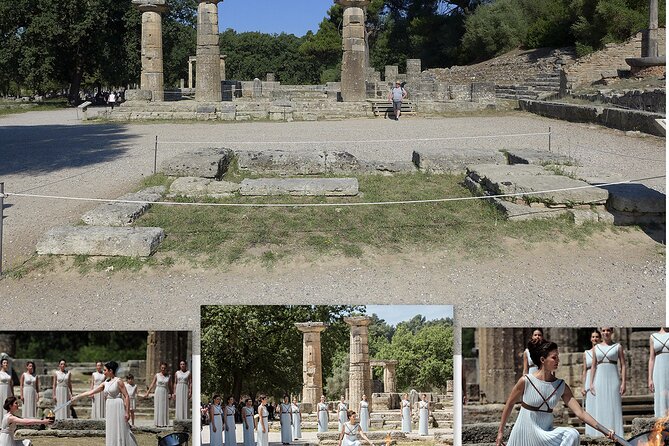
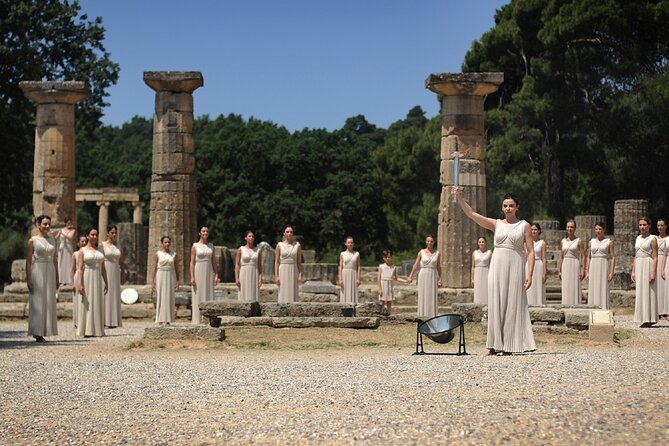
Altar of Hera, where the Olympic flame gets lit
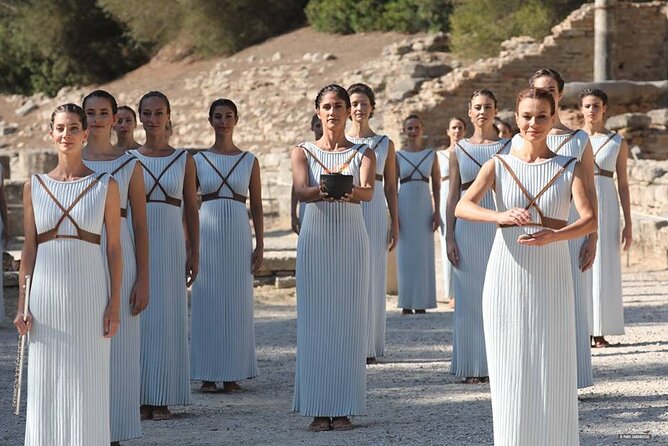
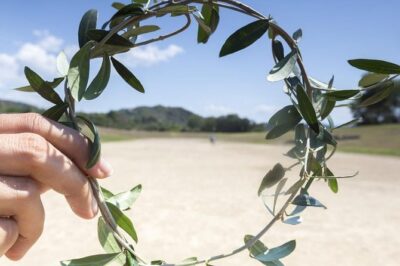
Close by is the Temple of Hera, described as one of the oldest temples in Greece, constructed in the 7th century BC in the Dorian style. Today, it is the altar where the Olympic flame is lit before the games.
That continuity is powerful. You are not only looking at what ancient people built, you are standing near where modern ceremonies reference the same idea of ritual and tradition.
Philippieion, the unusual circular presence
The Philippieion is the only circular building inside the Altis, dedicated to Zeus by Philip II of Macedon. This is one of those structures that makes you slow down, because it looks different from the typical temple-and-column pattern.
The value of seeing it is simple: it reminds you that Olympia was not just one big stadium and a couple of temples. It was a whole complex with architecture that reflects different eras and influences.
The palaestra, training culture in stone
The palaestra sits west of the Altis enclosure near the Kladeos River. Built in the 3rd century BC, it was part of the gymnasium complex and used for boxing, wrestling, and jumping practice.
This is where you start thinking like an athlete. The Olympics were not only “race day.” They were the end of training cycles and physical discipline.
One consideration: because this is a guided-by-driver style experience, not a licensed site guide walking you through every stop, you may want to rely on what you read onsite. A licensed tour guide can be requested depending on availability, and that can be worth it if you want deeper commentary while you walk.
Museum time: Olympia Archaeological Museum and the Museum of the Olympic Games
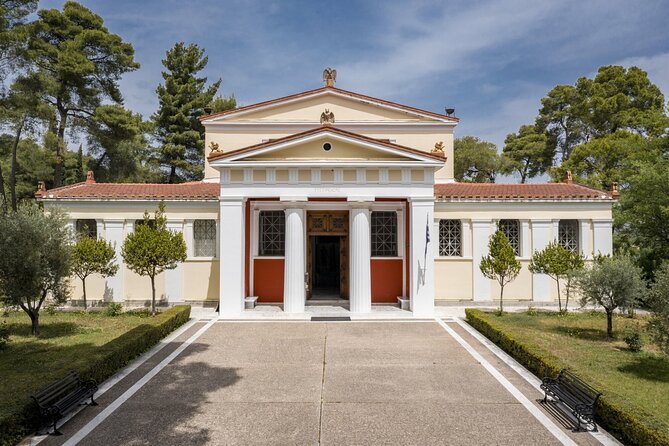
A lot of people treat museums as “waiting rooms” between outdoor sights. Here, the museum pair actually upgrades your understanding of what you just saw.
You have two museum slots:
- Olympia Archaeological Museum for about 1 hour
- Museum of the History of the Olympic Games for about 45 minutes
This combination is useful because one museum helps you understand the physical finds from the wider area. The other focuses more directly on the Olympic story itself.
Olympia Archaeological Museum, the best kind of context
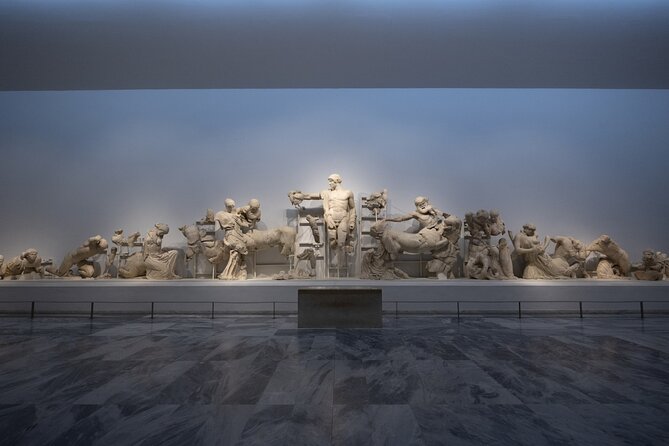
The Archaeological Museum is considered among the best in Greece, and it holds findings from the ancient site and from other excavations in the area. The layout is described as well labeled with many rooms, which matters when you have limited time.
Two named highlights are the statues of Hermes by Praxiteles and the statue of Nike by Paionios. Those are the kinds of works that make you rethink the ancient world as more than stone blocks. Art and craft were central, even in a setting defined by competition.
When you do this after walking the ruins, the museum becomes a kind of “translation layer.” Details you might miss outside snap into place.
Museum of the Olympic Games, the timeline feeling
The Museum of the History of the Olympic Games is housed in the old archaeological museum in Ancient Olympia. It focuses on findings related to the games across the entire area.
This is the right follow-up after you’ve seen the stadium and temples. Instead of stopping at the moment of ruins, you get a broader sense of how the Games fit into a longer history.
Time is short, so you’ll want to skim efficiently. Pick a couple of exhibits that match your interests, then let the rest fill in the background.
How much this day trip costs and where the add-ons really are
At $327.43 per person, this is not a budget outing. But you are paying for a few things that are hard to assemble yourself without stress: private round-trip transfers, a comfortable vehicle, and structured site time that covers Olympia plus the museum pair.
Here is where the “final cost” can grow:
- Olympia Archaeological Site admission is €20 per person and not included
- Museum admissions are also not included
- Lunch is not included
Ticket prices can vary by season, and that is important for planning. Because admissions are separate, your total might land noticeably higher in some periods.
So is it good value? For me, yes if you are counting comfort, time savings, and a day plan that avoids the hassle of coordinating transport. You also get help with skip-the-line ticket purchasing, which can be a real sanity saver at major sites.
But if you travel very cheaply and you enjoy building your own schedule, you might find a lower-cost option. Still, you would be giving up the straightforward pickup, private ride, and the smoother pacing that makes this day work.
Who this Ancient Olympia day trip suits best
This tour is ideal when you:
- want a one-day Ancient Olympia visit without wrestling with transfers
- appreciate comfort for a long day, especially in hot weather
- like history with big physical anchors like temples, stadiums, and training spaces
- want museum time instead of rushing straight home after ruins
It is also a good fit for cruise passengers because Port Piraeus pickup is built into the plan. You get a meeting setup with a sign and a named driver contact structure before the day.
If your main goal is a deep, step-by-step guided narration inside every site, you should consider requesting a licensed tour guide, since the driver is not licensed to accompany you inside museums and archaeological areas.
Tips to make your 8-10 hour Olympia day feel smooth
You cannot stretch time, but you can avoid wasted time and fatigue.
First, plan your stamina. Olympia and its museums together are not just “a quick walk.” You will be outdoors and in exhibition spaces. Wear comfortable shoes and carry water, even though the vehicle provides bottled water.
Second, be strategic with your one-hour site window. Before you arrive, decide what you want most:
- athletic vibe (stadium and palaestra)
- religious power (Temple of Zeus and Hera)
- the odd architectural detail (Philippieion)
Picking your priorities helps you enjoy it instead of trying to photograph everything and understand nothing.
Third, if you care about skipping lines, take advantage of the skip-the-line ticket purchasing assistance. It is there for a reason. You want your time at the site and in the museum rooms, not stuck waiting.
Fourth, bring a simple midday plan since lunch is not included. Even if you do not want a full meal, having a snack or drink ready can stop the day from turning into low-energy math.
Finally, make use of the clear communication. Pickup details include a way to locate your driver, plus driver contact details sent in advance and an emergency number if you cannot find them.
Should you book this Ancient Olympia day trip?
If you want a practical, high-impact day built around the Olympics birthplace, I think this is a solid yes. You are not piecing together transport, and you are not sacrificing comfort for cost. You get a private ride, smart pacing across Olympia’s key structures, plus museum time that actually supports what you see outdoors.
I would pass or adjust expectations if:
- you are extremely budget-focused and admissions matter a lot to you
- you want a fully licensed guide inside every museum and every outdoor stop
- you dislike long days, since the total time is about 8 to 10 hours
In other words, book it when you want Olympia done well, with less friction and more time spent in the places that matter.
FAQ
How long is the Ancient Olympia day trip?
It runs about 8 to 10 hours.
What does the pickup and drop-off include?
You get hotel/Airbnb/Port Piraeus pickup and drop-off without extra charge.
Is transportation private or shared?
It is private transportation, and only your group participates.
What language is provided during the trip?
The driver is English speaking.
Is Wi-Fi included in the vehicle?
Yes, Wi-Fi is provided on board, along with air-conditioning.
Are museum and site admission fees included?
No. The admission fee for the Archaeological Site of Olympia is not included (€20.00 per person), and admission tickets for the museums are also not included.
Does the tour help with skip-the-line tickets?
Yes, you get assistance with purchasing skip-the-line tickets, and you cover the ticket cost.
Can I request a licensed tour guide?
A licensed tour guide can be requested depending on availability. The driver is not licensed to accompany you in sites.
What if I need to cancel?
Free cancellation is available if you cancel up to 24 hours in advance for a full refund.
More Tour Reviews in Athens
- All Day Cruise -3 Islands to Agistri,Moni, Aegina with lunch and drinks included
★ 5.0 · 4,958 reviews
Not for you? Here's more nearby things to do in Athens we have reviewed



Peloponnese Tours from Athens, compared.
 ★ 4.5Peloponnese Highlights Day Trip and V.R. Audio GuideFrom $331,425 reviews
 ★ 4.54-Day Classical Greece Tour: Epidaurus, Mycenae, Olympia, Delphi, MeteoraFrom $766732 reviews
 ★ 4.53-Day Classical Greece Tour: Epidaurus, Mycenae, Nafplion, Olympia, DelphiFrom $520342 reviews
 ★ 4.84-Day Tour of Mycenae, Epidaurus, Olympia, Delphi & MeteoraFrom $747168 reviews
 ★ 5.0PELOPONNESE HIGHLIGHTS PRIVATE: Corinth Mycenae Nafplio EpidaurusFrom $376103 reviews
 ★ 5.04-Day Greece Highlights Tour: Epidaurus, Mycenae, Olympia, Delphi and MeteoraFrom $76079 reviews
 ★ 5.0Day tour to Ancient Olympia,Ancient Sparta Mycenae Including MealFrom $28654 reviews
 ★ 4.9Ancient Olympia full day private tour from AthensFrom $29854 reviews
Browse the lists this tour appears in