
Reviewed · ATHENS PRIVATE TOURS
4-Days Argolis,Ancient Olympia,Delphi,Meteora private tour from Athens
Mainland Greece in four days feels fast, but it works. This private Athens trip strings together the big-name ancient sites, with a calm, no-stress flow thanks to private transportation and planned stops. I also like the emphasis on expert commentary between monuments, so the places make sense instead of turning into a photo line.
The main thing to watch is budgeting, because entrance fees are not included (and a licensed on-site guide is not guaranteed). That is easy to handle if you plan ahead, but it can change the final cost if you assume every ticket is covered.
Key Points at a Glance
- Private group of up to 8 with one vehicle, so you are not stuck waiting on strangers
- Athens pickup and a smooth schedule built around major mainland highlights
- Expert storytelling that keeps the myths, battles, and daily life connected
- Driver perks that matter: air-conditioning, WiFi onboard, and bottled water
- Tickets and monuments extra since entrances for sites and monasteries are not included
- Delphi to Meteora in one run, a rare mainland combo for a short trip
Why This 4-Day Mainland Route Feels Relaxed
This tour is built for people who want the classics without the hassle. You get a dedicated private vehicle, and that changes the whole experience. Instead of figuring out routes, parking, and transfers, you can spend your mental energy on what you are actually seeing.
I like the pacing because it mixes “wow factor” stops with smaller, atmosphere-rich ones. You hit mega-icons like Olympia and Delphi, but you also get places like Nafplio and Epidaurus, where the day slows down just enough to absorb what you are looking at.
One more practical plus: the tour offers a mobile ticket and runs in English. That matters when you are bouncing through museums and open-air ruins, where signage alone can leave you guessing.
You can also read our reviews of more private tours in Athens


Athens Pickup, Comfort, and the Real Meaning of Private
You start with pickup in Athens, and the guidance is clear: be ready about 10 minutes early at the pickup point. It sounds minor, but it helps the day stay smooth, especially on a multi-day route where timing matters.
Inside the car, you get air-conditioning, onboard WiFi, and bottled water. Those are not flashy perks, but they genuinely help when you are doing long drives across regions. They also make it easier to stay organized with maps, transport alerts, or just quick updates from home.
English support is handled by an English-speaking driver. That is a big win for comprehension. Just be aware of the nuance: the driver is not stated as licensed to accompany you inside every site. The provider notes that a licensed tour guide may be available upon request depending on availability, so if you want maximum in-museum detail, ask early.
Day 1 Peloponnese: From the Corinth Canal to the Theater of Epidaurus
Day one is all about separation, power, and the everyday feeling of places that have been visited for thousands of years.
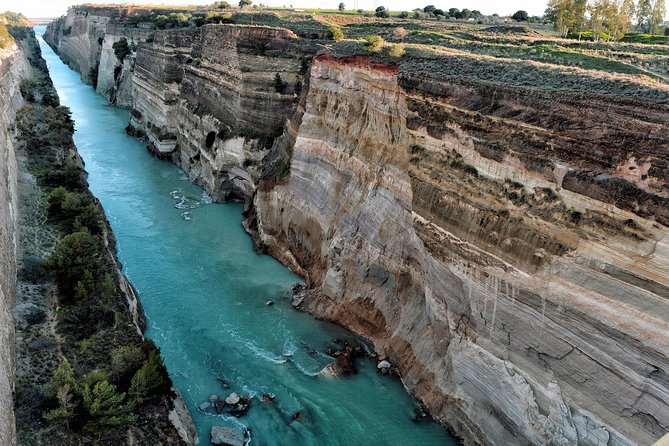
Corinth Canal: A Fast Stop With Big Geography
You begin at the Corinth Canal, where the canal slices between the Gulf of Corinth and the Saronic Gulf. The canal is short in time, around 20 minutes, but it is a strong “get your bearings” moment. It is one of those places where geography suddenly feels real, because you can see how this narrow passage shaped movement between regions.
Ancient Corinth: When Trade and Culture Meet
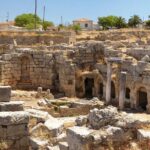
Next comes Ancient Corinth, with about 35 minutes on the ground. Corinth was a city-state on the Isthmus, the stretch that links the Peloponnese to mainland Greece. That location made it a hub, and the story of Corinth often reads like a mix of commerce, strategy, and cultural exchange.
Entrance fees are not included here, so you will want your budget ready. Still, even a short stop gives you context for what came later in the region’s political and mythic history.
- All Day Cruise -3 Islands to Agistri,Moni, Aegina with lunch and drinks included
★ 5.0 · 4,958 reviews



Mycenae and the Treasury of Atreus: Bronze Age Heavyweights
You then move to Mycenae, another roughly 35-minute stop. Mycenae is described as a major center of Greek civilization in the second millennium BC, known as a military stronghold with influence across southern Greece and beyond.
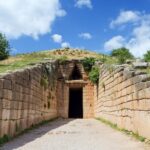
The highlight in this area is the Citadel and Treasury of Atreus, also called the Tomb of Agamemnon, with about 10 minutes. Even if you only get a brief look, this is the kind of place where details matter. The stone lintel above the doorway is famously massive, described here as weighing around 120 tons and noted as exceptionally large by world standards in the source description. The site is linked to long visibility and later discovery, including the mention of Pausanias in the 2nd century AD and Schliemann seeing evidence in 1879.
You do not need to be a classicist to feel the weight of it. What helps is having the context explained clearly, and this is one area where a well-run private guide format shines.
Nafplio and Acronauplia: Views, Fortifications, and a Real Town
After the ancient stops, you shift to the coastal mood of Argolis. Acronauplia is a short viewpoint stop, about 10 minutes, on a rocky peninsula above Nafplio. It is tied to Venetian fortification history and the sequence of who held it over time.
Then you get Nafplio itself, about 35 minutes. This is a seaport town that grew around hillsides near the Argolic Gulf. It also matters historically because it served as capital during the Greek Revolution period and even after, briefly marking early modern Greece from 1821 to 1834.
This is one of the best “your legs can breathe” parts of the day. Also, it is the kind of place where you can pause for a coffee, scan the streets, and let the day feel less like a museum checklist.
Epidaurus: The Quiet Power of Acoustics
Day one finishes with the Ancient Theatre of Epidaurus, about 30 minutes. This theater sits in the broader sanctuary dedicated to Asclepius, the ancient Greek god of medicine.
The big selling point here is acoustics and aesthetics, described as the most important ancient Greek theater for sound and visual design in the provided info. Even without technical explanations, the setting makes you understand why ancient people built places where voice carried.
Entrance tickets are again not included, so factor that into your planning.
Day 2 Olympia, Archimedes, and Nafpaktos in One Long Day
Day two leans into sports, science, and sea power. It starts early after breakfast, with Olympia and its museum sites, then continues through the afternoon and ends with a return to Athens in the early evening timeframe.
Ancient Olympia: Stadium to Temple of Zeus
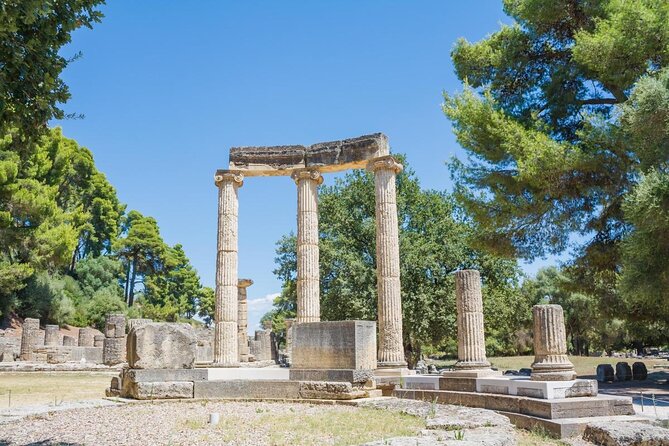
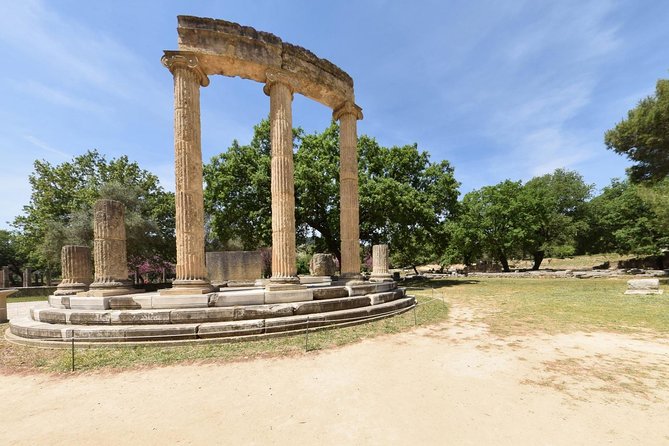
You visit the archaeological site of Olympia and the museum area, with about 2 hours. This is where the Olympics began, with Olympic Games mentioned from 776 BC to 393 AD.
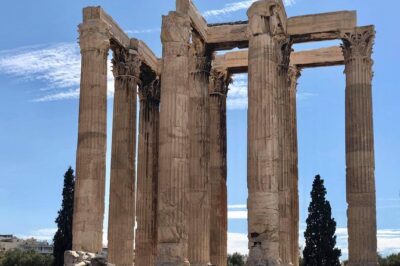
You see the ancient stadium, plus the Palaistra, where athletes trained for events like wrestling. You also get to the ruins of the temple of Zeus, where a statue of Olympian Zeus is referenced as one of the seven wonders in the information.
The workshop of Phedias is also part of the visit. Phedias is named as the great sculptor and architect tied to major works, including Athena Parthenos and Olympian Zeus. In a private format, these names help you connect art, politics, and religious power instead of treating each ruin like a standalone scene.
Entrance fees are not included. That is normal for major sites, but still, it is one of the biggest ticket days in the whole loop.
Archimedes Museum: Science Without the Lecture
After Olympia, you stop at the Archimedes Museum for about 35 minutes. This is dedicated to the ancient Greek mathematician, physicist, engineer, astronomer, and inventor, and it is described as tied directly to contributions to technology.
If your brain likes cause and effect, this break is useful. It keeps day two from being only monuments and myth. It also gives you a different kind of ancient “achievement,” which helps the rest of the trip feel more rounded.
Entrance is not included here either.
Nafpaktos (Lepanto): A Coastal History Loop
Next is Nafpaktos, about 1.5 hours, and it is a fascinating stop for anyone who likes history that keeps changing hands. The provided description ties it to Athenian naval strategy during the Peloponnesian War, then to Crusades era shifts, and later Venetian and Ottoman–Venetian conflicts. It even connects to the Battle of Lepanto in 1571, plus a brief Venetian period again much later and the return to Greek independence.
Admission is listed as free here. That means this is a low-cost stop that can still feel meaningful, because the story is heavy and the setting is coastal and practical.
Day 3 Delphi and Arachova: Oracle Country Plus Mountain Atmosphere
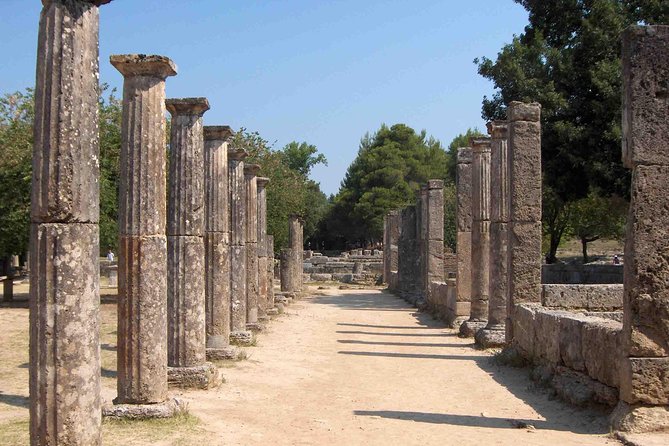
Day three is one of the most classic combinations in Greece: Delphi first, then Arachova for mountain mood.
Delphi Archaeological Museum: Where the Oracle Fit In
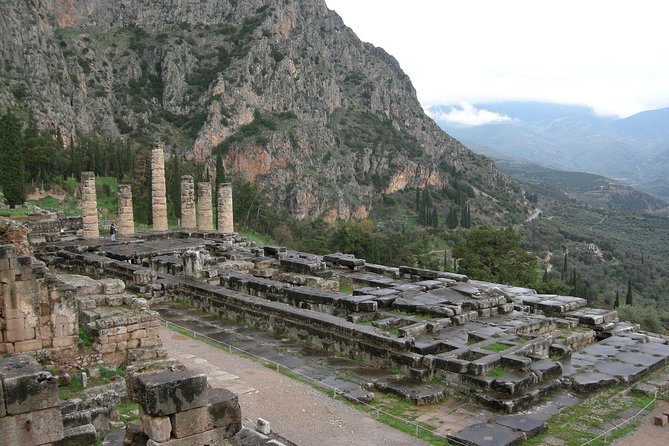
Delphi is described as an ancient sanctuary that became rich because it was the seat of the Pythia, the oracle consulted about major decisions. The information also notes the ancient belief that Delphi was the center of the world, marked by the omphalos, the stone monument called the navel.
You get about 2 hours 20 minutes here, plenty of time to read the story across multiple sections rather than rushing. The big value of a private guide is translating what you see into what it meant, especially when the symbols can look confusing if you only have printed signs.
Entrance fees are not included for the museum.
Arachova: A Short Mountain Pause Near Delphi
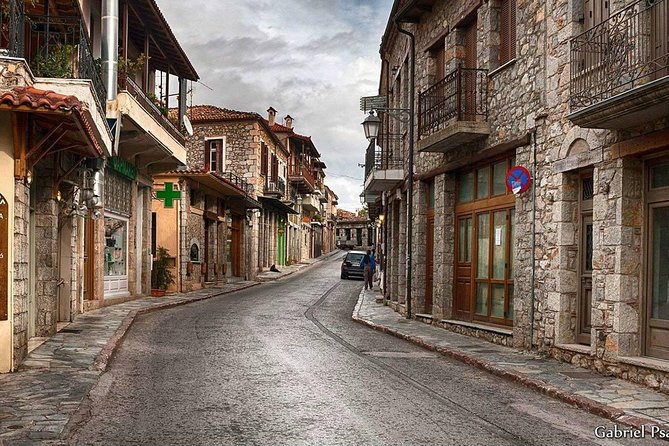
Arachova is the relief stop, about 25 minutes. It is a mountain town and described as a tourist destination because of its traditions and proximity to Delphi.
This is the moment in the trip where you can step away from ruins and breathe mountain air. It is also a good place to reset, because day four comes with a long and dramatic finale.
Admission is listed as free.
Day 4 Meteora Monasteries and Thermopylae: Two Icons With One Big Theme, Altitude
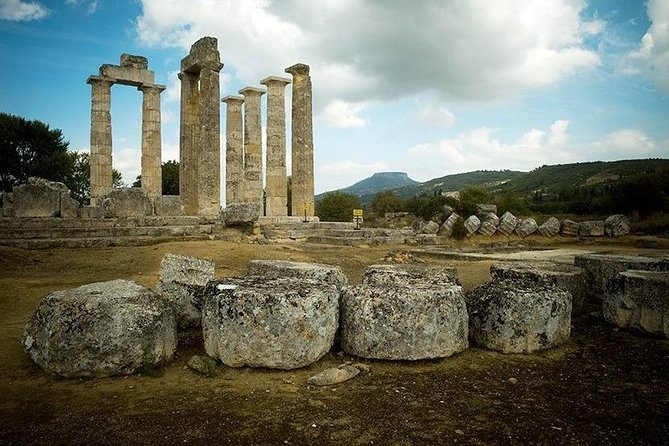
Day four is where the scenery starts doing the storytelling.
Meteora: Monasteries on Rock Pillars
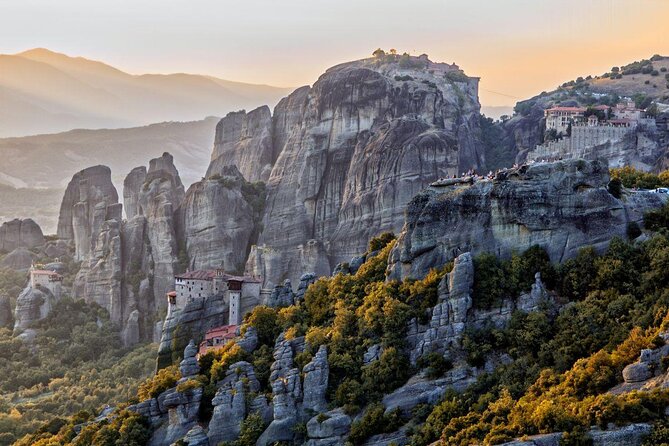
Meteora is described as rock formations hosting major Eastern Orthodox monasteries, second in importance only to Mount Athos. The six monasteries in use today are said to be built on enormous natural pillars and rounded boulders that dominate the region near Kalambaka.
Meteora is UNESCO listed under multiple criteria in the description, which signals why it is not just a pretty set of cliffs. This is architecture shaped by landscape and faith shaped by geography.
You get about 3 hours here, and entrance fees for monasteries are not included. That is important because Meteora costs can jump quickly once you start adding up ticket categories. If you want to control cost, ask in advance how many monastery entrances are planned during your time window.
Thermopylae Museum: The Hot Gates and the Battle Story
Next is Thermopylae Museum, about 35 minutes. Thermopylae is explained as the place where a narrow passage existed in antiquity, and it is connected to hot sulphur springs, which is literally why it is called Hot Gates.
The information also connects Thermopylae to mythology and the famous battle between Greek forces, notably Spartans, and Persian forces. It includes the famous epitaph about telling the Spartans, stranger passing by, that here they obeyed their laws and lay. It also notes that a modern monument to King Leonidas exists across the highway and a stone engraving is at the top of the hill where the epitaph is engraved.
Even in a short museum stop, this is a powerful end point. Meteora is about faith on height, and Thermopylae is about resistance at a choke point. Two different kinds of ancient mindset, both visible.
Entrance fees are not included.
The Value Question: What You Pay vs. What You Still Buy
The price is $3,880 per group, up to 8 people. That can sound high until you break it down by group size. If you are traveling as a full group of 8, you are closer to a shared rate that feels reasonable for private vehicle, multiple regions, and long-distance logistics. If you are only two people, the value depends more on how much you hate transfers and how much you want the guide’s time focused on your family or friends.
Here is what is included:
- Air-conditioned vehicle
- WiFi onboard
- Private transportation
- English speaking driver
- Bottled water
- Driver’s accommodation
Not included:
- Lunch and dinner
- Accommodation for passengers
- Entrance fees for archaeological sites, monasteries, and museums
So the honest way to think about the deal is this: you are paying for the vehicle, the planned day-by-day flow, and the explanation. You are not paying for entry tickets. If you like walking into major sites with no surprises, you will still want to budget for those admissions.
Also, since licensed tour guide service is described as “upon request depending on availability,” I suggest treating it like a variable. If you care a lot about museum-level storytelling inside each site, message ahead.
Accommodation Reality: Help Arranging vs. Guaranteed Hotel Nights
Passenger accommodation is listed as not included, but the operator says you can request help booking. That matches what many private tours do: they can recommend options, coordinate, or help you lock in lodging, without automatically including it in the price.
Based on guest comments included in your provided info, some groups ended up with really nice hotels. That suggests the booking help can be effective. Still, if hotels are a deal-breaker for you, confirm what level of assistance you will get and whether specific hotel types are suggested based on your dates and budget.
Food, Wine, and the Guide’s Practical Recommendations
One of the most praised elements in the info you shared is how the guide handled the human side, not just the monuments. Multiple guests highlight excellent local meals, including tasting perfect local dishes at Greek restaurants, and even mention great food and wine.
That kind of advice is not guaranteed everywhere, but in a private format, it is usually easier to steer you toward places that make sense geographically. You do not have to hunt for lunch between stops, and you can ask for suggestions that fit the day’s timing.
If you have food preferences, mention them early. You will get better results.
Who This Tour Suits Best (and Who Might Want Something Else)
This experience is strongest for:
- Small groups who want private pacing and one base plan
- People who care about stories behind Mycenae, Olympia, Delphi, and Meteora
- Travelers who dislike the friction of public transport and switching vehicles
It may be less ideal if:
- You want every single site guided by a licensed specialist throughout, with no variation
- You want a tour price that includes all entrance fees and meals, no extra planning required
- You prefer a slower pace with more time in each city, because key stops are timed and the days are packed
Should You Book This Athens to Meteora Private Tour?
I think you should book if you want a high-impact mainland sampler with stress-free logistics and guide support that helps you connect the dots across ancient Greece. The route hits the core names, but it also includes calmer breaks like Nafplio and Nafpaktos so the day does not feel like one long sprint of ruins.
I would hesitate if you dislike extra costs for admissions or if you need guaranteed licensed on-site guiding inside every major museum and monument. If that is you, ask upfront about licensed guide availability and plan for ticket budgets.
If you are traveling with up to 8 people, this is especially good value because the private vehicle cost is shared, and you get a coherent storyline from Corinth Canal to Thermopylae.
FAQ
FAQ
What is the price and group size for this 4-day private tour?
The price is $3,880 per group, for up to 8 people.
How long is the tour?
It is listed as 4 days (approx.).
Do you offer pickup from Athens?
Yes. Pickup is offered in Athens. You should be at the pickup location about 10 minutes before the scheduled time.
What language is the tour offered in, and do I get a ticket on my phone?
The tour is offered in English, and it includes a mobile ticket.
Are entrance fees included for museums and archaeological sites?
No. Entrance fees for archaeological sites, monasteries, and museums are not included.
Is lunch or dinner included?
No. Lunch and dinner are not included.
Is accommodation for passengers included?
Accommodation for passengers is not included, but you can contact the provider for help booking accommodation.
Will I have a licensed tour guide during site visits?
The driver is described as English speaking (not licensed to accompany you in any site). A licensed tour guide may be available upon request depending on availability.
What is included in the vehicle during the tour?
Included features are an air-conditioned vehicle, WiFi onboard, private transportation, and bottled water.
Can I cancel for a full refund?
Yes, there is free cancellation. You can cancel up to 24 hours in advance for a full refund.
More Private Tours in Athens


More Tours in Athens

More Tour Reviews in Athens
- All Day Cruise -3 Islands to Agistri,Moni, Aegina with lunch and drinks included
★ 5.0 · 4,958 reviews
Not for you? Here's more nearby things to do in Athens we have reviewed






Athens Private Tours, compared.
 ★ 5.0Best of Athens Half Day Private TourFrom $913,714 reviews
 ★ 5.0Athens Full Day Private TourFrom $2442,903 reviews
 ★ 5.0Athens Greece Full Day private tourFrom $683785 reviews
 ★ 5.04 Hours – Athens & Acropolis Highlights Private TourFrom $181681 reviews
★ 5.0Athens Full Day Private TourFrom $205667 reviews
 ★ 5.0Lake Vouliagmeni Thermal Spa And Temple Of Poseidon Private Full Day TourFrom $171578 reviews
 ★ 5.0Acropolis and Acropolis Museum Private Tour with Licensed ExpertFrom $188445 reviews
 ★ 5.0Athens Highlights Half Day Private TourFrom $305407 reviews
Browse the lists this tour appears in