
Reviewed · TOURS
Philosophical Tour in Athens
Athens gets philosophical fast. I liked the way guide Lampros builds a walking storyline from tragedy to civic life, so each stop feels connected instead of random sightseeing. Private, small-group conversation is part of the appeal, not just another route.
I also love how the tour uses multimedia and speakers at key viewpoints. Short visuals help you connect concepts like Plato’s cave or Jung’s ideas to the places you’re standing in.
The only real tradeoff is that it can get heady. If you want a quick photo tour with minimal discussion, plan for some serious talk during the walk and the stairs.
Key highlights to know before you go
- Lampros tailors the pacing so people with different interests can follow along
- You cover Athens ideas in order, from tragedy and democracy to happiness schools and Stoicism
- Most stops are free, so you are not paying entrance fees every few minutes
- Views are built into the route, especially around Philopappos and Pnyx
- You get breaks that make sense, including a solid lunch atmosphere near the Mnisikleous stairs
Why this Athens walk feels different from a normal tour

This is not a standard ruins parade. You are walking through places that shaped how Greeks thought, argued, and lived, while the guide frames each stop around a philosophical question.
What I like is that the tour stays practical, even when it talks about deep stuff. The guide ties ideas to psychology, self-awareness, and how we judge, choose, and cope. One review experience even took the conversation into the future of human reasoning and AI, which tells you the vibe: the discussion is meant to follow you past the last stop.
Also, you are not stuck in a lecture mode. The route is short enough to stay lively, and the guide uses speakers and multimedia presentations at moments that match the theme of the site.
You can also read our reviews of more tours and experiences in Athens.


Timing, meeting point, and how the 2.5 hours actually moves
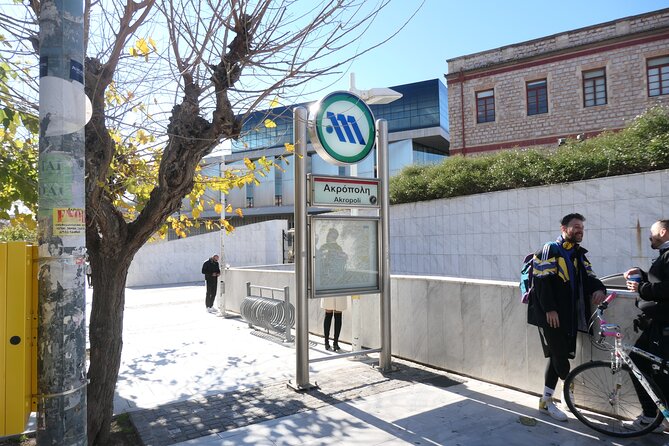
You meet at AcropoliAthens 117 42, Greece, with a start time of 11:00 am. The tour runs about 2 hours 30 minutes and ends back at the meeting point.
Because it is private for your group, you do not have that awkward shuffle of a big mass tour. The experience is designed for up to six people in total, and the price is listed per person (so small groups can still feel like a deal). The practical upside is simple: you can ask questions, and the guide can slow down when someone wants more context.
You’ll also feel the outdoor reality of Athens. This is a walking route with viewpoints and stairs, so wear comfortable shoes and expect some sun. In warmer weather, the guide is known for choosing shadier spots to talk and watch short videos, which makes a big difference for comfort.
Theatre of Dionysus to Anafiotika: the route built around ideas
The stops are arranged like a guided tour of how Athens formed its way of thinking. Here is what you can expect, in the same order you’ll walk it.
Theatre of Dionysus Eleuthereus: tragedy as mental medicine
You start outside the Theatre of Dionysus Eleuthereus, described as the birthplace of tragedy. The theme here is not just what tragedy was, but why people once felt it mattered for how they thought and judged.
The guide brings in psychology angles, including how Carl Jung interpreted tragedy as something that can help us become our best selves. You may also hear connections made between religious philosophy and evolution psychology, meant to explain how humans evolved to learn through story and emotion.
Herod Atticus Odeon: personality, roles, and the mask
At Herod Atticus Odeon, the conversation shifts to personality. You’ll connect the site to ideas like persona and Jungian concepts of animus and anima, turning the theatrical setting into a mirror for how we perform and interpret ourselves.
Even if you do not know those terms, the guide’s goal is to make the ideas usable, like a way to understand why people can seem different depending on context.
- All Day Cruise -3 Islands to Agistri,Moni, Aegina with lunch and drinks included
★ 5.0 · 4,958 reviews


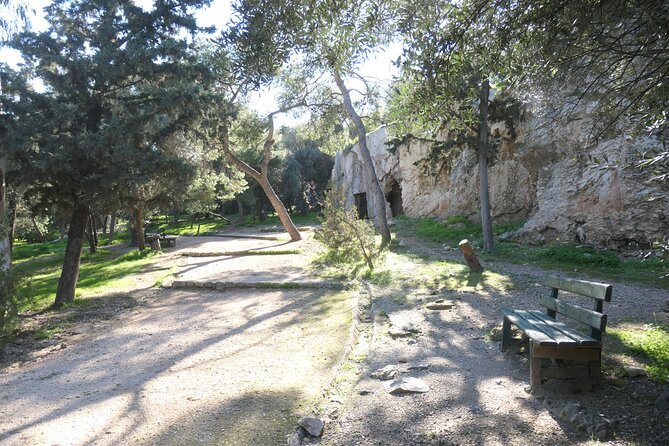
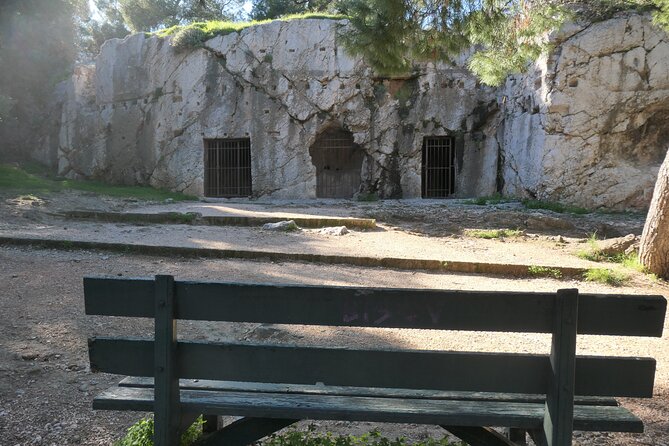
Prison of Socrates: the cave and what you think you see
Next is the Prison of Socrates theme, tied directly to Plato’s allegory of the cave. Instead of treating it like an abstract reading assignment, the guide uses the walking experience to make the lesson feel immediate: what we believe might be shaped by our surroundings, our habits, and our limited perception.
This stop is a good reset point. If you felt overloaded by the earlier psychology framing, this is where Plato’s core question becomes the anchor.
Agios Dimitrios Loumbardiaris: democracy takes shape in real streets
You then visit Eglise D’agios Dimitrios Loumbardiaris. The emphasis here is the birth of democracy and how public decision-making is tied to place, not just paperwork or slogans.
The guide uses this moment to connect civic life to philosophical growth, since democracy is where ideas fight it out in public instead of staying private.
Philopappos Monument: happiness, and a view worth walking for
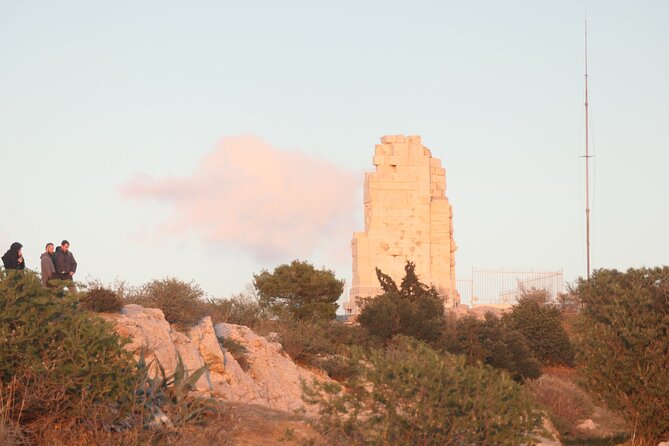
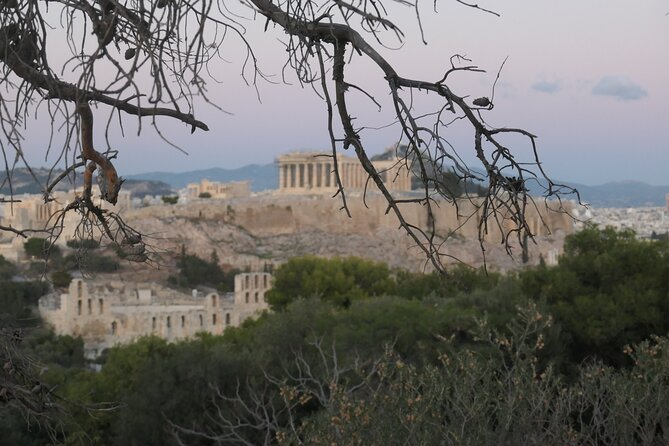
At Philopappos Monument, you get one of the best built-in payoffs of the whole route. The guide frames it as a highly energetic viewpoint with strong sightlines toward the Parthenon and the Acropolis.
Then the theme turns to the recipe of happiness, using Plato and Socrates as the backbone. This pairing matters because the view does something to your brain. It makes the talk about eudaimonia and wellbeing feel less like theory and more like lived perspective.
Pnyx: the assembly, eudaimonia, and the Socrates connection
You continue to Pnyx, the assembly area of Athenian citizens and often described as the best view of Athens. In the discussion, Aristotle’s perspective on eudaimonia (blissful wellbeing) comes into play, and the guide also points to a secret place of Socrates in this area.
This stop includes admission ticket access, so it is one of the places where you actually get to be inside the meaningful space, not only outside the perimeter.
Keramikos Archaeological Site: Epicurus and happiness by simplicity
Keramikos Archaeological Site is where the mood shifts again. You are at an ancient cemetery of Athens, and the philosophical theme becomes Epicurean happiness and the garden idea linked to Epicurus.
It is an interesting contrast to the earlier civic and tragic themes. The guide uses the setting to explain why some schools aimed for calm, balance, and wellbeing rather than public debate or emotional intensity.
The Stoicism born stop, plus a lovely street moment
Between the major named sites, the route includes a stop tied to where Stoicism was born, plus a moment framed as the most beautiful street in Athens. These sections can feel a bit more interpretive, but that is part of the point. The guide is building a mental map of Athens as a philosophy city, not a museum list.
If you like your sightseeing with meaning, these pauses are where the walk starts to feel personal.
Roman Agora, the meteorology pause, and the stairs lunch atmosphere
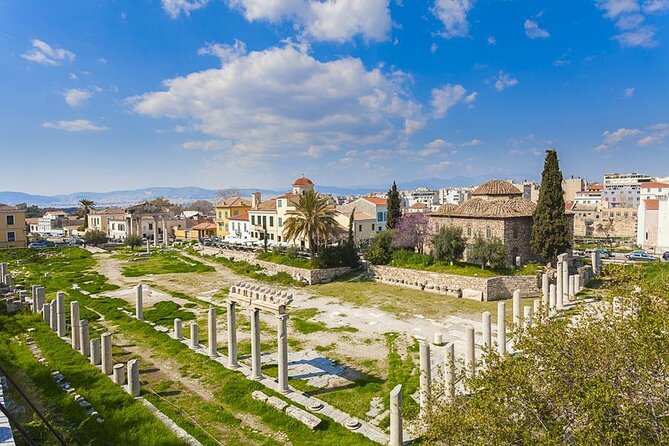
In the Roman Agora, the guide ties the space to Stoicism taught as a philosophy of life. This is also where you hit a unique fact-style moment, including mention of the first meteorological station in the world.
Then there is a practical break element near the Mnisikleous stair atmosphere, noted as a best place for lunch. The tour does not say lunch is included, but this is where you can plan your own food break, grab water, and let the conversation settle in before the next viewpoints.
Lysikratous Square: Apollonian and Dionysian ideas
At Lysikratous Square, the discussion zooms back toward the arts and inner balance. The focus is the Apollonian and Dionysian sides of Athens, a theme that works well after tragedy and theatrical spaces earlier in the walk.
You’ll likely hear this used to explain how people cope with order versus chaos, and how culture trains our minds.
Anafiotika: feeling like you stepped onto an island street
You finish at Anafiotika, framed as a high-energy area that feels like a Cycladic island. This is a calmer, more atmospheric ending compared to the earlier civic and philosophical power centers, and it makes a nice last chapter before you head back.
It is also where the walk feels most like a real neighborhood, not only a timeline.
How the big ideas turn into takeaways you can use
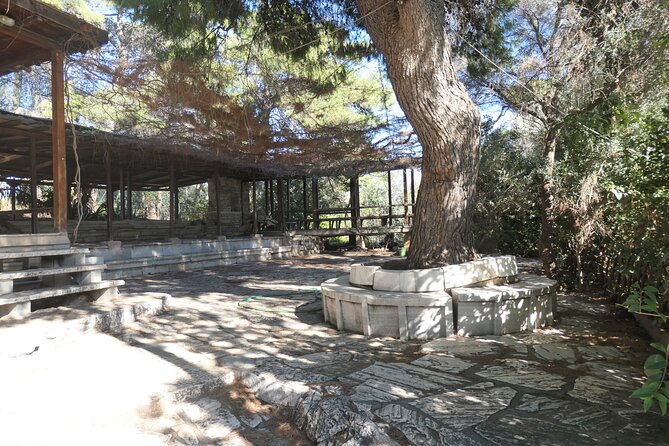
The strongest praise for this tour is how it connects philosophy to how you live. One standout theme in the discussion style is self-knowledge, with reason, reflection, and awareness used as tools to understand and heal the self.
You’ll also notice the guide does not treat schools like schoolbook categories. Instead, the guide keeps returning to questions like:
- How do we judge too fast?
- How do stories shape our behavior?
- What helps us stay steady when life gets unstable?
Happiness schools get special attention. You move through ideas of happiness tied to Plato and Socrates at Philopappos, Aristotle’s eudaimonia at Pnyx, and Epicurean happiness at Keramikos. Then Stoicism comes back in at the Roman Agora, bringing the discussion from wellbeing into coping and everyday resilience.
And if you are curious about modern topics, you might find the guide draws lines to psychology and even technology. One review specifically called out reflections on AI and the future of human reasoning, which matches the tour’s approach of connecting timeless questions to today’s tools.
The multimedia moments, shade breaks, and why Lampros matters
A normal walking tour can be one of two things: either a fast walk with minimal depth, or a slow slog with no structure. This one aims for structure. It uses short video clips and multimedia moments at the points where the theme changes.
That matters because philosophy can sound abstract when you hear it only in speech. Put a short visual next to Plato’s cave, or Jungian personality ideas next to a theatrical setting, and the concepts click faster.
Comfort is also part of the design. In warm conditions, the guide is known for using shade and seating breaks, so the route stays human. And multiple reviews mention Lampros being friendly, flexible, and willing to meet people at their level, which is exactly what you want in a tour where some people may know philosophy and others may be total beginners.
If you like getting practical extras, you may also hear recommendations for where to go after the tour. One review highlighted tips like rooftop bars and ideas for an open air cinema, plus a fun food tip for lunch.
Price and value for $90.11 with a group of up to six
At $90.11 per person, the value comes from a few specific choices:
- You are paying for a private-feeling experience with only your group up to six
- You walk a compact route in about 2 hours 30 minutes, so it is not a time sink
- Most stops list free admission tickets, meaning you are not stacking entry costs site by site
- Pnyx includes an admission ticket, so at least one key area is handled for you
This is also a smart spend if you are traveling with teens or a small family. One review called it a must-do and said it helped everyone, even those who did not know much philosophy. If your group includes one person who loves deep thinking and another who mostly wants good viewpoints, this tour is built to keep both interested.
I would book it around a few weeks ahead if you can, since the average booking timing is reported at about 21 days in advance.
Who should book, and who might skip this one
Book this if you:
- like your sightseeing with discussion, not just audio facts
- enjoy ideas about happiness, ethics, and self-knowledge
- want a route that connects Athens sites into a single story
- appreciate tools like videos and guided prompts
Skip it if you want:
- a purely visual tour with minimal talking
- a low-walking, low-stairs day
- a focus only on major monuments with no psychology layer
Also, the experience requires good weather. Athens can be gorgeous, but sun plus stairs is real. If the forecast looks rough, plan for the fact that the tour may shift or be refunded.
Should you book this philosophical tour in Athens?
If you want Athens to feel like more than a list of landmarks, I think this is a strong yes. The small group format, the multimedia teaching moments, and the way Lampros ties tragedy, democracy, happiness, Epicurus, and Stoicism into one walk make it a memorable use of a half day.
If your style is quick and quiet, or you do not enjoy philosophical discussion, you might want a more straightforward sightseeing tour instead. Otherwise, bring water, wear comfy shoes, and give yourself over to the questions. Athens works best when you let it think with you.
FAQ
Where is the meeting point for the tour?
The tour meets at AcropoliAthens, 117 42, Greece.
What time does the tour start?
The start time is 11:00 am.
How long is the walking tour?
It runs for about 2 hours 30 minutes.
Is this a private tour?
Yes. It is private, and only your group participates. The group size is up to six people.
What language is the tour offered in?
The tour is offered in English.
Are there admission fees for the stops?
The tour lists free admission tickets for most stops, and Pnyx has admission included.
How do I receive the ticket?
You use a mobile ticket.
Are service animals allowed, and is it near public transportation?
Service animals are allowed, and it is near public transportation.
What happens if the weather is bad or you cancel?
The experience requires good weather. If it is canceled due to poor weather, you are offered a different date or a full refund. You can cancel for a full refund up to 24 hours in advance.
More Tours in Athens



More Tour Reviews in Athens
- All Day Cruise -3 Islands to Agistri,Moni, Aegina with lunch and drinks included
★ 5.0 · 4,958 reviews
Not for you? Here's more nearby things to do in Athens we have reviewed









Tours, compared.
 ★ 4.8Acropolis, Parthenon & Acropolis Museum Guided TourFrom $409,316 reviews
 ★ 4.6Acropolis and Parthenon Guided Walking TourFrom $385,882 reviews
 ★ 5.0Greek Food Walking Tour in AthensFrom $874,740 reviews
 ★ 4.3City Sightseeing Hop-On Hop-Off Bus TourFrom $254,520 reviews
 ★ 4.6Mythology of Delphi, Museum and Arachova Guided TourFrom $314,008 reviews
 ★ 5.0Best of Athens Half Day Private TourFrom $913,714 reviews
★ 4.8Acropolis, Parthenon & Acropolis Museum Guided TourFrom $413,579 reviews
★ 5.0Best of Athens Half Day Private TourFrom $913,714 reviews
★ 4.8Acropolis, Parthenon & Acropolis Museum Guided TourFrom $413,579 reviews
 ★ 4.7Acropolis: Acropolis and Parthenon Guided Walking TourFrom $363,442 reviews