
Reviewed · ATHENS SIGHTSEEING TOURS
Full Day Private Of Athens Highlights of Classical &Modern Athens
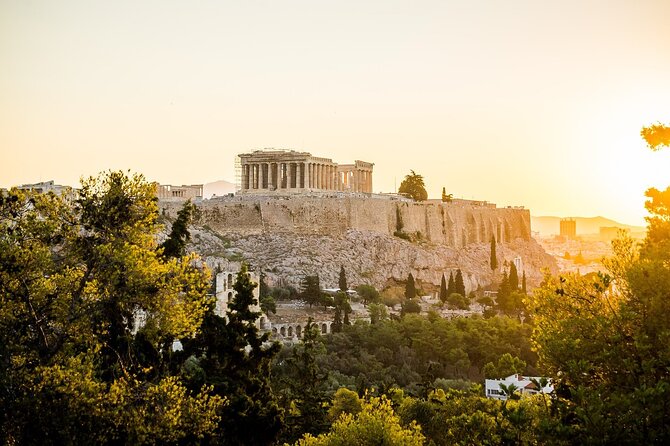
Athens hits hardest when you see the classics first thing. This private 6-hour highlights route links the Acropolis to modern Syntagma Square, with a smooth door-to-door drive that keeps the day from turning into a stressful map hunt. You get a driver with fluent English commentary, plus the option to tailor the stops so you do not spend your limited time on things you would skip.
I especially like the way the itinerary concentrates on the big names without making you feel lost, starting with key Acropolis landmarks like the Propylaea gateway and moving on to the Parthenon complex. I also like the practical realism of the day, including time for the Acropolis Museum right after the hill, so the sculptures and architecture actually make sense.
One thing to consider is cost creep: several entrances are not included (most famously the Acropolis), and you will also do a fair amount of walking on steep ground. Bring comfortable shoes, and plan to add a bit of cash for tickets and any optional extras.
Key highlights you should know before you go
- Private pickup and return from your hotel, residence, or cruise terminal area, timed for an efficient day
- Acropolis focus on the Parthenon circuit, plus stops like the Caryatids area and the Theatre of Dionysus
- Acropolis Museum visit after the walk down, which helps the “what am I looking at?” moments click
- Syntagma Square and Evzones at the Unknown Soldier, with the changing of the guard happening every hour
- Modern Athens rhythm with Plaka, Monastiraki, and market streets alongside major ruins
- Optional flavor stops like Lake Vouliagmeni waters and the Piraeus harbor vibe of Mikrolimano, time permitting
Private Athens in 6 hours, with pickup that actually helps
If your days in Athens are measured in hours, a private format matters. This one is built around pickup from Athens hotels and Piraeus cruise port, with return to the same place or a point you prefer. For cruise passengers, that timing focus is huge, because you are not guessing transit times or waiting on other groups.
The transportation is also part of the value. You ride in an A/C, non-smoking vehicle suited to group size (sedan for 1 to 3 people, mini vans for 4 to 7). You get bottled water and free Wi-Fi on board, which sounds small until you are dehydrated, sunburn-prone, and trying to keep phones charged for photos.
The other practical advantage is flexibility. This is a tailor made tour where you can include or skip sites in the Athens city portion, and family groups can be modified for kids. Just keep expectations clear: your driver can guide you with fluent English commentary, but they do not enter archaeological sites with you.
You can also read our reviews of more private tours in Athens


Acropolis morning route: from Propylaea to the sacred hill
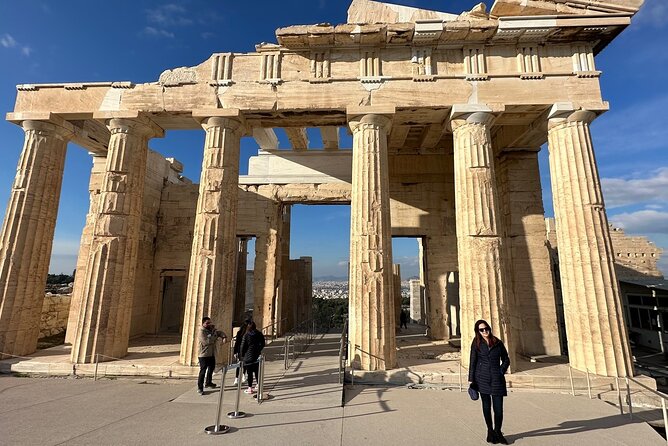
The day starts early for a reason: you want the Acropolis before heat and crowds turn every stop into a bottleneck. The highlight opener is the Propylaea, the monumental gateway into the Acropolis area. It is not just a pretty start point. It connects to a real historical story, commissioned by Pericles for rebuilding the Acropolis after the Persian Wars, so you land in the right mindset from minute one.
From there, you move onto the broader Acropolis zone. This is where the tour’s “major sites” approach works best: you are not stuck with only one viewpoint or one monument. Instead, you cover the circuit that helps you understand how the Greeks layered sacred, civic, and artistic meaning on the same hill.
You are also given short but focused blocks of time at key points, which is a smarter use of a limited schedule than wandering aimlessly. The tradeoff is that you will still be moving, and the Acropolis is not flat. Think good shoes, hat, and hydration.
Tip that will save your energy: start hydrating from the first hour. One practical note from a past group, logged during a similar full-day pace, was how fast you lose water in Athens heat, even when you do not feel like you are sweating.
Inside the Acropolis circuit: Parthenon, Athena Nike, Caryatids
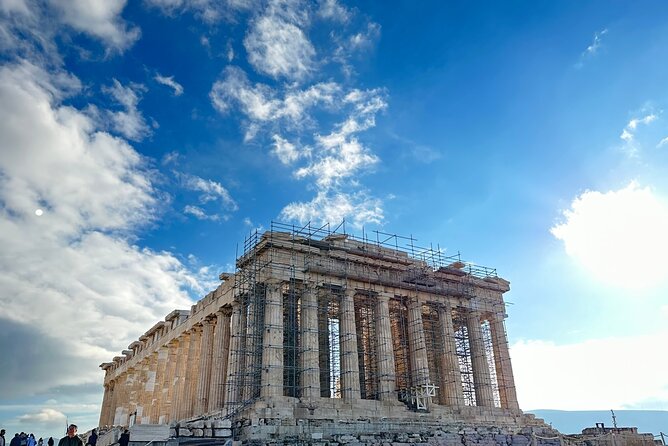
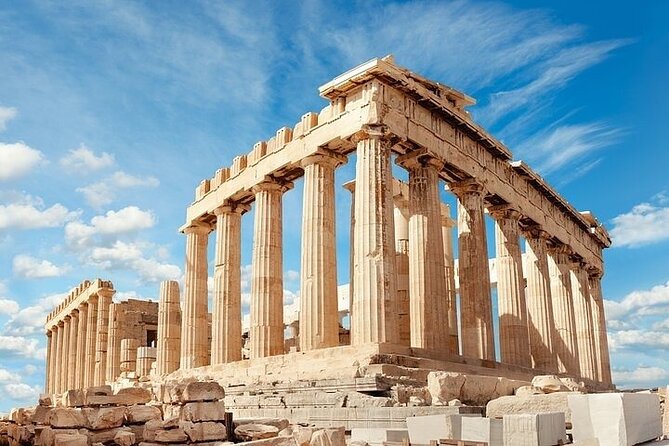
Once you reach the Parthenon area, you get the core experience most first-timers come for. The Parthenon is the defining image, dedicated to Athena, and it is as much about proportion and craftsmanship as it is about the “wow” factor. Even if you have seen photos, being there changes how you see the marble surfaces and the space around the structure.
But the tour keeps you from turning it into a single-photo moment. You also get time at the Temple of Athena Nike, built around 420 BC. This is described as the earliest fully Ionic temple on the Acropolis, and its position near a steep bastion makes the architecture feel connected to the terrain, not stuck on top of it.
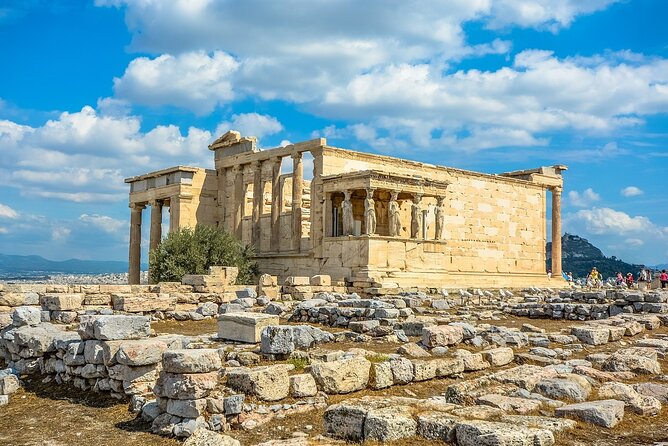
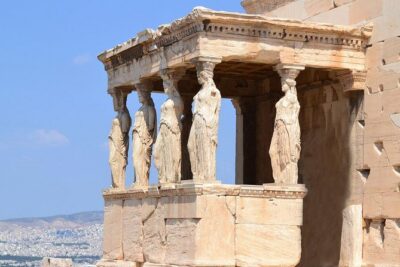
Then comes one of the most memorable Acropolis details for many visitors: the Erechtheion and its Caryatid figures, often called the Maidens. These female statues are famous for a reason, and having them on your route helps you see the Acropolis as more than one monument.
You are also exposed to other highlights in the same run, like:
- the Odeum of Herodes Atticus
- the Theatre of Dionysus, often described as the first theatre in the world
- the Areopagus area, also known as Mars Hill
Practical drawback: because the tour is private and moving across several points, you will want to keep your pace. If you prefer slow, long photo sessions at one monument, ask your driver to adjust the sequence and time allocation.
Museum after the hill: why the Acropolis Museum makes the day click
After descending the Acropolis area, you go to the Acropolis Museum, right at the base of the Sacred Rock. This is a big deal for comprehension. Standing outside, you get the scale and the skyline. In the museum, you get the “why” behind the forms, through marbles and relics found during Acropolis excavations.
The practical value is how quickly it reduces confusion. When you have just walked past places like the Parthenon, Athena Nike, and the Erechtheion, the museum helps you connect what you saw to what was carved, built, and used.
This stop is shorter than the Acropolis walk, but it is timed well. If you do it later in the day, your brain may be too tired to connect details. Here, you still have the hill fresh in your mind, so the museum feels like an extension instead of an afterthought.
If you want deeper interpretation, the tour includes an option for an optional licensed guide to accompany you into archaeological sites. That is listed as an extra cost. If you are the kind of traveler who likes context for myths, politics, and architecture, it can be worth it. If you just want a strong highlights loop, you can skip it and rely on the driver commentary.
Panathenaic Stadium: the marble link between ancient games and 1896
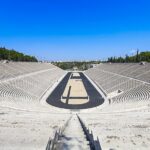
Next up is the Panathenaic Stadium, often called Kallimarmaron. This stop gives you a nice break from ruins and shows how Athens reuses history in modern life.
Here’s what makes it stand out:
- It hosted the inaugural modern Olympic Games in 1896
- It played a role in Olympic events up to the 2004 Athens Games
- It is tied to the Olympic Flame ceremonial passing
The stadium is also built of Pentelic marble, and the tour gives a quick historical arc: it began as a natural hollow between hills, transformed into a stadium by Lykourgos in 330 to 329 BC, then restored in the Roman period by Herodes Atticus. Even with limited time, you end up understanding why this stadium feels different from a typical modern arena.
The time on the ground is brief, and in the heat you might want more. Still, for many visitors this is the perfect mid-day “reset,” because it is flatter, more photo-friendly, and easier to digest after the Acropolis.
More Athens tours and experiences for the shortlist
- All Day Cruise -3 Islands to Agistri,Moni, Aegina with lunch and drinks included
★ 5.0 · 4,958 reviews

Syntagma Square and Parliament: the Evzones change the pace
If Athens has a daily performance, this is it. You reach Syntagma Square in front of the Greek Parliament, which is housed in the old Royal Palace since 1934. The square itself ties to a political turning point too, named after the Constitution Otto was obliged to grant after the uprising on 3 September 1843.
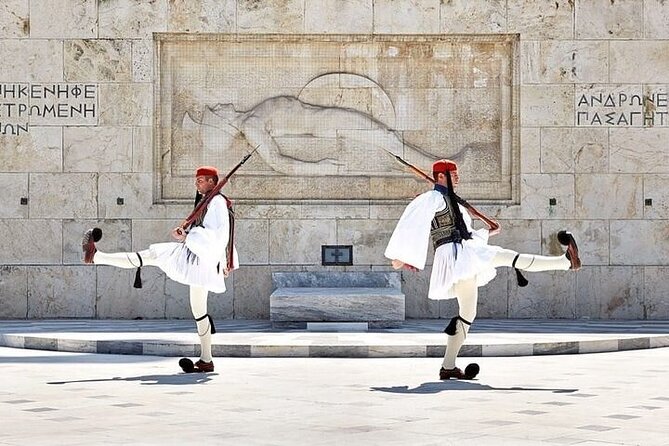
Then you add the show: the changing of the guard ceremony by the Evzones in front of the Unknown Soldier. It happens every hour, with two soldiers rotating positions. The spectacle part is not subtle. The Evzones stretch and move with a distinct gait, and the show lasts about 15 minutes, followed by them standing still again.
Why this stop works on a highlights tour: it is unmistakable, it is central, and it is easy to time. You can plan your pictures and still keep moving without feeling like you are stuck in traffic for another hour.
Practical tip: if you want the best view, pick your spot early. Once you see the rhythm, you can step aside for photos and then return before they freeze in position again.
Ancient Agora and Plaka: where the ruins meet real street life
After the formality of Parliament Square, the day becomes more human-scale. You move toward the Ancient Agora of Athens, the classic “center” of civic life. The tour frames it as a place connected to democracy, philosophy, and free speech, and explains its geographic edges: bounded by the hill of the Areopagus to the south and Agoraios Kolonos (Market Hill) to the west.
This is where ruins start feeling like a city again. The Ancient Agora was used for commercial, assembly, and residential gatherings, and having Roman context included in the same area helps you see Athens as continuous, not frozen.
You also get time in Plaka, the older neighborhood built on the slopes near the Acropolis. It is often described as the Neighborhood of the Gods, and the charm here is practical: you get to wander lanes, browse small shops, and treat this as a break rather than another timed ticket line.
Then you add Monastiraki, including the flea market and the surrounding market energy. The tour suggests a chance to sample Greek flavors through an authentic Athenian tavern experience, but it also acknowledges that you might prefer to explore on your own. Either approach works, just don’t lose track of your return time.
One thing I like about this part of the tour is balance. You are not only collecting ruins. You are collecting street scenes that help Athens feel like a living place.
Sights on the drive: Hephaestus, libraries, and the Athens you pass every day
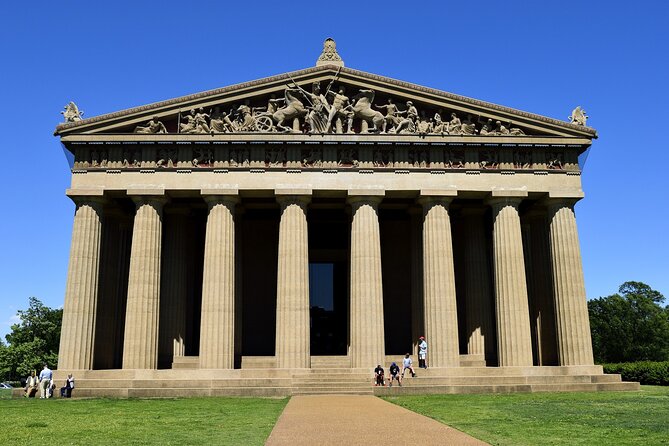
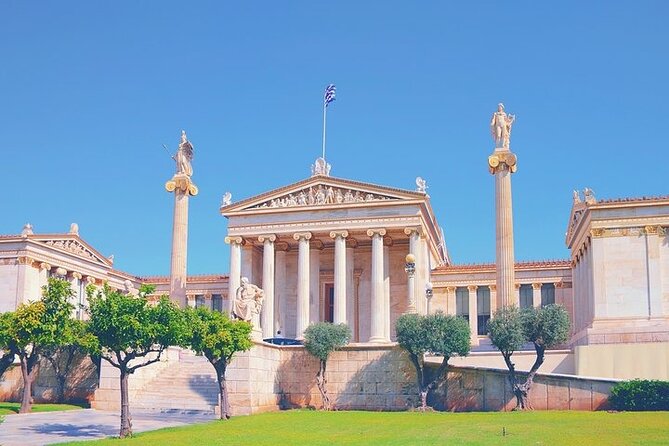
You will also see several major architectural and historic landmarks from the road, which is a smart use of a six-hour schedule. The tour includes references to the Academy of Athens (established in 1926) and the National Library of Greece, designed by Danish architect Theophil Freiherr von Hansen as part of a neo-classical trilogy.
It also lists the Temple of Hephaestus (Hephaisteion), one of the best-preserved ancient Greek temples, and notes it served as an Orthodox church until 1834. Even if your time at each drive-by point is limited, having them named helps you look instead of just staring out a window.
If you like architecture, these in-between moments are where Athens starts to feel like more than one highlight. You notice the grid of streets, the way neo-classical buildings frame the modern city, and how the ancient ruins sit inside a living capital.
Lycabettus viewpoint and Temple of Olympian Zeus: big scale, quick payoffs
Later in the day, you drive up to Lycabettus (Mount Lycabettus) for panoramic views. This is a useful stop because it forces you to zoom out and see the city layout, the mix of ancient sites, and the modern neighborhoods spread below. The tour lists it as a free admission viewpoint stop, and it is short enough to keep the schedule on track.
Then you reach the Temple of Olympian Zeus, where only part of the original complex remains standing. The tour notes details like the column arrangement and surviving columns, and mentions that in the past it housed a massive statue of Zeus and an emperor. Even if you do not linger, you get the sense of scale that made this temple a statement of power.
If you are thinking about value: these stops are less about detailed close-up ruins and more about understanding why Athens kept building with ambition. For a highlights day, that is exactly what you want.
Optional nature break: Lake Vouliagmeni waters, then Mikrolimano by the sea
One of the most interesting add-ons in this route is Lake Vouliagmeni, described as Athens’ natural spa. It is about 20 km south of the city center, and the tour explains its origin as a collapsed underground cave. The big attraction is the water temperature, listed as around 22 to 29°C year-round, plus mineral-rich content and a high salinity.
The tour also mentions a quirky, spa-like feature: fish (Garra rufa) that provide natural exfoliation. If you are curious and you pack accordingly, this can turn a long sightseeing day into a reset.
There is also Mikrolimano in Piraeus, a small harbor described as horseshoe-shaped and calmer than the larger Port of Piraeus. The vibe is seafood plus boats, with colorful waterfront energy and views that feel more intimate than the big terminal areas. The tour highlights good seafood tavernas around the harbor, from grilled sardines to more upscale dishes.
Time note: both stops are listed for short visits (Lake Vouliagmeni is 20 minutes). If you want a real swim time, plan for the reality of a highlights schedule.
Price and value: what the $179.59 does, and what you add later
At $179.59 per person for about 6 hours, you are paying mostly for three things:
- Private door-to-door transport (not sharing a van with strangers)
- A driver who provides English commentary throughout
- A route that hits the highest-demand anchors in one day, without forcing you to coordinate transit yourself
But you should treat entrances as an added budget. The tour explicitly lists several not included:
- Acropolis admission at €30 per person
- Acropolis Museum at €20 per person
- Ancient Agora at €20 per person
- Optional entrances like Panathenaic Stadium photos €20 per person and Temple of Olympian Zeus €20 per person
If you skip optional entrances, you can keep the total lower. If you do them all, the entrance cost becomes a meaningful chunk of your spending. Still, it is often worth it because these are the sites you cannot replicate later in the same way.
Also note: the optional licensed guide to accompany you into archaeological sites is listed separately at €250 per person, so it is a serious add-on for fans of deep interpretation.
My practical advice: decide in advance what “must see” means for you. If Acropolis and the museum are your top two, prioritize your budget there and consider skipping optional paid entrances for the rest if you are trying to hold costs.
Should you book this Athens highlights private day?
I would book this tour if you want a stress-light, schedule-driven Athens day. The private pickup, A/C vehicle, and tight sequencing make it a smart choice for cruise passengers, first-timers, and anyone who does not want to spend half the day figuring out buses.
I would think twice if your dream day is slow walking with long pauses at one monument. This route is designed for moving across several major zones, including the steep Acropolis terrain.
If you do book, go in with the right expectations: wear comfortable shoes, pack water and a sun layer, and plan your entrance budget for the Acropolis and museum. If you handle those basics, you will walk away with a clean overview of Athens, from Parthenon to Parliament, and you will not feel like you missed the city’s big stories.
FAQ
What is included in the tour price?
The tour includes a private tour format, luxury A/C transportation, English-speaking tour leader driver commentary, hotel or cruise port pickup and return (for Athens and Piraeus areas), bottled water, and free Wi-Fi on board. Fuel and tolls are also included.
How long is the tour?
The duration is about 6 hours.
Are Acropolis tickets included?
No. Acropolis entrance is not included and is listed at €30 per person.
Do I need to buy tickets for the Acropolis Museum and Ancient Agora?
Yes. Both the Acropolis Museum (€20 per person) and the Ancient Agora entrance (€20 per person) are listed as not included.
What about Syntagma Square and the changing of the guard?
The changing of the guard ceremony is included, and it happens every hour. The tour notes the ceremony lasts about 15 minutes.
Can the itinerary be customized?
Yes. It is described as a tailor made tour where you can include or skip sites in the Athens city portion. Family groups can also be modified to fit children’s needs.
Is there an optional licensed guide for archaeological sites?
Yes. An optional licensed guide is listed as €250 per person to accompany you into archaeological sites.
What is the tour’s main language?
It is offered in English.
What happens if weather is poor?
The experience requires good weather. If canceled due to poor weather, you will be offered a different date or a full refund.
More Full-Day in Athens
- All Day Cruise -3 Islands to Agistri,Moni, Aegina with lunch and drinks included
★ 5.0 · 4,958 reviews
More Private Tours in Athens

More Tour Reviews in Athens
- All Day Cruise -3 Islands to Agistri,Moni, Aegina with lunch and drinks included
★ 5.0 · 4,958 reviews



Not for you? Here's more nearby things to do in Athens we have reviewed







Athens Sightseeing Tours, compared.
 ★ 4.3City Sightseeing Hop-On Hop-Off Bus TourFrom $254,520 reviews
 ★ 5.0Best of Athens Half Day Private TourFrom $913,714 reviews
 ★ 4.0City Sightseeing Athens, Piraeus & Beach Riviera Hop-On Hop-Off Bus ToursFrom $261,887 reviews
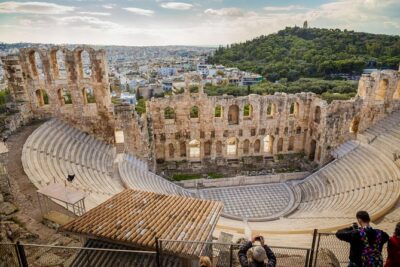 ★ 4.0Athens Half-Day Sightseeing Tour with Tickets of AcropolisFrom $1041,402 reviews
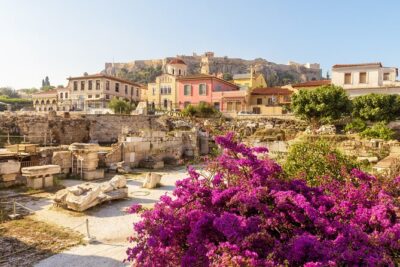 ★ 4.5Athens Sightseeing Small Group Tour (Acropolis Tickets Included)From $133754 reviews
 ★ 5.0Essential Athens Highlights Plus Cape Sounion Skip-The-Line TourFrom $365705 reviews
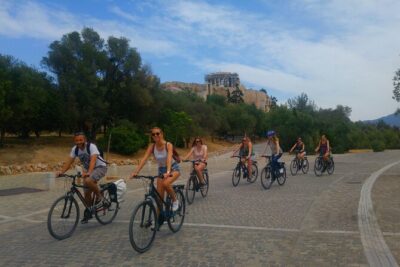 ★ 5.0Acropolis & Parthenon Tour and Athens Highlights Bike tourFrom $81605 reviews
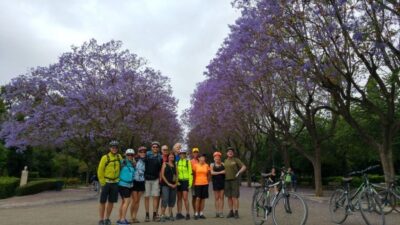 ★ 4.9City Highlights Bike tourFrom $39453 reviews
Browse the lists this tour appears in