
Reviewed · HISTORICAL TOURS
Athens Historical Private Virtual Tour Live Experience
One live guide can cover a lot. This is a private virtual sightseeing experience that lets you follow Athens’ big landmarks in just about 30 minutes, with a live guide you can ask questions to during the session. It’s also a practical way to see the city highlights if you’re visiting from elsewhere or you don’t want to wrestle with mobility issues.
Two things I like a lot are the interactive live Q&A and the tight pacing. You get multiple major stops, not just one viewpoint, and the tour format is built for people who want to move fast and still come away with a clear sense of where things are in Athens. The main drawback to keep in mind is that virtual viewing can’t replace being there in person, so you won’t get the up-close textures and time to linger at each site.
What you’ll notice in the best moments

The best part is how the route strings together Athens’ political center, panoramic viewpoints, and the Acropolis landmarks you’ve probably seen in photos. In one review, Joanna was singled out as a wonderful guide, and that matches what this format is good at, turning landmarks into a story you can actually follow. Still, because the tour is short, you’ll want to treat it as a smart orientation, not a substitute for a full-day site visit.
Key points to know before you log in
- Live guide, real-time questions: You can ask during the experience and get direct answers.
- Private group format: Only your group participates, priced per group up to 15 people.
- Fast route with heavy hitters: Parliament, Lycabettus, Acropolis, and the Temple of Olympian Zeus in about 30 minutes.
- Syntagma Square is the hub: The tour starts at Plateia Syntagmatos (Syntagma Square).
- Mobile ticket: You’ll have a mobile ticket for the experience.
- Great for less walking days: It’s a solid fit if mobility is a concern or you’re outside Athens.
You can also read our reviews of more private tours in Athens



How this Athens virtual tour actually feels (and who it’s for)
This isn’t a “watch a video” situation. You’re joining a live session, guided in real time, and you can ask questions while the tour is happening. That small detail matters because it helps you connect what you’re seeing with why it matters, instead of just collecting names.
The experience runs about 30 minutes, which is ideal if you want Athens highlights without turning it into a time sink. You’re also not tied to lining up at sites or moving between far-apart neighborhoods in a single day. If you’re traveling with limited mobility, or you’re learning the geography before you ever go, this kind of short guided format can be a big win.
On the flip side, the short duration means you won’t go deep on every monument. Think of it like getting your bearings fast, then deciding what deserves your extra time later. If you want long museum-style explanations or plenty of “stand here for 20 minutes” moments, you might find this too tight.
Price and group value: $115.64 per group up to 15
The price is $115.64 per group, with a maximum group size of up to 15 people. That’s an important value detail: you’re not paying per person in the way many private tours do. If you’re traveling with family, friends, or even a small group of classmates, the per-group structure can make this much more affordable than you’d expect.
Duration is about 30 minutes, so you’re essentially paying for a live guide’s time plus the guided route covering multiple landmark zones. You also get a mobile ticket and a set meeting point, which makes it feel organized rather than chaotic.
If you’re traveling solo, the cost might still feel a bit high compared to free online content, so the real question is whether you’ll use the live Q&A. If you’ll ask questions and want a guided, structured walkthrough of Athens’ major sites, then the value starts making sense.
Starting at Syntagma Square: Parliament first, then the guard change
Most people recognize Athens from the Acropolis, but this tour begins in a different place, at the political heart of the city. You meet at Syntagma Square (Plateia Syntagmatos) and start with the Hellenic Parliament, known in Greek as Voulí ton Ellínon.
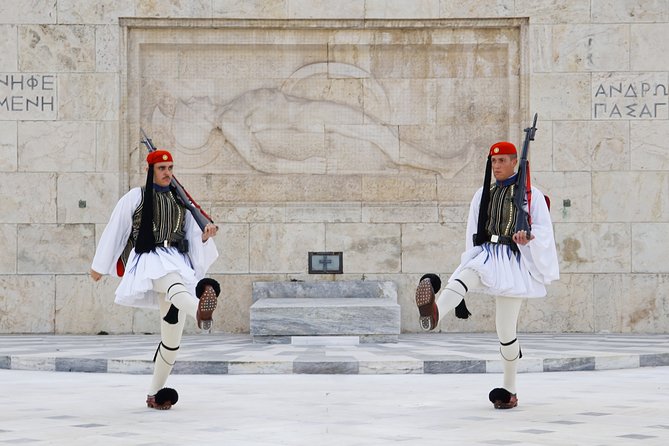
From there, the highlight moment is the changing of the guard, the Euzones, in front of the old palace, now used as Parliament House above the central square. Even if you only watch it on a screen, it’s a neat contrast to the ancient sites later in the route. It also helps you anchor Athens in a modern civic setting, not just an archaeological one.
You’ll also get quick context around the university and the neoclassical cluster nearby. The National and Kapodistrian University of Athens is framed as one of Greece’s major state institutions, with the Athens University designed by Danish architect Christian Hansen and completed in 1864. Then you move to the National Library of Greece, built at the end of the nineteenth century, designed by Theophil Hansen, and part of the Architectural trilogy in Athens that also includes the Academy and the University.
Practical takeaway: this “Parliament first” start is useful if you want to understand where the city’s modern public life sits relative to the monuments. It also gives you a more varied Athens introduction than jumping straight into ruins.
Lycabettus Hill viewpoint and Panathenaic Stadium moments
After the Parliament area, the route shifts toward a high viewpoint, Mount Lycabettus (Lykavittos). You go up Athens’ highest hill, and the payoff is the panoramic view, from the Acropolis all the way toward the Aegean Sea.
This is the part where the virtual format can actually help. Panoramas are easier to follow when someone is pointing out the direction and landmarks you’d otherwise struggle to locate. You get a sense of how the Acropolis sits above the city, which is exactly what you want before you zoom in on specific monuments.
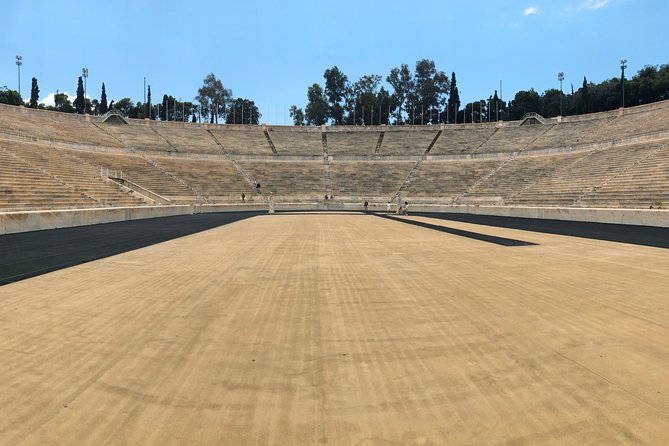
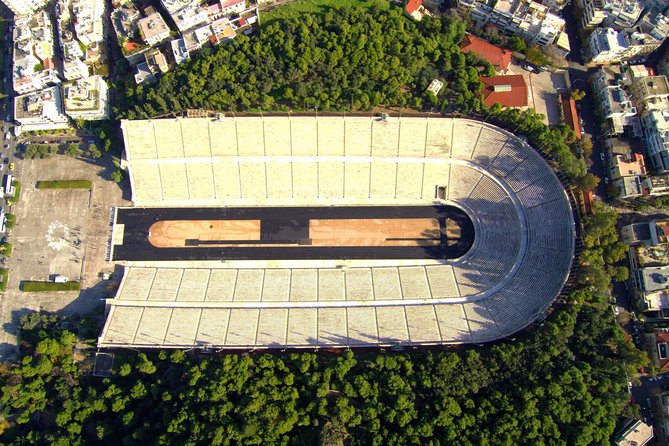
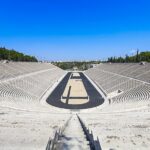
From Lycabettus, the tour includes a stop at Panathenaic Stadium, notable for hosting the first modern Olympic Games in 1896. It’s a great reminder that Athens history isn’t only ancient stone. It’s also about how ancient ideals got reused and reimagined in modern times.
You also see the Academy building as part of an “architectural trilogy,” associated with the academy’s foundation through a Constitutional Decree on March 18, 1926. Even though the details move fast, the point is clear: Athens has clusters of landmark buildings designed to communicate ideas of education and civic life.
If you’re trying to build a mental map of Athens, this Lycabettus segment is one of the most helpful sections because it connects distance, direction, and the big sites you’ll recognize later.
You can also read our reviews of more historical tours in Athens




Acropolis time: what you’ll actually cover on screen
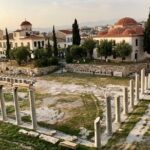
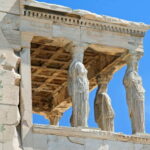
Then you reach the big one: the Acropolis. In a virtual format, Acropolis viewing works best when the guide helps you connect each building to the sacred zone idea, not just recite facts. Here, you get an overview that includes several key structures.
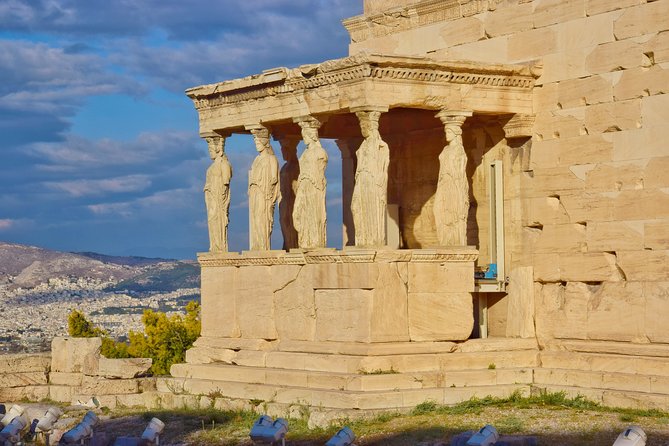
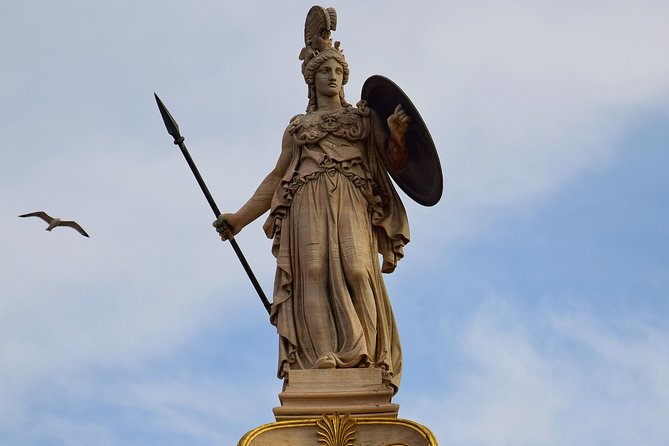
You’ll have a chance to see (or at least be oriented to) the Odeon of Herodes Atticus, the Temple of Athena Nike, the Propylaea, the Erechtheum, and of course the Parthenon, dedicated to Athena. The tour also points you to the Theatre of Dionysus Eleuthereus, described as a major theatre and considered the world’s first theatre, built at the foot of the Acropolis.
A standout detail is the focus on the Parthenon as a symbol. The tour frames it as an eternal symbol of Athenian democracy and Western civilization. Even if you’ve read that before, hearing it tied to what you’re looking at can make the monument feel less like a distant icon and more like a civic statement.
The Propylaea and Apteros Nike restoration
The Propylaea gets attention as the monumental gateway into the sacred area dedicated to Athena, built using Pentelic marble and designed by Mnesicles. The design is described as avant-garde, and you’ll also hear about the Ionian temple of Apteros Nike, which is currently being restored.
Why this matters, even virtually: restoration updates can change what you expect to see. A guided explanation helps you understand that not all sites are frozen in time, and that ongoing work affects visibility and appearance.
Theatre and Odeon: ancient performance spaces
The Theatre of Dionysus Eleuthereus and the Odeon of Herodes Atticus are both included, which is a smart pairing because performance spaces tell you something about daily life in ancient Athens. The tour notes that the Odeon of Herodes Atticus is a stone Roman structure completed in 161 AD and renovated in 1950.
If you’re the kind of traveler who likes Athens beyond just the Parthenon, this segment gives you extra texture. It nudges you toward thinking about what people did there, not just what rulers built.
A small caution about depth
Because this whole Acropolis portion is time-limited, the experience is a guided overview rather than a slow, detailed walkthrough. If you’re the type who needs to read inscriptions and study architectural details at length, you’ll want to follow this with in-person visits if you can.
Temple of Olympian Zeus and Hadrian’s Arch: the scale lesson
After the Acropolis, you head toward the Temple of Zeus, also known as the Temple of Olympian Zeus. The tour describes it as the biggest temple in antiquity, devoted to the king of the gods, and mentions Hadrian’s Arch as part of the route context.
Even in a short virtual session, this is a useful contrast. The Acropolis gives you the idea of sacred civic height, while the Temple of Zeus is about massive scale and power. It helps you see Athens as layered: different periods, different ideas of grandeur, different centers of importance.
Admission is listed as ticket free for the major included moments, which is nice to know in case you’re trying to decide whether this experience is likely to overlap with what you’ll do in person later. Either way, it’s a helpful zoom out from the Acropolis zone.
Live guide quality: Joanna and the value of a real person
In one of the reviews, the guide Joanna was described as wonderful, and the message highlighted that the group saw a lot during the virtual tour. That kind of feedback matters because virtual tours live or die on pacing and clarity. If the guide can keep you oriented, answer questions, and connect the visuals to meaning, the whole experience feels worth it.
The provider’s response is signed by Ioanna Gryllaki, which reinforces that this is a staffed service, not an automated feed. For you, that translates into a better chance of getting your questions answered in a way that helps you understand Athens instead of just reciting facts.
Mobile ticket and meeting point: simple and structured
You start at Syntagma Square (Plateia Syntagmatos) and end back at the meeting point. The start time listed is 9:00 am, and confirmation is received at time of booking.
You also get a mobile ticket, which keeps things simple on the day. Since this is virtual, “near public transportation” matters less than the fact that the provider has a real-world anchor for the experience, not just random online viewing.
Service animals are allowed, and the experience notes that most travelers can participate. That’s a decent sign if you’re planning around accessibility needs.
Practical tips to get more out of the 30 minutes
If you’re going to spend time and money on a virtual Athens tour, you’ll get the most by preparing your questions ahead of time. Pick one theme you care about most, like how the Acropolis fits into the city, or what modern Athens shares with ancient civic life.
During the Q&A, ask things that help you map the experience. For example:
- Which sites are most worth seeing in person first?
- What’s the best way to understand the layout of the sacred area on the Acropolis?
- Where should I look for direction when I’m in Athens walking on my own?
Also, set your expectations. This tour is short by design, and that’s a strength. Use it to build a foundation, then decide what you want to see up close when you’re there, or use it as a standalone “great highlights” overview if you can’t travel.
Should you book this Athens virtual tour?
Book it if you want a guided, interactive Athens overview in a short time window, and you like the idea of starting at Syntagma Square before moving up to Lycabettus and down the Athens landmark chain toward the Acropolis and the Temple of Olympian Zeus. It’s also a smart choice if mobility is a concern, or if you’re traveling when getting out and about is just not realistic.
Skip it if you’re expecting a full site visit with deep time at each monument. This is best treated like orientation plus a strong highlights hit, not a replacement for wandering the Acropolis at your own pace.
If you’re going to ask questions, and you want someone to help you connect the dots quickly, this tour fits that goal really well.
More Private Tours in Athens


More Tours in Athens




More Tour Reviews in Athens
- All Day Cruise -3 Islands to Agistri,Moni, Aegina with lunch and drinks included
★ 5.0 · 4,958 reviews



Not for you? Here's more nearby things to do in Athens we have reviewed









Historical Tours, compared.
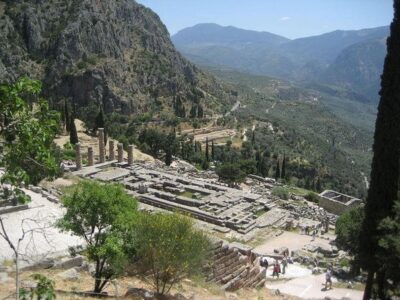 ★ 4.5Historical Delphi One Day Tour with Arachova Stop & Expert GuideFrom $341,247 reviews
 ★ 4.9Historic Athens: Small Group Electric Bike TourFrom $50740 reviews
 ★ 5.0The History of Athens: Greek Mythology Private TourFrom $199138 reviews
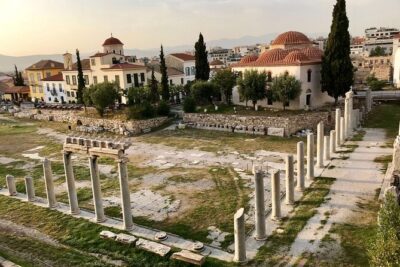 ★ 5.0Athens Highlights by E-Bike: Small-Group Historic TourFrom $54131 reviews
 ★ 4.9Small-Group E-Bike Tour of Historic HighlightsFrom $43119 reviews
 ★ 5.0History of Rebellion Walking TourFrom $44110 reviews
 ★ 5.0Half Day Historical Athens City Private Taxi Service TourFrom $11079 reviews
 ★ 5.0Half day tour to Acropolis and the must-see historical sites and downtownFrom $18069 reviews
Browse the lists this tour appears in