
Reviewed · TOURS
Philosophy and Democracy tour of Athens
Democracy gets a street level makeover. On this Athens philosophy tour, you connect ancient debates to real places, from Kerameikos to the Pnyx hill. You also get a slow, human pace through parts of the city many people skip.
I especially like how the guide turns ideas into scenes. You do not just hear about “democracy” and “philosophy,” you see where people argued, voted, and built civic identity in daily life. I also love the small group feel, because it makes it easy to ask questions and get clear answers while you walk.
One watch-out: you will cover several archaeological areas on foot, and some key stops require separate admission. Plan for extra walking in good weather, and budget a little for entry fees at the sites marked not included.
Key things to know before you go
- Kerameikos blends pottery workshops and Athens’ cemetery, plus Pericles’ famous funeral speech context
- Pnyx Hill is treated as the “cradle of democracy,” with major Acropolis views
- The Tower of the Winds explains how Greeks tracked winds and time, including a sound mechanism
- The Ancient Agora ties philosophers and politicians to the physical center where arguments happened
- Plaka gives you a classic, low-stress way to end the tour after the big ideas
Kerameikos, the cemetery that explains Pericles
This tour starts at the Statue of Theseus, then moves into a part of Athens that often gets passed over. Your first major stop is Kerameikos, a site with two jobs in the city story. It was called ceramic because of the pottery workshops that once operated there. And it also functioned as Athens’ cemetery for centuries, including the burial of prominent Athenians.
What makes Kerameikos matter for this tour is how it anchors political theory in real events. You get the setting for Pericles’ well-known funeral speech for the first casualties of the Peloponnesian War, where democracy is praised through the values and character of Athenians. That is the core trick of this tour: big concepts land harder when you stand where the culture actually lived.
You will only be there about 15 minutes, so you need to keep your focus. Think of Kerameikos as the opening chapter. It sets the tone for the whole walk by showing that civic ideals were not abstract. They were tied to community, sacrifice, and public identity.
One practical note: admission is not included at Kerameikos. If you are trying to minimize extra costs, look at this tour as a guided route where you may need to pay entry at multiple archaeological stops.
You can also read our reviews of more tours and experiences in Athens.


Flea market pacing, then on to Hadrian and the Roman Agora
After Kerameikos, the walk briefly relaxes with a stop at the Flea Market. This is short, easy, and designed as a breather in the schedule. It is free, and the pace shift matters because the rest of the tour is concept heavy. You get 15 minutes to wander without feeling like you are racing.
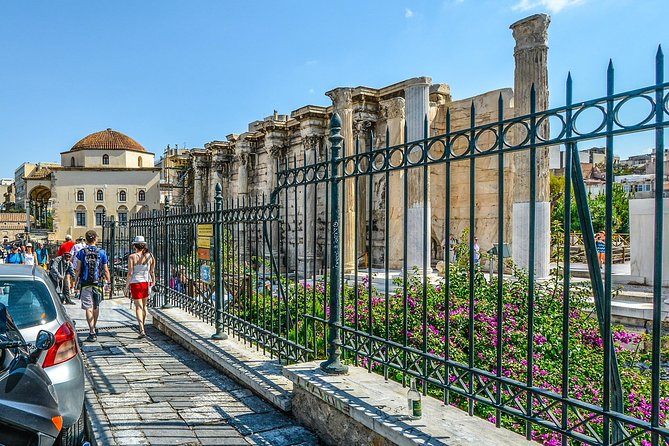
Then the Roman layers of Athens move in. You visit Hadrian’s Library, built by Emperor Hadrian in AD 132 on the north side of the Acropolis. This stop helps you see how later rulers used scholarship, public buildings, and learning spaces to project power. It is not only about Greeks and their ideas. It is also about how the city’s intellectual branding survived and changed under Rome.
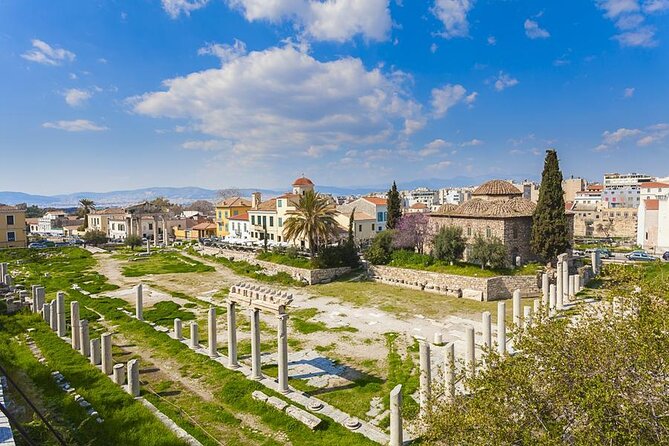
Next up is the Roman Agora, positioned north of the Acropolis and east of the Ancient Agora. Even with a short 15-minute stop, the guide should help you understand why there are so many “agoras” in Athens. The word signals civic activity, but each era shapes it differently.
Why you should care: when you compare democracies across time, you start noticing patterns like public spaces for debate, rules, and collective decision making. The Roman sites are useful because they show what gets reused, what gets repurposed, and what disappears.
Again, some Roman-era stops have admissions not included. Build a bit of flexibility into your budget.
The Tower of the Winds: Athens as weather station and clock
At the Tower of the Winds, you get one of the most fun science-meets-city moments on the route. This octagonal structure was made in the 1st century BC by the astronomer Andronicus of Kyrristos. It served as both a wind indicator and a clock. If you have heard of Greek ingenuity before, this is a great place to make it feel tangible.
The tour’s description is the kind of detail that sticks. The clock was solar, so it tracked time with the sun. But in cloudy conditions, there was also a hydraulic mechanism. When it needed to keep time, it produced a sound every hour. In other words, this was Athens with a built-in public notification system, long before anyone had smart watches.
This is also where you get a useful reminder for the tour theme. Democracy depends on shared time and shared rules. You can only run meetings and manage civic schedules if the city has ways to coordinate daily life. This tower is a small structure, but it explains a big point: the “tools” of society are as important as the “ideas.”
The Tower of the Winds stop is short, about five minutes, and admission is not included. It is a great stop to connect the dots quickly, especially if you like when history comes with real-world function.
Ancient Agora: where thinkers met the voting reality
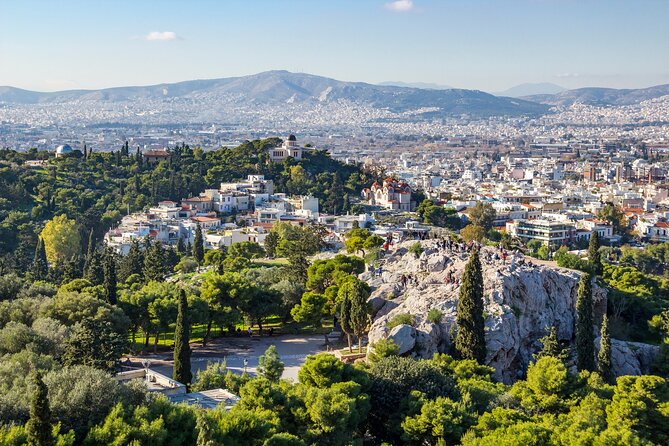
The heart of the tour comes next at the Ancient Agora of Athens, the center where daily civic life unfolded. You spend about 20 minutes here, but it is not the kind of stop where you just look at rocks. It is built for discussion. The Agora was where philosophers, politicians, and ordinary citizens walked and debated almost everything, from ethics to policy.
Expect the guide to connect big names to the space. You should hear how figures like Socrates and Plato, plus political leaders such as Solon and Pericles, belonged to the same civic ecosystem. The tour also references Thucydides, Sophocles, and Aristophanes, which helps broaden “philosophy” beyond one narrow lane. In Athens, public life was not separate from thought. It was thought in motion.
This is one of the tour’s most praised aspects: the explanations are clear and the experience tends to feel like a guided conversation, not a lecture. The tour is designed so you are not lost, even if you do not know the Greek classics already. You should leave with a better sense of why ancient Athens is still used as a reference point for modern democracy.
Then you add a smaller, quieter stop: the Prison of Socrates. The tour offers a tribute here, about 10 minutes, and that makes sense for theme. It reminds you that ideas have consequences. It is hard to talk about democracy and free thought without touching the tension that comes when governments and philosophers collide.
If you are short on time in Athens, the Agora and Pnyx are the “core,” and everything else supports them.
Pnyx Hill and the views that explain why it mattered
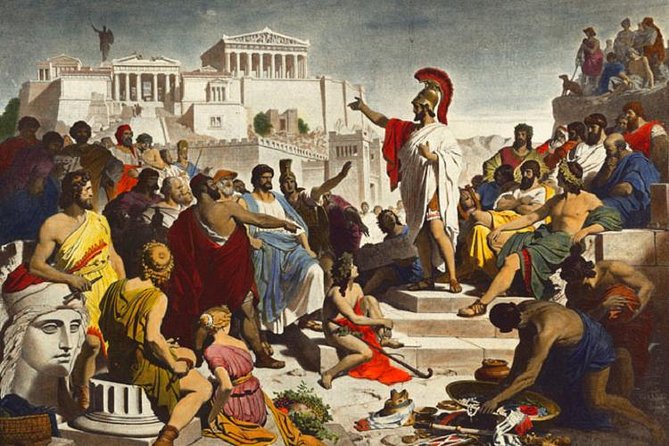
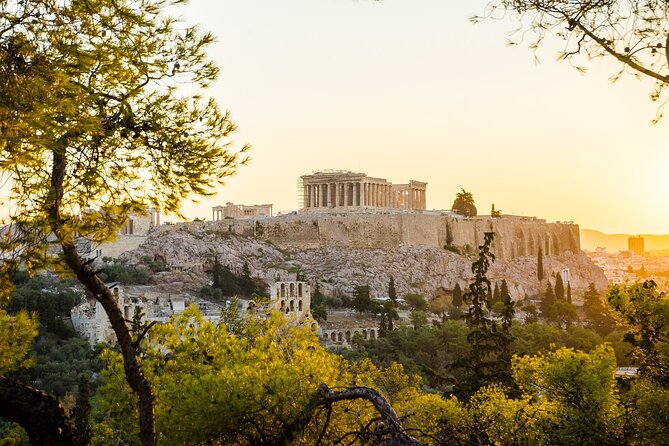
Next comes Pnyx, which the tour calls the cradle of democracy. This is the first place in the world where people took decisions about their future, and that idea makes the hill feel like more than a viewpoint.
You get 30 minutes here, which is important. Decision making needs space for people. The slope and the open air setting help you picture crowds, speeches, and votes. You also get great views of Athens and the Acropolis, and those views are not just scenery. They reinforce why the meeting place was powerful. In a city-state, the physical setting shapes how people feel, how they gather, and how authority looks.
What I like about putting Pnyx in the schedule after the Agora: it is the same civic thread, but the roles shift. In the Agora, you see debate and public life. On the Pnyx, you experience the mechanics of rule making. That contrast makes the topic easier to remember.
If you are trying to understand democracy beyond vocabulary, Pnyx is a practical stop. It helps you ask better questions, like who gets heard, what rules guide participation, and how leaders persuade.
Admission is free for Pnyx in this tour flow, which is another win.
- All Day Cruise -3 Islands to Agistri,Moni, Aegina with lunch and drinks included
★ 5.0 · 4,958 reviews


Plaka at the end: use the narrow streets as your reset button
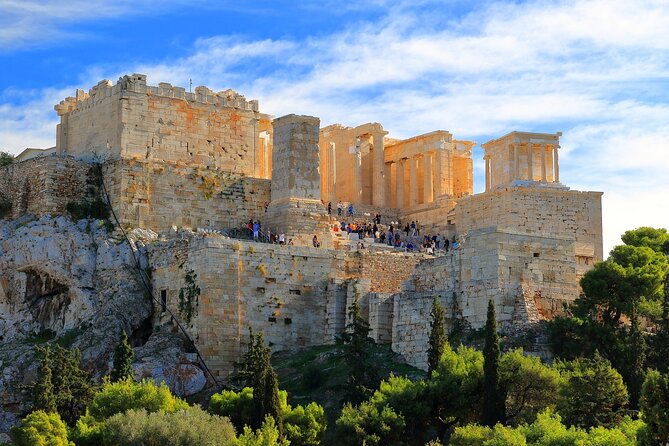
The tour wraps with time in Plaka, described as a scenic neighborhood of small houses and narrow streets. Even if you only get a short moment, this is a smart ending. After 3.5 hours of ideas, you want a low-pressure space to walk casually, grab water, and let your brain cool down.
Plaka is also the kind of place where you can turn your notes into real choices. Maybe you decide to linger near a view. Maybe you stop for coffee. Maybe you plan your next day of exploration with a better sense of where you are.
A lot of this tour’s value is that it gives you a mental map. Once you understand where democracy and philosophy “sat” in the city, the rest of Athens feels more connected. Plaka is your payoff area for that sense of direction.
This is also a good time to remember the simplest comfort advice. Bring water. Wear shoes that can handle uneven ground. If the weather is hot, take your time at the viewpoints.
Pacing and what 3 hours 30 minutes feels like on foot
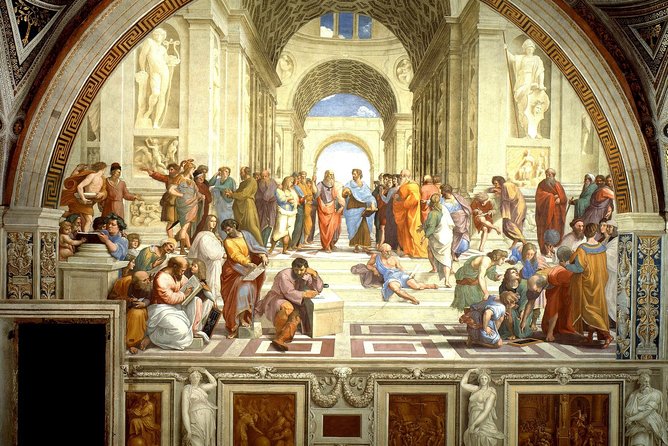
This is listed as about 3 hours 30 minutes and it is a walking tour with multiple stops. The good part is the group size limit of 15 travelers, which usually means fewer crowds at each stop and better attention from your guide.
The other practical benefit shows up in how the schedule is built. You alternate deeper stops with shorter breaks, like the Flea Market walk, and you get short, focused time windows at sites that would be overwhelming if you tried to explore alone. The pace is often called excellent by people who want learning without feeling dragged across the city.
Still, it is not a sit-and-listen bus tour. You should expect real walking and some standing. One review-style theme here is prep. Plan for the walk, and do it with comfort in mind.
Weather matters too. The tour requires good weather, which makes sense because you are outdoors for the full route. If you are visiting during a changeable season, build a little flexibility into your Athens day.
Price value at about $50.81, plus what you should budget for entries

At $50.81 per person, this is one of those Athens experiences that can feel like a bargain if you care about context. You are paying for a guided storyline that ties places together: Kerameikos leads into civic memory. The Roman stops show how ideas were carried forward. The Agora and Pnyx provide the civic engine. Plaka gives you the afterglow.
But you should also plan around what is not included. Several major sites are marked as admission ticket not included. That includes Kerameikos, Hadrian’s Library, the Roman Agora, the Tower of the Winds, and the Ancient Agora of Athens.
Meanwhile, some stops are free, including the Flea Market, the Prison of Socrates tribute, and Pnyx. So the total cost is not just the tour price, but the math often still works if you would pay entry fees anyway. What changes is that the guide helps you get far more meaning from each one.
If you are cost sensitive, the key is to think of this as a guided route where you will pay entrance fees on specific stops. The value is the connection and the explanations, not just access to ticketed sites.
Who should book this Philosophy and Democracy tour in Athens
This tour fits best if you want Athens to make sense, not just look impressive. If you already plan to see the Acropolis and you feel like other tours leave you with gaps about how the city organized civic life, this route is built to close those gaps.
It is also a good family choice in the right ages. The tour is described as targeting adults and working well for teenagers too, especially for groups that enjoy discussions and thinking.
You will probably enjoy it most if:
- you like history that connects to modern life
- you want philosophy without needing a textbook background
- you prefer small groups over huge crowds
- you are comfortable walking for a half-day and standing at viewpoints
It may feel less ideal if you want a slow, museum-only day, or if you dislike paying separate admissions at multiple stops.
Should you book this Athens philosophy and democracy tour?
I think you should book it if your goal is to understand why ancient Athens keeps showing up in modern conversations. The route is built around the civic “how,” not just the famous names. You will get a clear path from Pericles-era public ideals to the places where debate and decision making happened, then end in Plaka so your afternoon does not feel like homework.
Book it especially early in your Athens plans. Seeing these sites first often makes the rest of the city easier to read.
If you are set on paying as little as possible in extra entry fees, check your expectations. Some stops require separate admissions, and the walking pace is real. But if that is fine for you, this is one of the strongest ways to make Athens feel like more than a postcard.
FAQ
How long is the Philosophy and Democracy tour of Athens?
It runs for about 3 hours 30 minutes (approx.).
How much does the tour cost?
The price is $50.81 per person.
Is the tour in English?
Yes, it is offered in English.
What group size is this tour limited to?
It has a maximum of 15 travelers.
Are admission tickets included for all stops?
No. Some stops are marked as admission ticket not included, while others are free (like the Flea Market, Prison of Socrates tribute, and Pnyx).
Where does the tour start and end?
It starts at Statue of Theseus, Athens 105 55, Greece, and ends at Theorias 21, Athina 105 58, Greece.
Does the tour require good weather?
Yes. It requires good weather.
What is the cancellation policy?
You can cancel for a full refund up to 24 hours in advance. If you cancel less than 24 hours before the experience starts, the amount paid will not be refunded.
More Tours in Athens


More Tour Reviews in Athens
- All Day Cruise -3 Islands to Agistri,Moni, Aegina with lunch and drinks included
★ 5.0 · 4,958 reviews
Not for you? Here's more nearby things to do in Athens we have reviewed








Tours, compared.
 ★ 4.8Acropolis, Parthenon & Acropolis Museum Guided TourFrom $409,316 reviews
 ★ 4.6Acropolis and Parthenon Guided Walking TourFrom $385,882 reviews
 ★ 5.0Greek Food Walking Tour in AthensFrom $874,740 reviews
 ★ 4.3City Sightseeing Hop-On Hop-Off Bus TourFrom $254,520 reviews
 ★ 4.6Mythology of Delphi, Museum and Arachova Guided TourFrom $314,008 reviews
 ★ 5.0Best of Athens Half Day Private TourFrom $913,714 reviews
★ 4.8Acropolis, Parthenon & Acropolis Museum Guided TourFrom $413,579 reviews
★ 5.0Best of Athens Half Day Private TourFrom $913,714 reviews
★ 4.8Acropolis, Parthenon & Acropolis Museum Guided TourFrom $413,579 reviews
 ★ 4.7Acropolis: Acropolis and Parthenon Guided Walking TourFrom $363,442 reviews