
Reviewed · EVENING EXPERIENCES
Night Tour of the City of Athens with Guide in Spanish
Athens looks different under moonlight. This night tour in Spanish focuses on the city’s most famous buildings and squares when they glow, with time to ask questions and shoot photos. You’ll hear stories tied to history and mythology, then watch the city’s “day face” fade into a calmer, more atmospheric scene.
I especially like the small group size (up to 15), because it makes the pace feel personal instead of rushed. I also like that the guide brings modern and classical Athens together, so places like Syntagma Square and the Ancient Agora feel connected rather than random stops. One drawback to plan for: it is a walking route for about two hours, and you do not get interior access to archaeological sites.
Key highlights worth knowing before you go
- Moonlit photo stops at major landmarks, with time built in for pictures
- Spanish guiding with an easy, friendly teaching style shown by guides like Juan and Lorena Navarrete
- A tight route designed for a 2 hour evening stroll, not a half-day marathon
- No archaeological interiors, so think of it as exterior views and street-level context
- A classic Athens mix of neoclassical buildings, parliament area landmarks, and ancient sites
- Ends at the Ancient Agora so you can continue exploring right after the tour
Starting at Vallianeio Megaron and finding your bearings fast
Your evening starts at Vallianeio Megaron on Panepistimiou 32. This is a smart kickoff because you begin in the area of major academic and cultural landmarks, not down in the densest tourist core. In practice, that means you can settle in, get oriented, and feel the neighborhood rhythm early, before the route climbs into the big-name squares.
The tour immediately signals what it wants you to notice: the contrast between architecture in daylight and how buildings change after dark. When the lights come on, you stop seeing Athens as a list of sites and start seeing it as a connected cityscape. Even if you are new to Athens, you’ll get a mental map quickly, which helps later when you wander on your own.
Plan for comfortable walking shoes. The stops are short, but you are moving through the evening, and a smooth pace makes the whole thing more enjoyable.
You can also read our reviews of more guided tours in Athens
The Athenian trilogy: National Library areas and the Academy of Athens by night
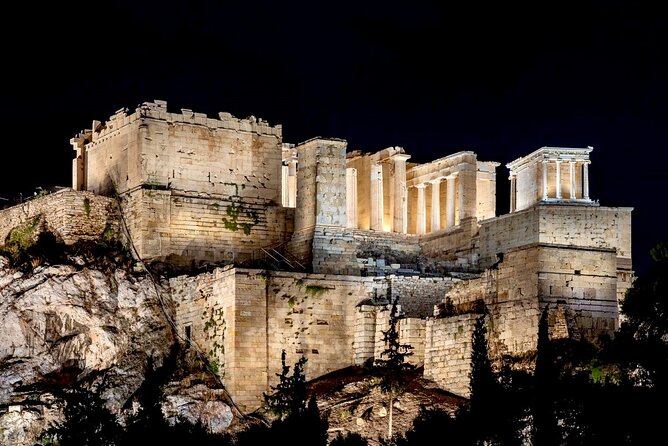
After the start, the route hits the National Library of Athens area, which is part of the so-called Athenian trilogy. The idea here is simple: these big institutional buildings were designed to project knowledge and civic identity, and night lighting makes those “statements in stone” look dramatic rather than merely impressive.
You also pass the National and Kapodistrian University of Athens complex (including the radiology and medical imaging research area listed on the stop notes). You might not expect a research unit to be part of a tourist story, but the value is that your guide can explain why these buildings matter in the Greek capital, not just why they look good in photos.
Next comes the Academy of Athens. This is one of those stops where, even from the outside, you can see why it is often used as an example of what Greek building traditions tried to communicate. At night, the shapes feel more formal and the details pop under the lights. You are not doing museum-style “inside viewing,” but you are learning how to read the architecture as a symbol.
If you like architecture and how cities represent ideas, you’ll probably enjoy this segment most. If you are mainly chasing ancient ruins, it’s still worth it because it sets up how the city links past ideals to modern institutions.
Syntagma Square and the Hellenic Parliament after dark
From the more academic area, the route moves toward Syntagma Square, the centerpiece for modern Athens. The stop notes tie Syntagma’s name to the Constitution, commemorating King Otto I, and that gives you a useful way to understand why the square feels so politically charged and central.
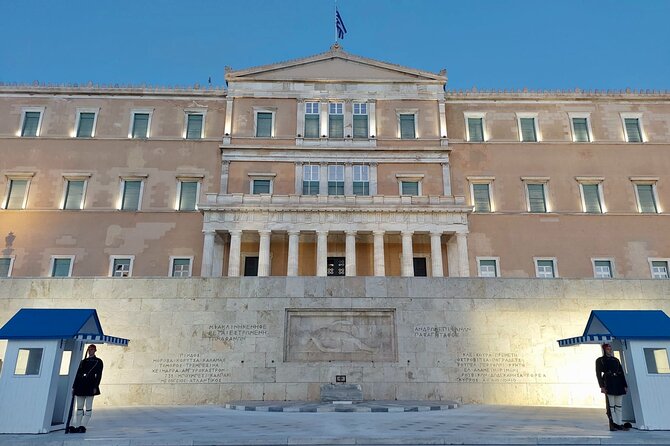
Then you reach the Hellenic Parliament area. Even if you do not care about politics day-to-day, this is a key Athens location to know. Night changes the vibe: the square feels more open and less hectic, and the building facades look crisp under lights. This is the moment where you start noticing how Athens can feel both monumental and very human at the street level.
A practical consideration: this part of the evening can naturally attract foot traffic. You are not touring inside the building, but you may feel the normal crowd flow around major government landmarks. If you hate busy places, keep your expectations realistic, and focus on listening and on your photos during the brief stop windows.
Zappeion, the Olympics link, and Panathenaic Stadium’s glow
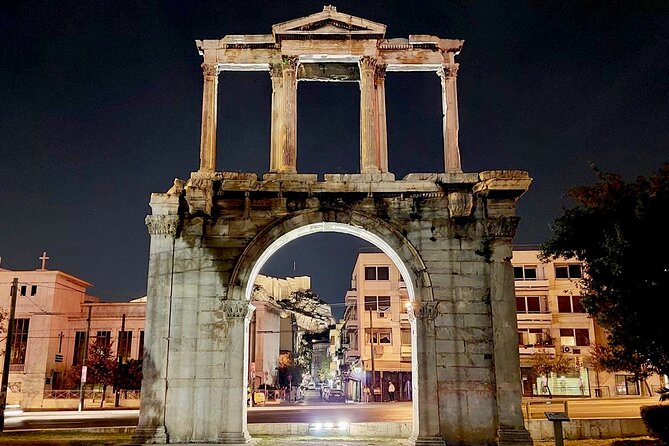
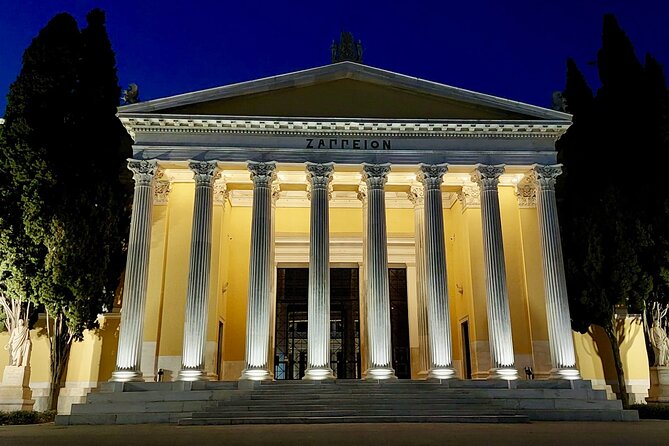
Next up is the Zappeion, with a note that it is linked to the Olympics. This stop matters because it shows how Athens builds continuity between ancient athletic ideals and modern global events. It’s not just a “look at the building” moment. It is a “why this place was chosen” moment.
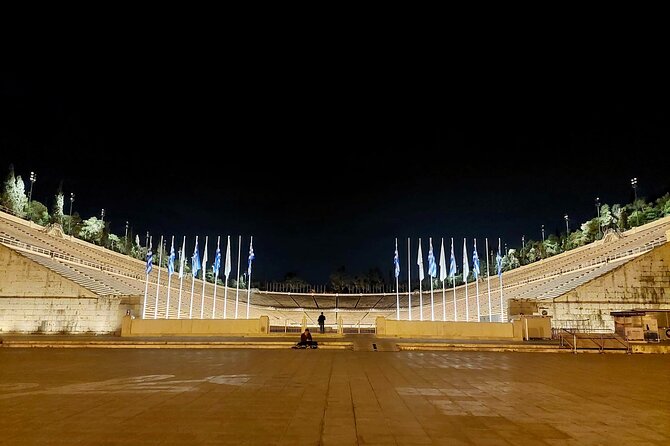
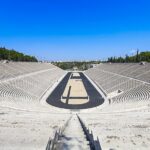
Then the route brings you to the Panathenaic Stadium, famously connected to the first edition of the Olympic Games. In evening light, the stadium area feels almost cinematic. Even without any interior access mentioned for stadium viewing, the exterior experience can still be powerful because the location is built for spectacle.
If your goal is to get that Athens sense of scale, this segment helps. You see how the city puts ceremonial spaces right in the urban flow. It’s also a nice break from squares and government-focused stops, since stadium architecture has its own rhythm and identity.
For photo-minded planning, this is a great time to pull out your camera, because the stadium lighting tends to give contrast and depth compared with the darker streets around it. Your guide typically leaves room for photos, so you are not stuck rushing.
Leof. Vasilisis Amalias 50 and Olympian Zeus, huge scale in softer light
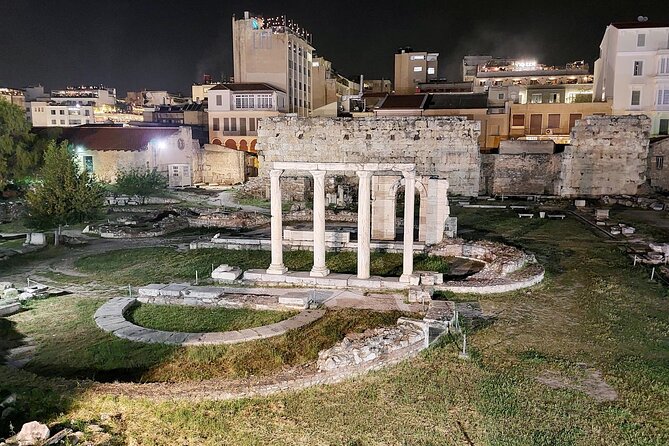
One stop is listed at Leof. Vasilisis Amalias 50, described as one of the most significant monuments of the Greek capital. Since the interior is not the point, focus on what you can observe on the street: the monument’s position in the city, how it sits relative to nearby landmarks, and how the lighting frames its proportions.
Then comes Tempio di Zeus Olimpio (Temple of Olympian Zeus). The stop notes say it was the largest temple in all of Greece, and that is exactly the kind of statement you want to hear on location. At night, the temple area can feel larger than it does in daylight, because shadows and illumination accent the scale. It turns a fact into a feeling.
Here’s the key value for your brain: your guide’s job is to connect “what it was” to “how it looks now.” You might see ruins and fragments, but the explanation helps you picture the original size and intent. That transformation is what makes the night format work, because you’re not competing with midday crowds and glare.
You can also read our reviews of more city tours in Athens

Plaka at night: Metropolitan Cathedral, the Ancient Agora, and the end point
The tour then reaches the Metropolitan Cathedral of Athens in the heart of the Plaka neighborhood. This stop adds texture. Plaka is often associated with cozy wandering and old-town charm, and night makes it feel calmer and more intimate. Even if you have not planned a Plaka route, this stop gives you a direct “this is where you’ll want to stroll later” reference.
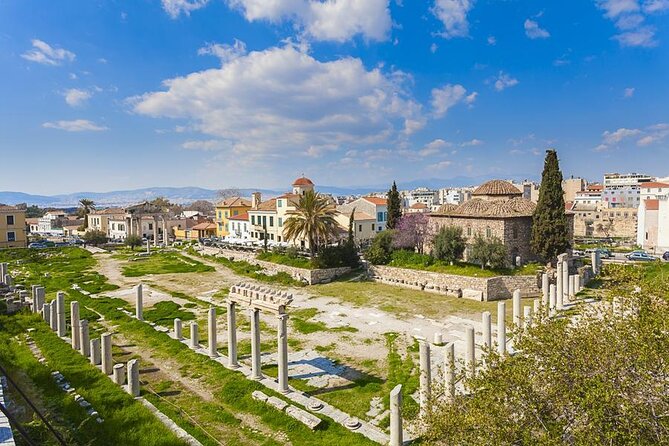
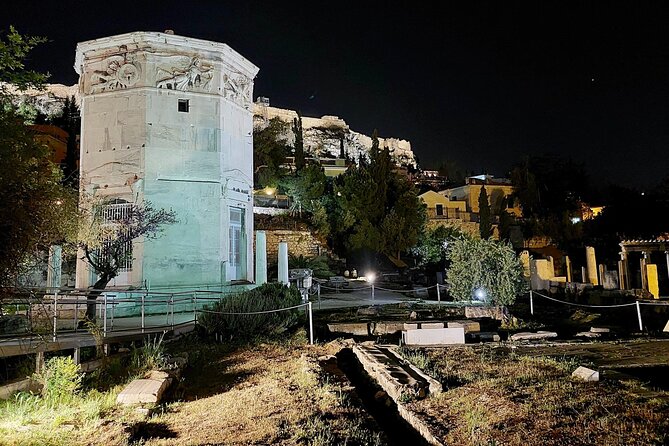
Finally, the experience ends at the Ancient Agora of Athens. The route is structured around stop-and-learn moments rather than long museum visits. The big limitation you should know clearly is: there is no access to the interior of any archaeological site. So you should come expecting exterior viewing and street-level context, not a guided walk through ticketed indoor galleries.
Still, finishing at the Ancient Agora is a smart choice, because it places you right where you may want to continue on your own. If you like to keep exploring after a tour, ending here gives you momentum instead of sending you back to a starting area miles away.
Price and what you really get for $27.51
At $27.51 per person for about 2 hours, this tour sits in the “good value for a guided orientation” category. You are paying for a live official tourist guide in Spanish, a structured nighttime route, and the pacing that helps you understand what you are seeing without doing all the research yourself.
What makes the price feel reasonable is the balance: you get enough major stops to feel like you learned something substantial, but the tour is short enough to stay energetic. The group limit of 15 also matters. Smaller groups usually mean fewer communication problems, more attention, and less time lost waiting around.
Also, the tour uses a mobile ticket, which is convenient on evenings when you want to travel light and avoid printing. And while there is no dinner, that can actually be a benefit. You can eat where you want afterward, in Plaka or elsewhere, instead of feeling locked into a specific meal plan.
If you’re on a tight first trip day, or you want a “how Athens fits together” evening, this is the kind of experience that can pay off later when you plan your next day.
Logistics that affect your comfort (not just the fine print)
This is a nighttime walking tour, so a few practical choices will matter more than you might think.
- Wear comfortable shoes. Even short stops can add up on cobblestones and uneven sidewalks.
- Bring a light layer. Night air can feel cooler even when the day was warm.
- Keep your phone charged. You will likely use it for photos and to navigate afterward.
The meeting point is clear and specific at Panepistimiou 32, and the tour ends at the Ancient Agora. That means you can plan your post-tour time nearby instead of crisscrossing the city.
The tour is also described as near public transportation, which is useful if you are mixing this evening activity with other plans. Confirmation is received at booking time, and service animals are allowed, which is helpful for many kinds of visitors.
Who should book this night tour (and who should pick something else)
This night tour is a strong fit if you want:
- A Spanish-guided orientation to Athens with context and stories
- A route focused on major highlights rather than off-the-beaten-path neighborhoods
- A short evening plan that ends in a place where you can keep exploring, the Ancient Agora
It might be less ideal if you:
- Want lots of time inside museums or archaeological interiors, because none are included
- Prefer long, slow visits at fewer sites instead of brief stops and continual movement
- Get stressed by city squares with normal foot traffic, since Syntagma and parliament-area areas are central and can feel busy
The best part is that the tour is built for the night experience. Athens at midnight is not the same city as Athens at noon, and the lighting and atmosphere help you understand why the Greeks capital inspires people in the first place.
Should you book this Athens night tour in Spanish?
I think this is a smart booking when you want guided context without committing to a half-day schedule. The combination of a Spanish guide, a small group, and a route that stitches together neoclassical Athens, modern civic landmarks, and ancient sites makes it feel like more than “just photos.”
Book it if you want an evening that helps you read the city, ask questions, and then carry that map into your next day walks. Skip it or adjust expectations if you are hoping for interior access to archaeological sites or long visits. For everything else, especially a first or second day in Athens, it’s a solid way to see the city’s nighttime personality quickly and well.
FAQ
What language is the guide?
The tour includes an official tourist guide in Spanish.
How long is the night tour?
The duration is about 2 hours.
How much does the tour cost?
The price is listed as $27.51 per person.
What is the group size limit?
The tour has a maximum of 15 travelers.
Where do we meet for the tour?
The start is at Vallianeio Megaron, Panepistimiou 32, Athina 106 79, Greece.
Where does the tour end?
The tour ends at Ancient Agora of Athens, Athens 105 55, Greece.
Is the ticket mobile or printed?
It is a mobile ticket.
Is dinner included?
No, dinner is not included.
Do we get access to the interior of archaeological sites?
No, there is no access to the interior of any archaeological site.
Can I cancel for a full refund, and are service animals allowed?
You can cancel for a full refund by canceling at least 24 hours in advance. Service animals are allowed.
More Guided Tours in Athens

More Tours in Athens

More Tour Reviews in Athens
- All Day Cruise -3 Islands to Agistri,Moni, Aegina with lunch and drinks included
★ 5.0 · 4,958 reviews


Not for you? Here's more nearby things to do in Athens we have reviewed






Evening Experiences, compared.
 ★ 4.8Cape Sounion & Poseidon Temple Sunset Half-Day TripFrom $238,241 reviews
 ★ 4.3Cape Sounion & Temple of Poseidon Sunset ExperienceFrom $22857 reviews
 ★ 5.0Athens Evening Food TourFrom $96766 reviews
 ★ 5.0Enjoy Cape Sounio Private Majestic Sunset With Seaside DinnerFrom $151613 reviews
 ★ 4.5Temple of Poseidon and Cape Sounion Sunset Tour with Audio GuideFrom $33542 reviews
 ★ 4.8Acropolis Sunset Tour with Optional Fast-Track EntryFrom $45490 reviews
 ★ 4.3Hop-on-Hop-off Bus and Cape Sounion Sunset TourFrom $23484 reviews
 ★ 4.9Evening Food Walking TourFrom $94422 reviews
Browse the lists this tour appears in