
Reviewed · DELPHI DAY TRIPS FROM ATHENS
Argolis Olympia & Delphi Three-Day Tour
A trip through the Peloponnese and up to Delphi feels like a time machine. This private 3-day route strings together major UNESCO-grade sites with smaller stops, using timing that helps you see monuments before the biggest crowds arrive.
I love the private, door-to-site transportation in a comfortable air-conditioned vehicle, plus bottled water and WiFi onboard. I also like that your driver is fluent in English and brings real care for your schedule, with guides like Panos and Michael highlighted for keeping the experience smooth and fun.
One consideration: meals, hotel nights, and entrance fees are extra, so you will want to budget for those before you commit, and you should confirm what your tour day pace will feel like with your group.
Key things to know before you go
- Private timing that can mean fewer crowds at big sites compared with large group buses
- Air-conditioned, WiFi onboard vehicle plus bottled water for longer driving days
- Entrance fees are an added cost (plan on about 60 euros per adult total)
- Hotel accommodation is not included, so you’ll need to arrange your nights
- Optional licensed guides are available on request (additional cost) for deeper explanations
- A packed but balanced route: ancient sanctuaries, museums, seaside towns, and major monuments
The value in a private route: comfort, timing, and control
This is not a marathon bus crawl. It’s a private, three-day plan built around the classics of mainland Greece, with an air-conditioned vehicle, bottled water, and onboard WiFi to make the long drives feel less painful. You also get pickup offered, which matters in Athens when you don’t want to waste half a day figuring out logistics.
The other big value is timing. This plan is designed to let you visit key archaeological sites at different times than the huge coach tours. That can make a noticeable difference at places like Ancient Corinth, Epidaurus, and Delphi, where crowds can change how enjoyable a site is. You’re not just “checking boxes.” You get moments where you can actually look, read, and breathe.
Your driver is English-speaking and certified, but they are not licensed to walk into sites with you. That’s common, and it can actually be a good thing if you like browsing at your own pace. If you want a more talk-heavy experience, you can request three local licensed tour guides (when available) for an extra fee.
You can also read our reviews of more tours and experiences in Athens.


Corinth Canal: a quick photo stop with a cool engineering story
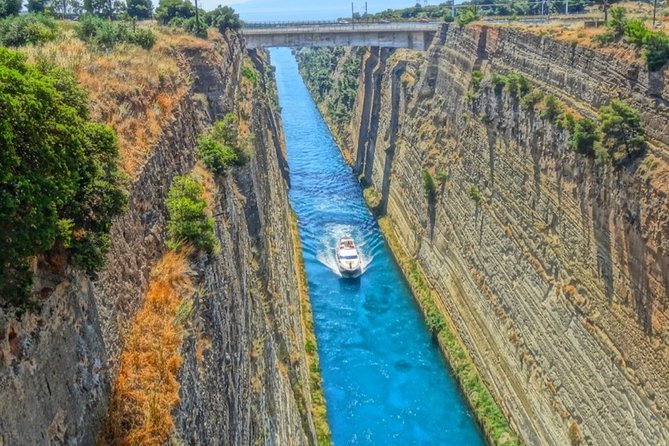
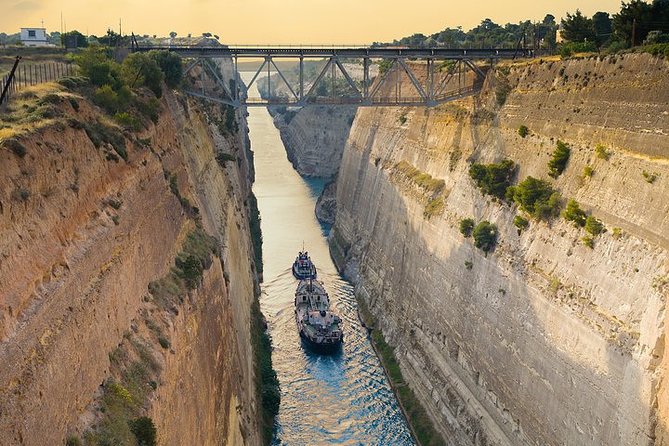
You’ll start with the Corinth Canal, a short, scenic break that adds a modern layer to an ancient journey. The canal connects the Gulf of Corinth to the Saronic Gulf, cutting through the Isthmus of Corinth and separating the Peloponnese from mainland Greece, sort of like a human-made island.
What makes it more than a quick stretch of water is the scale and design:
- 6.4 kilometers long (about 4 miles)
- 21.4 meters wide at the base
- No locks, dug at sea level
Even better, the canal has a long backstory. It was proposed in classical times, with a failed effort in the 1st century AD, and construction only began in 1881. Today it’s mainly a tourist attraction rather than an essential shipping route, which means your stop feels straightforward and low-pressure.
Tip for your photos: bring a lens hood or just keep your camera steady. This is the kind of spot where wind off the water can get annoying.
Ancient Corinth and the museum: Doric power and a very human religious court case
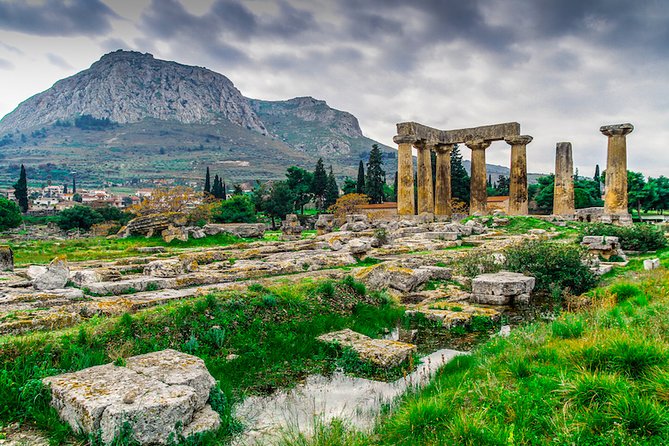
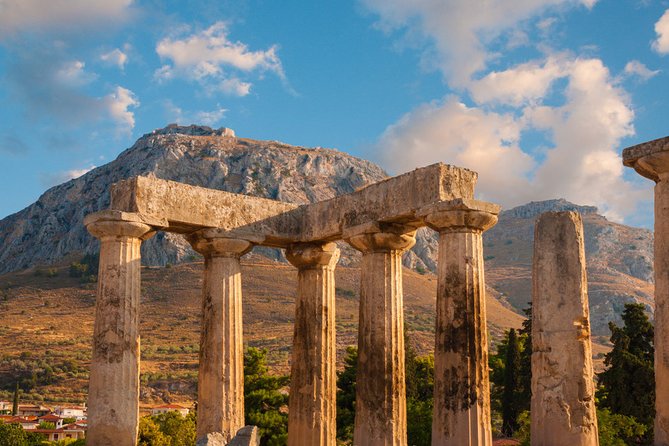
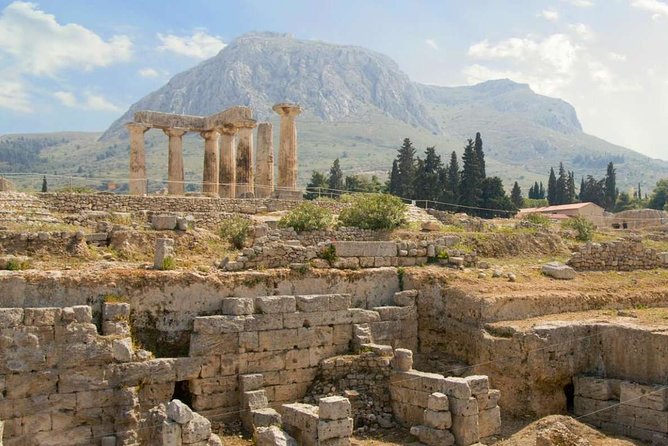
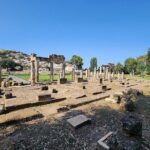
Ancient Corinth (Archaia Korinthos) is the kind of place where you can feel the city’s importance without needing a lecture to understand it. You’ll spend about 45 minutes here, with highlights that include the Temple of Apollo and the site associated with St. Paul’s trial.
The Temple of Apollo matters because it’s early Doric in style, built around 560 BCE, using local oolithic limestone and perched on a rocky hill near Acrocorinth. Even if you don’t memorize architectural terms, you’ll likely notice how grounded and solid it feels. Doric temples often look simple from a distance, but up close the details and proportions are the point.
St. Paul’s Step connects this archaeological site to the New Testament era. The plan references Paul being brought before the proconsul Lucius Junius Gallio Annaeanus, and it points to the Bema, an elevated rostrum central to Corinth’s Roman forum space. It’s one of those moments where the stones feel surprisingly close to real people.
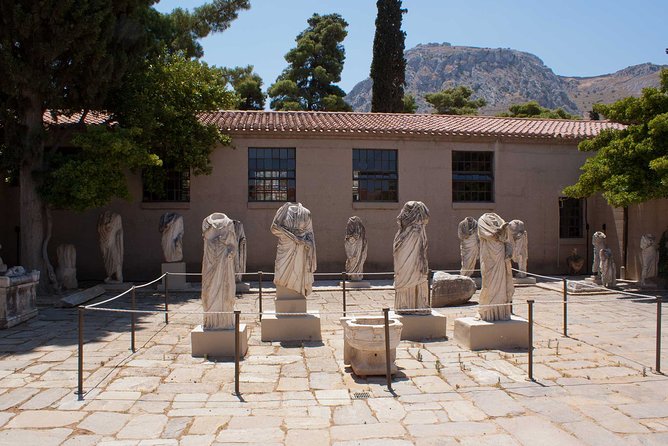
Right after that, you’ll add 30 minutes at the Archaeological Museum of Corinth. This isn’t just a random room to kill time. It’s where you can see how many layers a major city accumulates:
- finds from the Prehistoric period
- material from the Geometric, Archaic, Classical, and Hellenistic eras
- items from the Roman, Byzantine, and Frankish city
- exhibits connected to the sanctuary of Asklepios and an early Christian cemetery
If you want a cleaner transition from ruins to context, this museum stop is a smart move because it fills in the gaps before you move on.
Epidaurus: a healing sanctuary and a theater you can feel
Next comes the Ancient Theatre of Epidaurus. This stop is built for anyone who loves settings where architecture does the work. Epidaurus is linked to the sanctuary of Aesculapius, a healing center and cultural hub in antiquity.
You’ll get about 45 minutes here, and the theater is the star for practical reasons: it has unique acoustics, and it retains an original circular orchestral area. It’s also still used today, which gives you a rare sense that the place wasn’t frozen in the past.
What to do on-site:
- Walk up to get perspective on how the theater shape fits the landscape.
- Spend a minute just listening to the space. Even if sound does not behave like a museum recording, the theater design is part of why people get emotional here.
Nafplio and Tolon: slow down, eat well, and enjoy the waterline
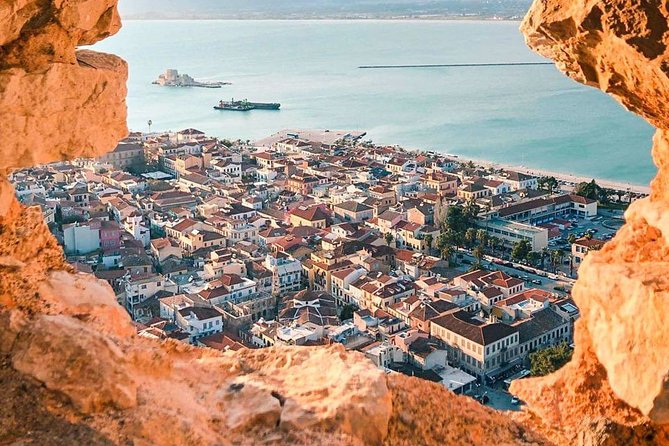
After Epidaurus, you’ll transition into the Argolic Gulf area with time for Nafplio and then Tolon. Nafplio is a seaport town that climbed the hills near the Gulf of Argolis. It used to be a capital city at key points, including:
- the capital of the First Hellenic Republic
- and later the Kingdom of Greece from the start of the Greek Revolution in 1821 until 1834
That political weight shows up in the town’s layers and layout, and it’s exactly why Nafplio works well in a history-heavy tour day. It gives you a break from ruins without turning the day into something generic.
You’ll have about 40 minutes in Nafplio, and then roughly 45 minutes in Tolon. Tolon is a sea town about 7 kilometers east of Nafplion, and the plan is to enjoy lunch at a traditional family-owned restaurant with views of the Saronic Gulf. Since meals are not included, you’ll want to budget for your lunch, but this is one of those times where paying for a good view is worth it.
If your group gets restless on driving days, this is the moment to regain calm. The ocean air does the job.
- All Day Cruise -3 Islands to Agistri,Moni, Aegina with lunch and drinks included
★ 5.0 · 4,958 reviews

Mycenae: Cyclopean walls and the Agamemnon legend
Your next big hit is the Archaeological Site of Mycenae. You’ll spend about 1 hour here, and it’s a site that rewards even a quick visit because it’s so visually clear.
Mycenae was a center of power in the Late Bronze Age, roughly from the 16th century BCE to the 11th century BCE. The acropolis sits behind famous Cyclopean walls. Then you move toward the Lion Gates and up through the palace complex area.
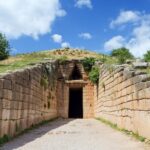
The plan highlights the palace connected to Agamemnon, including the tragic arc tied to Clytemnestra and her lover after his return from the Trojan War. Next you’ll include a short stop up on another hill opposite the palace, visiting the Treasury of Atreus, also called the Tomb of Agamemnon.
Even if you know the legends already, Mycenae is one of the best places in Greece to understand why those stories stuck. The scale of the fortifications makes myth feel like a memory system.
One drawback to consider: with only about an hour, you’ll want to pick what to focus on. If you love tomb architecture, spend a bit more time on the Treasury area. If you love city layouts, aim your attention at the paths and gate areas.
Olympia overnight: giving the next day the right energy
Day 1 ends with reaching Olympia and staying the night at a local hotel. The day includes a long driving block afterward, so think of this as the pivot point. You’re trading the seaside and Peloponnese towns for a sanctuary that feels ceremonial and heavy in meaning.
Olympia is famous for the Olympic Games, held every four years to honor Zeus beginning in 776 BCE. Even when you know the headline, the feeling at Olympia is different once you walk among the ruins.
The big question for you: can your group handle a long driving day and still enjoy the next morning? If you’re traveling with kids, or you have someone who gets car-sick, ask for a pace that includes frequent comfort stops. The plan already builds in breaks, but your body still sets the real tempo.
Olympia in the morning: Temple of Zeus, Hera, and Pheidias’ workshop
The next day starts with Olympia archaeological time, about 1 hour 30 minutes at the site. The plan is smart here because it hits the three most important ideas: power, sanctity, and the craft behind it.
Highlights include:
- The Temple of Zeus, the largest temple in the Peloponnese, in the Altis sacred precinct
- The Temple of Hera, one of the oldest monumental temples in Greece, tied to lighting the Olympic Flame in modern times
- The workshop of Pheidias, where the great sculptor crafted the gigantic chryselephantine statue
Even if you don’t see the original statue, understanding the workshop context helps you imagine how colossal art was made. It turns Olympia from a set of stone fragments into a working cultural system.
Then you’ll add 45 minutes at the Archaeological Museum of Olympia. This museum is one of the best payoff stops on the route because it gives scale and material reality to the sanctuary. The plan notes special strengths including:
- major sculpture collection
- a bronze collection described as the richest of its type in the world
- large terracottas collection
If you want one museum moment to slow your brain down and make the ruins easier to understand later, this is it.
The bridge stop on the way to Delphi: modern Greece as a palate cleanser
En route to Delphi, the plan includes a stop for the Charilaos Trikoupis bridge, a long multi-span cable-stayed bridge crossing the Gulf of Corinth. It links the town of Rio on the Peloponnese peninsula to Antirrio on mainland Greece by road.
Why it’s worth paying attention to: it opened on 12 August 2004, one day before the Athens 2004 Summer Olympics, and it was used to transport the Olympic Flame. So you get a practical connection between ancient and modern sporting symbolism.
Then you’ll have shorter picture or coffee breaks in:
- Nafpaktos Old Port (about 10 minutes)
- Galaxidi (about 20 minutes)
Galaxidi’s story is the kind you remember. It was a 19th-century shipbuilding center, with stone mansions from that time. The older harbor is known locally as Hirolakas, or Widows Port, remembering wives waiting for husbands who never returned.
These stops are brief, but they keep the drive from feeling like one long hallway between temples.
Delphi: the oracle’s setting and the modern town below Mount Parnassus
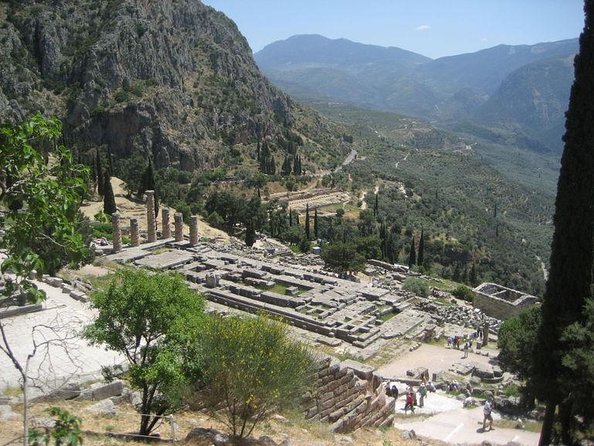
Delphi is both an archaeological site and a modern town on the southwestern slope of Mount Parnassus in the Phocis valley. It’s famous as the navel of the earth in mythology and as the site of the Delphic Oracle, Apollo’s major sanctuary after he slew the Python.
You’ll spend the night in a local hotel at Delphi, which makes the site feel less rushed on the third day. That’s a big quality-of-life factor, because Delphi is not a place you should squeeze like a roadside attraction.
Castalia spring and the core sanctuaries: what you need to see in one focused morning
On Day 3, your main Delphi site visit is about 1 hour 30 minutes, and it hits a high-value list:
- Castalia spring
- ancient Sanctuary of Apollo
- Treasury of the Athenians
- ancient stadium
- ancient theatre
- the unique bronze Charioteer
- Temple of Athena Pronea
- Gymnasium
This is a useful set because it moves across themes. The springs and Apollo sanctuary connect to the Oracle and sacred rituals. The stadium and theater show community life and performance. The charioteer, even referenced as a highlight, signals the artistic level of the sanctuary.
If you want one practical strategy: don’t try to read everything in one pass. Pick two or three spots and really look. Delphi rewards attention more than speed.
Delphi Archaeological Museum: where the fragments become a story
After the ruins, you’ll visit the Delphi Archaeological Museum for about 45 minutes. The plan notes it as one of the most important in Greece, and it emphasizes the museum’s role in explaining the sanctuary’s history.
It’s described as a two-storey building with 14 exhibition rooms and spaces for conservation and storage. You’ll find mostly architectural sculpture, statues, and minor objects donated to the sanctuary, reflecting religious, political, and artistic activity from the 8th century BCE through Late Antiquity decline.
If you felt slightly overwhelmed on the site, this museum helps you reframe. It turns scattered details into a more coherent picture.
Arachova and Hosios Loukas: mountain town charm and mosaic brilliance
Next comes Arachova, about 10 kilometers from Delphi. You’ll have around 30 minutes here. The point of Arachova is less about ruins and more about atmosphere, where old and new blend around mountain life tied to Apollo’s holy mountain setting.
Then the tour finishes with Hosios Loukas Monastery, about 45 minutes. This monastery is established by the Greek monk Loukas, and it includes his crypt burial area in the plan. One of the most striking details is the entrance mosaic, described as a spectacular gold mosaic of the saint.
Inside, there’s the Katholikon and the Theotokos, with Theotokos erected between 997 and 1011 to honor the Virgin Mary. The plan also points out well-preserved frescoes and mosaics. If you like church art, this is a great way to end a history-heavy trip without needing another set of archaeological stones.
The comparison offered is that Hosios Loukas may remind you of Hagia Sophia in Istanbul or St. Mark’s Basilica in Venice, not because it is the same, but because the mosaic and architecture approach creates a similar sense of visual impact.
Price and logistics: what $2,388.27 per group really buys
The price listed is $2,388.27 per group (up to 2) for the 3-day experience. That sounds high until you look at what’s included and what’s not.
Included items you’re paying for:
- private transportation in an air-conditioned vehicle
- bottled water
- WiFi onboard
- pickup offered
- professional, English-fluent drivers (certified)
- mobile ticket noted
Not included items that affect your true trip cost:
- meals
- entrance fees, totaling about 60 euros per adult
- optional local licensed guides (additional 620 euros if requested, depending on availability)
- hotel accommodation
So the value question becomes simple: if you want private comfort, flexible pacing, and the ability to customize with optional guides, this price can make sense. If you are cost-minimizing and don’t care about privacy, you could likely spend less with shared options, but you would sacrifice the control that makes timing work.
One more thing to consider: this plan is designed for a pair or a small group, which is why it works so well for value. If you’re traveling with more people and need extra vehicles or arrangements, confirm what the price covers for your exact group size.
Practical tips for enjoying every stop (without getting exhausted)
This route stacks big sites and long days. A few practical moves will make a difference:
- Wear shoes you can trust on uneven ground at places like Ancient Corinth, Epidaurus, and Mycenae.
- Plan for sun and wind. The Corinth Canal, seaside Nafplio and Tolon areas, and open archaeological spaces can all feel intense.
- For meals, think ahead. The plan includes lunch at Tolon at a traditional family-owned restaurant with a view, but all meals are otherwise not included.
- If you want more storytelling at the major sites, consider the optional licensed guides. It’s the only part that directly adds structured on-site interpretation.
- Keep your group hydrated. Bottled water is included, and you’ll likely use it.
If you like structure, you’ll appreciate the way the time blocks are set. If you prefer slow travel, you might find some stops feel short, especially Mycenae and the short seaside port breaks. That doesn’t mean it’s bad. It means you’ll get the best experience by choosing what matters most to your group.
Should you book the Argolis, Olympia, and Delphi three-day tour?
I think you should book this tour if you want a private, comfortable, classics-focused trip that uses smarter timing to improve your experience at major sites. It’s especially good if you care about seeing Ancient Corinth, Epidaurus, Mycenae, Olympia, and Delphi without dealing with a crowded bus vibe.
You might skip it if your priority is a super low-cost trip, or if you do not want to handle extra planning for hotels and entrance fees. Also, because the plan packs in a lot, you should be honest about your group stamina, since the best parts are spread across both driving-heavy days and site-heavy mornings.
If you want the most value, pair it with your preferences: request optional licensed guides if you want extra depth, and plan meals with care so you keep energy up for the archaeology days. This route works when you treat it like a curated route, not a checklist.
More Tours in Athens

More Tour Reviews in Athens
- All Day Cruise -3 Islands to Agistri,Moni, Aegina with lunch and drinks included
★ 5.0 · 4,958 reviews
Not for you? Here's more nearby things to do in Athens we have reviewed






Delphi Day Trips from Athens, compared.
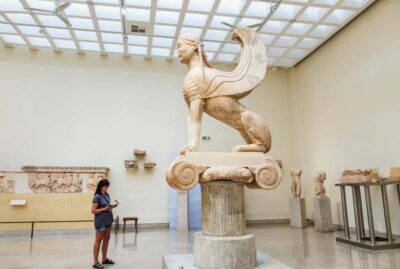 ★ 4.6Mythology of Delphi, Museum and Arachova Guided TourFrom $314,008 reviews
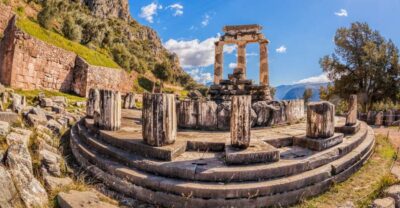 ★ 4.6From Athens: Delphi Full Day V.R. Audio Guided TourFrom $303,028 reviews
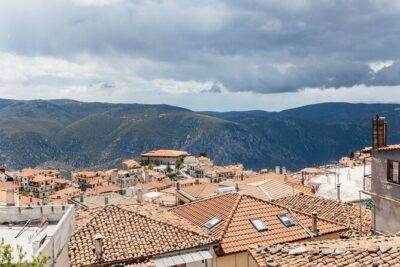 ★ 4.8From Athens: Small-Group Delphi, Museum & Arachova Day TripFrom $342,476 reviews
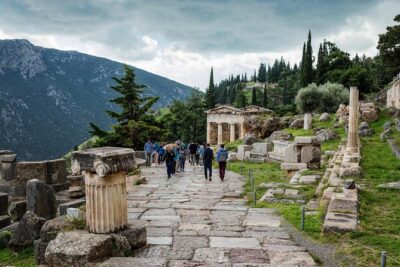 ★ 4.5Delphi English Day Trip from Athens with Official GuideFrom $782,199 reviews
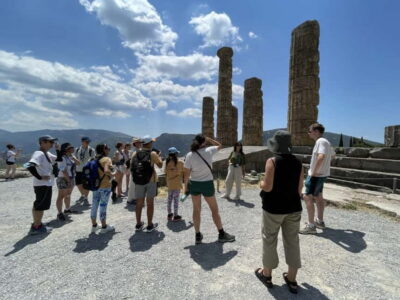 ★ 4.7Delphi Guided Trip with Optional Lunch and EntryFrom $331,553 reviews
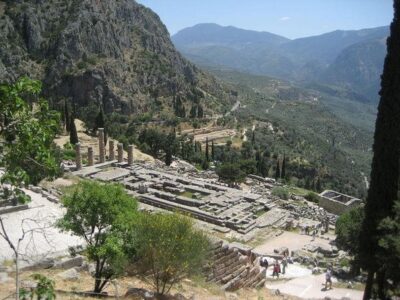 ★ 4.5Historical Delphi One Day Tour with Arachova Stop & Expert GuideFrom $341,247 reviews
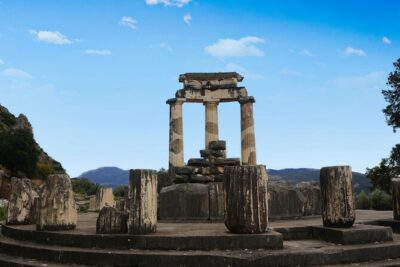 ★ 4.5Premium Delphi Day Trip with an Expert Guide, Museum & LunchFrom $381,100 reviews
 ★ 4.5From Athens: Delphi and Meteora 2-Day Guided TourFrom $271825 reviews
Browse the lists this tour appears in