

Reviewed · ATHENS BIKE TOURS
Ancient Athens E-Bike Tour
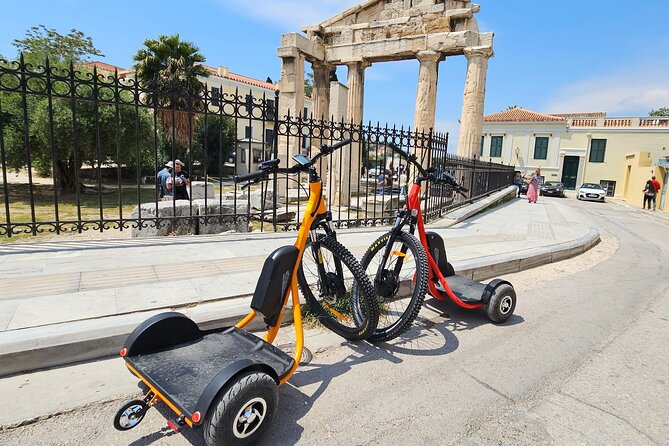
Two hours, Athens, zero slogging uphill. This Ancient Athens e-bike tour is built for fast, scenic sightseeing, using a motorized standing trikke so you can glide between key ruins and neighborhoods with way less walking. You hit the Acropolis, Ancient Agora, and Plaka in one tight loop, with time to stop, look, and soak in the big-picture story without turning it into a full day.
I particularly like two things about it. First, the standing e-bike (trikke) setup is simply easier than pedaling or tackling steep routes on foot, especially when the sun is strong. Second, the guides I’ve heard about, including Dimitris and Kevin, are praised for keeping you comfortable and adjusting what you focus on based on what you already want to see.
The one drawback to plan for is money: the tour price covers the ride, helmet, and insurance, but most archaeological site tickets are extra, and the stops are short enough that you cannot treat this like a slow museum visit.
Key highlights to know before you go
- Standing trikke ride means no pedaling required, which saves your legs for the viewing parts
- Max 12 travelers keeps it friendly and easy to manage on crowded streets
- Acropolis Hill ticket value can cover major sights like the Theatre of Dionysus and the Odeon of Herodes Atticus
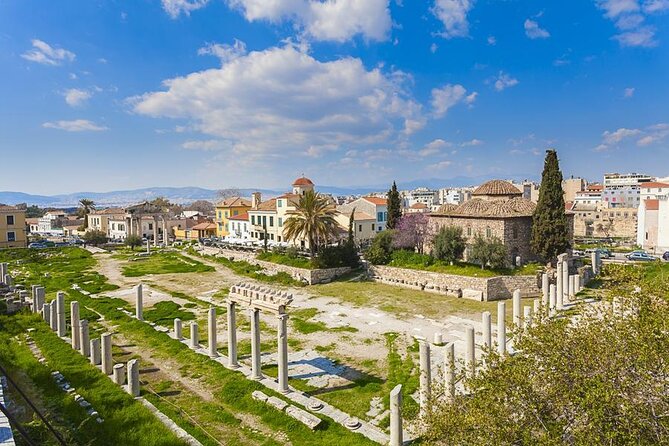
- A tight two-hour loop that strings together Acropolis, Pnyx, Agora, Roman Agora, and Plaka
- Electric help for heat and distance, so you can cover more than a walk would allow
- Guides who adapt their route and commentary to match your interests and pace
A standing e-bike makes steep Athens feel doable
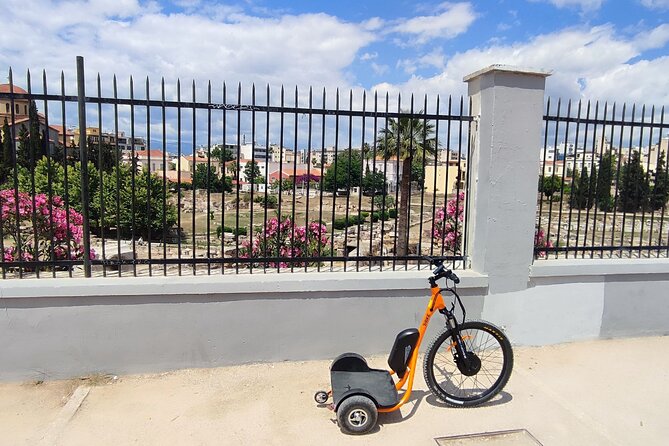
Athens is full of “short but steep” moments. This tour is designed for that reality. Instead of walking the climbs at a crawl, you use a motorized standing trikke. The big payoff is mental as much as physical: you spend your effort on stopping to look and understand, not on simply getting from one hilltop viewpoint to the next.
You also get a helmet and customer insurance included, which matters when you’re mixing speed, sidewalks, and busier areas near major sights. Most people can participate, and several families have done it with kids, which is a good sign that the ride feels approachable when you follow the guide’s lead.
If you’re the type who likes to take your time at viewpoints, this is still a good option, but it works best when you accept that you’re getting a “best-of” tour rather than a deep, hour-by-hour exploration of every monument.
You can also read our reviews of more cycling tours in Athens



Your 2-hour route: Acropolis to Plaka without wasting time
This is structured as a quick sampler of Ancient Athens and the surrounding modern neighborhood life. In about two hours, you’re led to a sequence of iconic places tied together by geography: performance and politics on the hills, marketplaces in the valleys, and Athens’ everyday heartbeat in the streets afterward.
The rhythm is easy to understand: some stops are quick photo and context breaks, while others give you enough time to really connect the site to the wider story. You’re also back at the meeting point at the end, which keeps logistics simple after the ride.
One practical benefit of this route style is what it does for your next steps. After you see the big cluster on one pass, you’ll usually know which areas you want to revisit on foot later, when you have more time and less structure.
Theatre of Dionysus and the Odeon of Herodes Atticus, where performances still matter

Your first major historical stop is the Theatre of Dionysus. This is described as the most important theatre in Ancient Greece and a birthplace of theatre as an idea. There’s a reason that matters: you’re not just looking at seats carved into a hillside, you’re standing where public performance became a civic event tied to the culture of the city.
The ticket pricing for this segment is given as 20€, and it’s also noted that the Acropolis Hill ticket can include the Theatre of Dionysus. That means you should treat the 20€ ticket as your key to unlocking multiple linked sights, not only one entrance.
Then you move to the Odeon of Herodes Atticus, a Roman theatre still used for shows. It was created in the second century A.D. as a memorial for the death of Herod Atticus’ wife. Even if you’re not catching a performance that day, the fact that it’s still in use changes the feeling. You can picture the “live” aspect more easily when the space is still active.
This stop is also priced at 20€ in the information provided, and again the note says it can be included with the Acropolis Hill ticket. In real life, ticket rules can vary by vendor, so I’d budget time and money based on the conservative assumption that you’ll need the Acropolis-related ticket anyway, since it’s the common thread here.
Acropolis Hill on the close side, Parthenon views without the long grind

The Acropolis stop is built around proximity. Instead of presenting Acropolis as a distant skyline shot, you’re brought to a close side where you can actually see the hill and the temples up close, with the Parthenon sitting at the top.
The price listed for the Acropolis Hill is 20€, and this is the ticket you should think of as the core purchase for the whole “Ancient Athens” part of the tour. The value isn’t only the main site. It’s the way it connects the Acropolis to nearby theatres and the broader cluster of monuments you’ll touch on this ride.
Time is short here, so go in with a strategy. If you want the best photos, pick your angle early. Glance at the shape of the Parthenon area first, then rotate to capture the hill from a slightly different perspective. Since you’re on a guided loop, you’ll be in motion again soon, which is exactly why this works as a sampler.
The e-bike component helps, because you’re not arriving sweaty and exhausted. You arrive ready to look.
Pnyx and the National Observatory of Athens, politics and science in one breath
After the Acropolis area, the tour shifts to two more “hill-top thinking” stops.
First comes Pnyx, described as the place where democracy started. It’s inside an archaeological area that also functions as a park, which gives the stop a different mood than the stone-focused sites. You’re not just seeing structures. You’re standing in a landscape that carries civic meaning, which is a useful contrast after the theatre and monumental architecture.
Pnyx is free, and the stop time is listed as 15 minutes. That’s enough time to understand the idea, take a couple photos, and connect it to what you’re seeing around the slopes and seating areas.
Next you visit the National Observatory of Athens, with 15 minutes there as well. This one is noted as being the first observatory of Athens, and it’s located on the hill of Nymphs inside an archaeological area that is also a park with historical layers.
This stop is marked as admission included, so it’s one less ticket you have to budget. It’s also a good reminder that Athens is not only ancient ruins and Instagram backdrops. It’s a city where earlier thinking continued into later scientific projects.
More Athens tours and experiences for the shortlist





Ancient Agora, Kerameikos, and the Roman Agora, markets and meaning
The Ancient Agora is where the tour really turns toward everyday life in the ancient city. It’s described as the most important side of Ancient Greece and the main market in ancient society. That wording matters. You’re not only studying rulers and battles. You’re seeing the economic and social core where people gathered and exchanged goods and ideas.
The Ancient Agora stop is 20 minutes, and the ticket price listed is 4€. Admission is marked as included on this stop, so you do not have to buy it separately for this tour experience. Still, I recommend you double-check when you arrive, because ticket systems can differ by date, and you want to avoid surprises at the entrance.
Kerameikos follows next, a nearby archaeological area close to the Agora. This is the ceramics production zone, and the neighborhood name ties back to that craft. Kerameikos is free on this tour, and it takes about 10 minutes.
Then you move to the Roman Agora, built by the Romans in the second century A.D. It’s described as a Roman version of the Ancient Greek Agora. Here you can see the Tower of the Winds, which is one of those elements that makes the whole market-and-science angle feel less abstract. Roman Athens is still Athens, and the infrastructure tells that story.
Roman Agora is listed with a 4€ ticket, but it’s also marked as free admission on this tour segment, which again suggests it’s included as part of the overall experience. Still, if you’re budgeting tightly, I’d plan as if tickets might be required, then confirm on-site.
Plaka, the finish line where Athens feels like itself
After the ruins and archaeological zones, you land in Plaka, described as the traditional neighborhood of Athens. It’s portrayed as picturesque, with a style that looks like a Greek island, and that comparison helps you expect a more relaxed feel after all the stone history.
Plaka is free and included in the tour, with about 10 minutes here. That time is meant for orientation more than a full wandering session. Think of it like your payoff moment: a place to absorb the atmosphere and decide where to go next.
This is also where the e-bike tour’s greatest advantage shows up. You arrive with context. You know which “ancient Athens” threads you just followed, and now you can connect them to the streets, shops, and evening plans that come right after.
Price and value: 72.09, plus plan for site tickets
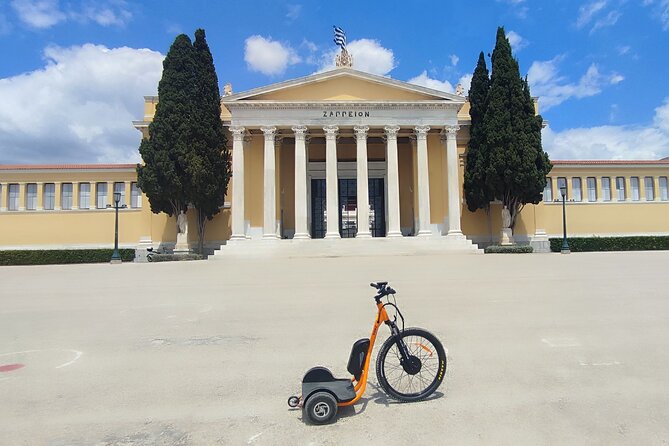
The tour price is $72.09 per person for roughly two hours of guided riding with helmet and insurance. That price includes the ride itself, which is often the expensive part of any e-bike style sightseeing day in a major city.
What’s not included is admission to most archaeological areas. Based on the site pricing listed:
- 20€ for the Theatre of Dionysus and 20€ for the Odeon of Herodes Atticus
- 20€ for Acropolis Hill
- 4€ for Ancient Agora of Athens
- 4€ for Roman Agora
- Free stops include Pnyx, Kerameikos, and Plaka in the info provided
- National Observatory of Athens is marked as admission included
The most useful way to think about cost is not adding every number like a math quiz. Instead, treat it as two layers:
1) the fixed tour fee for the ride and guide
2) the archaeological admissions you may need, with Acropolis-related tickets acting as your biggest line item
If you’re trying to control your budget, prioritize the Acropolis Hill ticket purchase plan, because it is explicitly linked to the theatre sites. Then plan for Agora-related entry. Everything else is either free or marked included for this tour.
The guide effect: Dimitris and Kevin keep it moving and human
The quality difference on this kind of short, fast loop usually comes down to the guide. In this case, Dimitris and Kevin are specifically called out in the feedback, and the themes are consistent: guides make you feel safe, keep the pace comfortable, and adjust what you see.
That adaptability is more than personality. It’s practical value. If you already saw certain highlights earlier in your trip, a good guide can shift your attention to what you might otherwise miss. That means your time stays efficient, and you don’t just “collect stamps” of monuments you didn’t care about.
I also like that the stop pattern includes viewpoints, not only entrances. In a city like Athens, where a single elevation can change your understanding, those moments matter.
If you want a heat-friendly or even evening-feeling ride, the electric assist helps. You’ll spend your energy on seeing, not pushing through fatigue.
Practical planning: meeting point, hours, and group size
The meeting point is Leof. Andrea Siggrou 22, Athina 117 42, Greece, and the tour ends back there.
This experience runs Monday to Saturday from 10:00 AM to 4:00 PM, during the stated availability window (05/01/2023 to 12/22/2026). You’ll also get a mobile ticket, and confirmation is received at booking time.
Group size is capped at 12 travelers, which is key for a standing ride through busy city areas. Smaller groups also tend to mean easier control and more space to hear your guide.
Finally, the tour is offered in English, and the format says most travelers can participate. If you’re comfortable being on your feet while riding, you’re likely a good match.
Who this tour fits best, and who should walk instead
This is a strong fit if you:
- want to cover major Ancient Athens sights in a compact time window
- prefer less walking and more guided stops
- are visiting in hot weather and want to keep your legs fresher for later
- like the idea of a “see it once, then revisit what you love” strategy
It can be less ideal if you:
- want long, slow time inside buildings and museums
- need a quiet, unstructured pace for indepth reading
- dislike standing riding formats, even with a guided setup
The big tradeoff is time at each stop. You’ll get orientation and context, but not a full deep dive at every site. Think of it like a focused highlights reel, then build your own chapter after.
Should you book Ancient Athens e-bike tour?
I’d book this if your goal is to maximize Athens without turning your day into a marathon. The standing trikke approach is a smart match for the hills around the Acropolis area, and the route connects big landmarks and neighborhoods in a way that leaves you ready to explore more on your own.
I’d hesitate if you hate time limits, or if you’re the kind of traveler who wants to spend most of the day inside sites rather than moving between them. In that case, a slower walking plan might suit you better.
If you do book, plan your budget around the 20€ Acropolis Hill ticket and the 4€ Agora tickets, since those are the big paid entrances called out in the tour information. Then use your two hours to get your bearings, learn the story, and decide what to revisit when you have more time.
FAQ
FAQ
How long is the Ancient Athens E-Bike Tour?
The tour lasts about 2 hours.
What does the tour cost?
The price is $72.09 per person.
What is included in the tour price?
Included items are use of the trikke, a helmet, and customer insurance.
Are archaeological site tickets included?
No. Tickets to archaeological areas are not included, based on the tour details you have.
What are the main sights you visit?
You pass key stops including the Theatre of Dionysus area, Odeon of Herodes Atticus, Acropolis, Pnyx, the National Observatory of Athens, Ancient Agora of Athens, Keramikos, Monastiraki, Roman Agora, and Plaka.
How many people are in the group?
The maximum group size is 12 travelers.
Is the tour offered in English?
Yes, the tour is offered in English.
When does the tour run?
It runs Monday to Saturday from 10:00 AM to 4:00 PM.
Where does the tour start and end?
It starts at Leof. Andrea Siggrou 22, Athina 117 42, Greece, and ends back at the same meeting point.
What is the cancellation policy?
You can cancel for a full refund if you cancel up to 24 hours in advance. If you cancel less than 24 hours before the experience starts, the amount paid is not refunded. The experience may also be canceled due to poor weather, in which case you are offered a different date or a full refund.
More Cycling Tours in Athens
More Tours in Athens


More Tour Reviews in Athens
- All Day Cruise -3 Islands to Agistri,Moni, Aegina with lunch and drinks included
★ 5.0 · 4,958 reviews



Not for you? Here's more nearby things to do in Athens we have reviewed








Athens Bike Tours, compared.
 ★ 5.0Athens Scenic Bike Tour with an Electric or a Regular BikeFrom $332,702 reviews
 ★ 5.0Athens Electric Bike TourFrom $58836 reviews
 ★ 4.9Old Town Highlights Guided E-Bike TourFrom $44834 reviews
 ★ 5.0Athens Small Group Electric Bike TourFrom $45803 reviews
 ★ 4.9Historic Athens: Small Group Electric Bike TourFrom $50740 reviews
 ★ 5.0Acropolis & Parthenon Tour and Athens Highlights Bike tourFrom $81605 reviews
 ★ 5.0Athens Acropolis Official E-Scooter Guided Tour Fat E-BikeFrom $71504 reviews
 ★ 4.9City Highlights Bike tourFrom $39453 reviews
Browse the lists this tour appears in